Advertisements
Advertisements
प्रश्न
How will you bring about the following conversion in not more than two steps?
Bromobenzene to 1-Phenylethanol
Advertisements
उत्तर
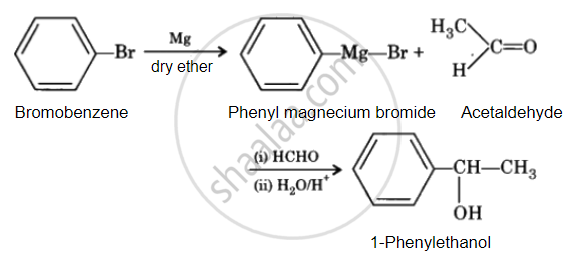
APPEARS IN
संबंधित प्रश्न
Arrange the following in the increasing order of their reactivity towards nucleophilic addition reaction:
C6H5COCH3, CH3-CHO, CH3COCH3
Write the structures of the main products when acetone (CH3 − CO − CH3) reacts with the following reagent :
H2N − NHCONH2/H+
What is meant by the following term? Give an example of the reaction in the following case.
Imine
Predict the products formed when cyclohexanecarbaldehyde reacts with the following reagents.
Semicarbazide and weak acid
What are amines?
How will you convert benzoic acid to m-bromobenzoic acid?
Write a test to differentiate between pentan-2-one and pentan-3-one.
Identify the compounds A, B and C in the following reaction.
\[\ce{CH3 - Br ->[Mg/ether] (A) ->[(i) CO][(ii) Water] (B) ->[CH3OH/H+][Δ] (C)}\]
Paraldehyde is formed as a result of polymerisation:-
The most stable reagent for the conversion of R – CH2OH → RCHO is
What happens when propanone is treated with CH3MgBr and then hydrolysed?
The increasing order of the following compounds towards HCN addition is:
| (i) |  |
| (ii) |  |
| (iii) |  |
| (iv) |  |
Why dissociation of HCN is suppressed by the addition of HCL?
Draw structure of the following derivative.
The ethylene ketal of hexan-3-one
Draw structures of the following derivatives.
Acetaldehydedimethylacetal
Draw the structure of the following derivative.
Acetaldehydedimethylacetal
Draw the structure of the given derivative.
The ethylene ketal of hexan-3-one
