Advertisements
Advertisements
Question
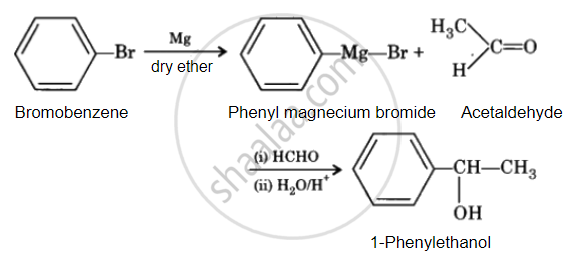
How will you bring about the following conversion in not more than two steps?
Bromobenzene to 1-Phenylethanol
Advertisements
Solution
APPEARS IN
RELATED QUESTIONS
Acetaldehyde, when treated with which among the following reagents does NOT undergo addition reaction?
(A) Ammonia
(B) Hydroxylamine
(C) Ammoniacal silver nitrate
(D) Semicarbazide
Predict the product of the following reaction:

Predict the product of the following reaction:
\[\begin{array}{cc}
\phantom{..............}\ce{O}\\
\phantom{..............}||\\
\ce{R - CH = CH - CHO + NH2 - C - NH - NH2 ->[H+]}\end{array}\]
What is meant by the following term? Give an example of the reaction in the following case.
Oxime
Predict the products formed when cyclohexanecarbaldehyde reacts with the following reagents.
PhMgBr and then H3O+
Explain the mechanism of alkaline hydrolysis of tert-butyl bromide with energy profile diagram.
What are amines?
How will you convert sodium acetate to methane?
Write the main product formed when propanal reacts with the following reagents:
H2N- NH2 followed by heating with KOH in ethylene glycol.
Identify the compounds A, B and C in the following reaction.
\[\ce{CH3 - Br ->[Mg/ether] (A) ->[(i) CO][(ii) Water] (B) ->[CH3OH/H+][Δ] (C)}\]
Grignard reagent on reaction with acetone forms.
Write the name of product formed, when acetone is treated with 2, 4-dinitrophenyl hydrazine.
Arrange the following in the increasing order of their property indicated:
Ethanal, Propanone, Propanal, Butanone (reactivity towards nucleophilic addition)
What happens when propanone is treated with CH3MgBr and then hydrolysed?
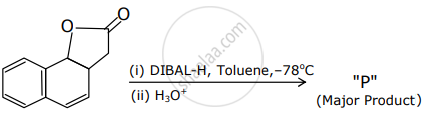
The product "P" in the above reaction is:
The product of following reaction is
\[\ce{CH3 - CH = CH - CH2 - CHO ->[i) LiAlH4][ii) H3O+]}\] ______?
Draw the structure of the following derivative.
The ethylene ketal of hexane-3-one
Draw structure of the following derivative.
The ethylene ketal of hexan-3-one
Which of the following will not be formed when calcium formate is distilled with calcium acetate?
