Advertisements
Advertisements
प्रश्न
Acetone, Acetaldehyde, Benzaldehyde, Acetophenone – reactivity towards addition of HCN.
Advertisements
उत्तर
Acetone, acetaldehyde, benzaldehyde, acetophenone - Reactivity with HCN
\[\begin{array}{c}\ce{CH3-C-CH3}\\\ce{||}\\\ce{O}\end{array}
\begin{array}{c}\ce{CH3-CHO}\\\ce{||}\\\ce{O}\end{array}\ce{C6H5CHO}\begin{array}{c}\ce{CH3-C-C6H5}\\\ce{||}\\\ce{O}\end{array}\]
Nucelophile addition by HCN is strongest for aldehyde than ketones. Also, acetophenone is more sterically hindered than acetone, hence comparatively less nucleophilic similarly C6 H5CHO i -s less reactive towards nucleophilic addition than CH3CHO.
\[\begin{array}{c}\ce{CH3-C-C6H5}\\\ce{||}\\\ce{O}\end{array}
\begin{array}{c}\ce{< CH3-C -CH3}\\\ce{||}\\\ce{O}\end{array}\ce{<C6H5CHO < CH3CHO}\]
APPEARS IN
संबंधित प्रश्न
Acetaldehyde, when treated with which among the following reagents does NOT undergo addition reaction?
(A) Ammonia
(B) Hydroxylamine
(C) Ammoniacal silver nitrate
(D) Semicarbazide
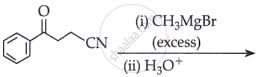
Predict the product of the following reaction:

What is meant by the following term? Give an example of the reaction in the following case.
Hemiacetal
What is meant by the following term? Give an example of the reaction in the following case.
Oxime
What is meant by the following term? Give an example of the reaction in the following case.
Imine
Which of the following has the most acidic hydrogen?
Which of the following is most reactive in nucleophilic addition reactions?
Draw structure of the following derivative.
The ethylene ketal of hexan-3-one
The product of the following reaction is
\[\begin{array}{cc}
\ce{O}\phantom{.........}\\
||\phantom{.........}\\
\ce{C2H5 - C - CH3 ->[H2/Ni][\Delta] \phantom{..}?}\end{array}\]
The major product of the following reaction is: