Advertisements
Advertisements
Question
Acetone, Acetaldehyde, Benzaldehyde, Acetophenone – reactivity towards addition of HCN.
Advertisements
Solution
Acetone, acetaldehyde, benzaldehyde, acetophenone - Reactivity with HCN
\[\begin{array}{c}\ce{CH3-C-CH3}\\\ce{||}\\\ce{O}\end{array}
\begin{array}{c}\ce{CH3-CHO}\\\ce{||}\\\ce{O}\end{array}\ce{C6H5CHO}\begin{array}{c}\ce{CH3-C-C6H5}\\\ce{||}\\\ce{O}\end{array}\]
Nucelophile addition by HCN is strongest for aldehyde than ketones. Also, acetophenone is more sterically hindered than acetone, hence comparatively less nucleophilic similarly C6 H5CHO i -s less reactive towards nucleophilic addition than CH3CHO.
\[\begin{array}{c}\ce{CH3-C-C6H5}\\\ce{||}\\\ce{O}\end{array}
\begin{array}{c}\ce{< CH3-C -CH3}\\\ce{||}\\\ce{O}\end{array}\ce{<C6H5CHO < CH3CHO}\]
APPEARS IN
RELATED QUESTIONS
Draw the structure of the semicarbazone of ethanal.
Acetaldehyde, Acetone, Di-tert-butyl ketone, Methyl tert-butyl ketone (reactivity towards HCN)
Complete the synthesis by giving missing starting material, reagent or product.

How will you convert benzoic acid to m-bromobenzoic acid?
Write a test to differentiate between pentan-2-one and pentan-3-one.
Reaction of aqueous sodium hydroxide on chlorobenzene gives which of the following products?
Grignard reagent on reaction with acetone forms.
Draw structure of the following derivative.
The ethylene ketal of hexan-3-one
Draw the structure of the following derivative.
The ethylene ketal of hexan-3-one
Complete the following reaction:
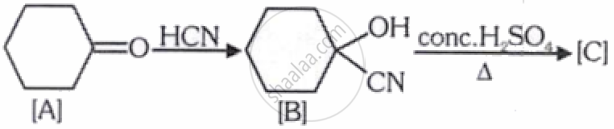
[C] is __________.
