Advertisements
Advertisements
प्रश्न
How will you convert sodium acetate to methane?
Convert sodium acetate to methane.
Advertisements
उत्तर
When sodium acetate is heated with soda lime (NaOH + CaO), methane is obtained.
\[\begin{array}{cc}
\ce{O}\phantom{.................................}\\
||\phantom{.................................}\\
\ce{\underset{(Sodium acetate)}{CH3 - C - ONa} + NaOH ->[CaO][\Delta] \underset{(Methane)}{CH4} + Na2CO3}\\
\end{array}\]
APPEARS IN
संबंधित प्रश्न
Arrange the following in the increasing order of their reactivity towards nucleophilic addition reaction:
C6H5COCH3, CH3-CHO, CH3COCH3
Draw the structure of the semicarbazone of ethanal.
Write the products formed when CH3CHO reacts with the following reagents : H2N – OH
Predict the product of the following reaction:

Predict the product of the following reaction:
\[\begin{array}{cc}
\phantom{..............}\ce{O}\\
\phantom{..............}||\\
\ce{R - CH = CH - CHO + NH2 - C - NH - NH2 ->[H+]}\end{array}\]
What is meant by the following term? Give an example of the reaction in the following case.
2, 4-DNP-derivative
Predict the products formed when cyclohexanecarbaldehyde reacts with the following reagents.
PhMgBr and then H3O+
Give plausible explanation for the following:
There are two −NH2 groups in semicarbazide. However, only one is involved in the formation of semicarbazones.
How are the following compounds prepared?
acetophenone from benzene
Give a simple chemical test to distinguish between 
How will you convert benzoic acid to m-bromobenzoic acid?
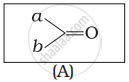
Which of the following is the correct representation for intermediate of nucleophilic addition reaction to the given carbonyl compound (A):
(i) 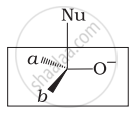
(ii) 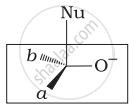
(iii) 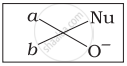
(iv) 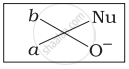
Which one of the following gives only one monochloro derivative?
Which of the following has the most acidic hydrogen?
A Idol condensation will not be observed in
Paraldehyde is formed as a result of polymerisation:-
What is the action of sodium hypoiodite on acetone?
Which will undergo faster nucleophilic addition reaction?
Acetaldehyde or Propanone
In the following reaction
\[\ce{Carbonyl compound + MeOH <=>[HCl] acetal}\]
Rate of the reaction is the highest for ______.
The product of following reaction is
\[\ce{CH3 - CH = CH - CH2 - CHO ->[i) LiAlH4][ii) H3O+]}\] ______?
Draw structures of the given derivatives.
The ethylene ketal of hexan-3-one
Why dissociation of HCN is suppressed by the addition of HCL?
Draw structures of the following derivative.
The ethylene ketal of hexan-3-one
Draw the structure of the following derivative.
The ethylene ketal of hexan-3-one
Draw structure of the following derivative.
The ethylene ketal of hexan-3-one
Draw structure of the following derivative.
The ethylene ketal of hexan-3-one
Draw the structure of the given derivative.
The ethylene ketal of hexan-3-one
Give an example of the reaction in the following case.
Imine
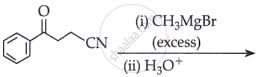
The major product of the following reaction is: