Advertisements
Advertisements
प्रश्न
Carboxylic acids contain carbonyl group but do not show the nucleophilic addition reaction like aldehydes or ketones. Why?
Advertisements
उत्तर
It is due to resonance as shown below. The partial positive charge on the carbonyl carbon atom is reduced
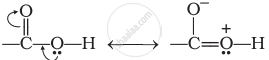
Similarly, a carbonyl group of aldehydes and ketones may be regarded as the resonance hybrid of the following structures.
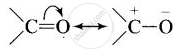
The carbonyl carbon of carboxylic group is less electrophilic than carbonyl carbon in aldehydes and ketones and hence nucleophilic addition reactions of aldehydes and ketones do not takes place with carboxylic acids.
APPEARS IN
संबंधित प्रश्न
Acetaldehyde, when treated with which among the following reagents does NOT undergo addition reaction?
(A) Ammonia
(B) Hydroxylamine
(C) Ammoniacal silver nitrate
(D) Semicarbazide
Arrange the following compound in increasing order of its reactivity in nucleophilic addition reactions.
Benzaldehyde, p-Tolualdehyde, p-Nitrobenzaldehyde, Acetophenone.
Hint: Consider steric effect and electronic effect.
Predict the product of the following reaction:

Predict the product of the following reaction:

What is meant by the following term? Give an example of the reaction in the following case.
Oxime
What is meant by the following term? Give an example of the reaction in the following case.
Imine
What is meant by the following term? Give an example of the reaction in the following case.
Schiff’s base
How are the following compounds prepared?
benzaldehyde from benzoyl chloride
What is the action of the following reagents on ethanoic acid?
1) `LiAlH_4"/"H_3O^+`
2) `PCl_3 , "heat"`
3) `P_2O_5, "heat"`
Give a simple chemical test to distinguish between 
Identify the compounds A, B and C in the following reaction.
\[\ce{CH3 - Br ->[Mg/ether] (A) ->[(i) CO][(ii) Water] (B) ->[CH3OH/H+][Δ] (C)}\]
Which one of the following gives only one monochloro derivative?
Which among the following is most reactive to give nucleophilic addition?
What is the action of sodium hypoiodite on acetone?
Arrange the following in the increasing order of their property indicated:
Ethanal, Propanone, Propanal, Butanone (reactivity towards nucleophilic addition)
Write the structure of the product formed when acetone reacts with 2, 4 DNP reagent.
Draw the structure of the following derivative.
The ethylene ketal of hexan-3-one
Draw structure of the following derivative.
The ethylene ketal of hexan-3-one
