Advertisements
Advertisements
Question
Carboxylic acids contain carbonyl group but do not show the nucleophilic addition reaction like aldehydes or ketones. Why?
Advertisements
Solution
It is due to resonance as shown below. The partial positive charge on the carbonyl carbon atom is reduced
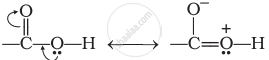
Similarly, a carbonyl group of aldehydes and ketones may be regarded as the resonance hybrid of the following structures.
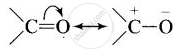
The carbonyl carbon of carboxylic group is less electrophilic than carbonyl carbon in aldehydes and ketones and hence nucleophilic addition reactions of aldehydes and ketones do not takes place with carboxylic acids.
APPEARS IN
RELATED QUESTIONS
Write the products formed when CH3CHO reacts with the following reagents : HCN
Write the products formed when CH3CHO reacts with the following reagents : H2N – OH
Predict the products formed when cyclohexanecarbaldehyde reacts with the following reagents.
PhMgBr and then H3O+
Predict the products formed when cyclohexanecarbaldehyde reacts with the following reagents.
Excess ethanol and acid
How will you convert sodium acetate to methane?
Give a simple chemical test to distinguish between 
A Idol condensation will not be observed in
Acetaldehyde and acetone differ in their reaction with
Which among the following is most reactive to give nucleophilic addition?
Which will undergo faster nucleophilic addition reaction?
Acetaldehyde or Propanone
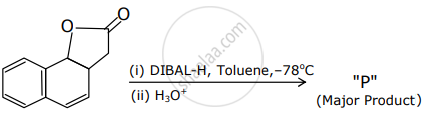
The product "P" in the above reaction is:
The increasing order of the following compounds towards HCN addition is:
| (i) |  |
| (ii) |  |
| (iii) |  |
| (iv) |  |
Which of the following is most reactive in nucleophilic addition reactions?
Why dissociation of HCN is suppressed by the addition of HCL?
Draw structures of the following derivative.
The ethylene ketal of hexan-3-one
The product of the following reaction is
\[\begin{array}{cc}
\ce{O}\phantom{.........}\\
||\phantom{.........}\\
\ce{C2H5 - C - CH3 ->[H2/Ni][\Delta] \phantom{..}?}\end{array}\]
Draw the structure of the following derivative.
Acetaldehydedimethylacetal
Which of the following will not be formed when calcium formate is distilled with calcium acetate?
