Advertisements
Advertisements
Question
What is meant by the following term? Give an example of the reaction in the following case.
Oxime
Advertisements
Solution
Oximes are formed by reaction between aldehydes or ketones and hydroxylamine. The reaction is carried out in a mildly acidic condition.
\[\begin{array}{cc}
\ce{H3C}\phantom{...........................}\ce{H3C}\phantom{.....................}\\
\backslash\phantom{..............................}\backslash\phantom{................}\\
\ce{= O + \underset{Hydroxylarnine}{H2N-OH} ->[pH 3.5] \phantom{......}= NOH + H2O}\\
/\phantom{..............................}/\phantom{.................}\\
\ce{H}\phantom{............................}\ce{\underset{Oxime}{H}}\phantom{..................}
\end{array}\]
APPEARS IN
RELATED QUESTIONS
Write balanced chemical equations for action of ammonia on - formaldehyde
Predict the products of the following reactions:

Predict the product of the following reaction:
\[\begin{array}{cc}
\phantom{..............}\ce{O}\\
\phantom{..............}||\\
\ce{R - CH = CH - CHO + NH2 - C - NH - NH2 ->[H+]}\end{array}\]
What is meant by the following term? Give an example of the reaction in the following case.
Hemiacetal
What is meant by the following term? Give an example of the reaction in the following case.
2, 4-DNP-derivative
What are amines?
Acetone, Acetaldehyde, Benzaldehyde, Acetophenone – reactivity towards addition of HCN.
Alkenes  and carbonyl compounds
  , both contain a π bond but alkenes show electrophilic addition reactions whereas carbonyl compounds show nucleophilic addition reactions. Explain.
Carboxylic acids contain carbonyl group but do not show the nucleophilic addition reaction like aldehydes or ketones. Why?
Acetaldehyde and acetone differ in their reaction with
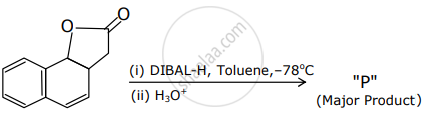
The product "P" in the above reaction is:
The product of following reaction is
\[\ce{CH3 - CH = CH - CH2 - CHO ->[i) LiAlH4][ii) H3O+]}\] ______?
Aldehydes and ketones react with hydroxylamine to form ______.
Why dissociation of HCN is suppressed by the addition of HCL?
Draw the structure of the following derivative.
Acetaldehydedimethylacetal
Draw structure of the following derivative:
Acetaldehydedimethylacetal
Draw structure of the following derivative.
The ethylene ketal of hexan-3-one
Draw structure of the following derivative.
The ethylene ketal of hexan-3-one
Which of the following will not be formed when calcium formate is distilled with calcium acetate?
