Advertisements
Advertisements
Question
What is meant by the following term? Give an example of the reaction in the following case.
2, 4-DNP-derivative
Advertisements
Solution
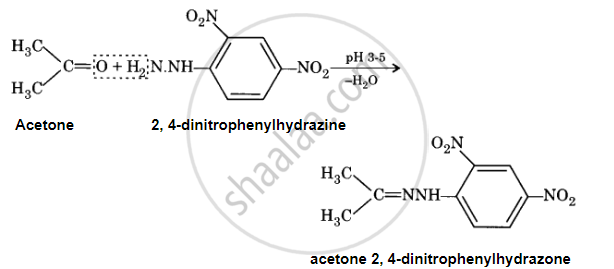
When an aldehyde or ketone reacts with 2, 4-dinitrophenylhydrazine in a weak acidic medium, 2, 4-dinitrophenylhydrazone (2, 4-DNP derivative) is produced.
APPEARS IN
RELATED QUESTIONS
Predict the product of the following reaction:

What is meant by the following term? Give an example of the reaction in the following case.
Semicarbazone
What is meant by the following term? Give an example of the reaction in the following case.
Ketal
What is meant by the following term? Give an example of the reaction in the following case.
Imine
Acetaldehyde, Acetone, Di-tert-butyl ketone, Methyl tert-butyl ketone (reactivity towards HCN)
Write a test to differentiate between pentan-2-one and pentan-3-one.
Benzaldehyde can be obtained from benzal chloride. Write reactions for obtaining benzalchloride and then benzaldehyde from it.
Carboxylic acids contain carbonyl group but do not show the nucleophilic addition reaction like aldehydes or ketones. Why?
A Idol condensation will not be observed in
Paraldehyde is formed as a result of polymerisation:-
What happens when propanone is treated with CH3MgBr and then hydrolysed?
The product of following reaction is
\[\ce{CH3 - CH = CH - CH2 - CHO ->[i) LiAlH4][ii) H3O+]}\] ______?
Draw the structure of the following derivative.
The ethylene ketal of hexane-3-one
Draw structure of the following derivative.
Acetaldehydedimethylacetal
Draw structure of the following derivative.
The ethylene ketal of hexan-3-one
Draw structure of the following derivative.
The ethylene ketal of hexan-3-one
Give an example of the reaction in the following case.
Imine
The major product of the following reaction is:
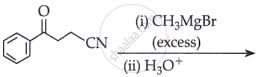
Complete the following reaction:
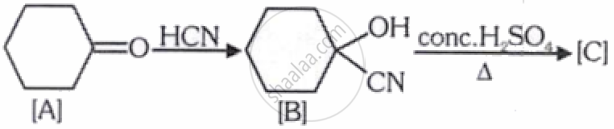
[C] is __________.
