Advertisements
Advertisements
Question
Acetaldehyde, Acetone, Di-tert-butyl ketone, Methyl tert-butyl ketone (reactivity towards HCN)
Advertisements
Solution
When HCN reacts with a compound, the attacking species is a CN− nucleophile. Therefore, as the negative charge on the compound increases, its reactivity with HCN decreases. In the given compounds, the +I effect increases as shown below. It can be observed that steric hindrance also increases.
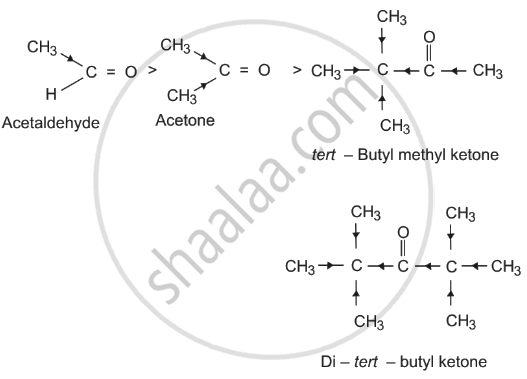
Hence, the given compounds can be arranged according to their increasing reactivities toward HCN as:
Di-tert-butyl ketone < Methyl tert-butyl ketone < Acetone < Acetaldehyde
APPEARS IN
RELATED QUESTIONS
Draw the structure of the semicarbazone of ethanal.
Predict the products formed when cyclohexanecarbaldehyde reacts with the following reagents.
PhMgBr and then H3O+
Write balanced chemical equations for action of ammonia on - acetaldehyde
What is the action of the following reagents on ethanoic acid?
1) `LiAlH_4"/"H_3O^+`
2) `PCl_3 , "heat"`
3) `P_2O_5, "heat"`
Write the structure of Phenylmethanamine.
What are amines?
Write the main product formed when propanal reacts with the following reagents:
H2N- NH2 followed by heating with KOH in ethylene glycol.
Acetone, Acetaldehyde, Benzaldehyde, Acetophenone – reactivity towards addition of HCN.
How will you convert benzoic acid to m-bromobenzoic acid?
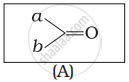
Which of the following is the correct representation for intermediate of nucleophilic addition reaction to the given carbonyl compound (A):
(i) 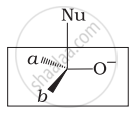
(ii) 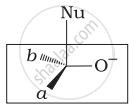
(iii) 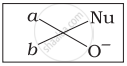
(iv) 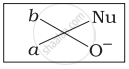
Which of the following has the most acidic hydrogen?
What happens when ethanal is treated with excess ethanol and acid?
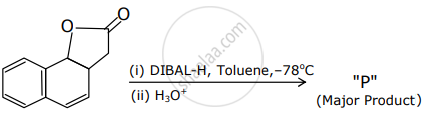
The product "P" in the above reaction is:
Draw structures of the given derivatives.
The ethylene ketal of hexan-3-one
The product of the following reaction is
\[\begin{array}{cc}
\ce{O}\phantom{.........}\\
||\phantom{.........}\\
\ce{C2H5 - C - CH3 ->[H2/Ni][\Delta] \phantom{..}?}\end{array}\]
Draw structure of the following derivative.
The ethylene ketal of hexan-3-one
Draw the structure of the following derivative.
Acetaldehydedimethylacetal
Draw structure of the following derivative.
The ethylene ketal of hexan-3-one
Draw the structure of the given derivative.
The ethylene ketal of hexan-3-one
Give an example of the reaction in the following case.
Oxime
