Advertisements
Advertisements
Question
What is meant by the following term? Give an example of the reaction in the following case.
Cyanohydrin
Advertisements
Solution
Aldehydes and ketones react with hydrogen cyanide (HCN) to yield cyanohydrins. This reaction occurs very slowly with pure HCN. Therefore, it is catalysed by a base and the generated cyanide ion (CN−) being a stronger nucleophile readily adds to carbonyl compounds to yield corresponding cyanohydrin.
\[\ce{HCN + O\overset{-}{H} <=> {_{\bullet}^{\bullet}}\overset{-}{C}N + H2O}\]

APPEARS IN
RELATED QUESTIONS
Predict the product of the following reaction:

Predict the product of the following reaction:

What is meant by the following term? Give an example of the reaction in the following case.
Semicarbazone
Acetaldehyde, Acetone, Di-tert-butyl ketone, Methyl tert-butyl ketone (reactivity towards HCN)
Write balanced chemical equations for action of ammonia on - acetone
What is the action of the following reagents on ethanoic acid?
1) `LiAlH_4"/"H_3O^+`
2) `PCl_3 , "heat"`
3) `P_2O_5, "heat"`
How will you convert sodium acetate to methane?
Write the main product formed when propanal reacts with the following reagents:
2 moles of 3 CH OH in presence of dry HCl
Write a test to differentiate between pentan-2-one and pentan-3-one.
The pH of blood does not appreciably change by a small addition of acid or base because
Paraldehyde is formed as a result of polymerisation:-
The most stable reagent for the conversion of R – CH2OH → RCHO is
What is the action of sodium hypoiodite on acetone?
The increasing order of the following compounds towards HCN addition is:
| (i) |  |
| (ii) |  |
| (iii) |  |
| (iv) |  |
Out of p-tolualdehyde and p-nitrobenzaldehyde, which one is more reactive towards nucleophilic addition reactions, why?
Draw structure of the following derivative.
The ethylene ketal of hexane-3-one
Why dissociation of HCN is suppressed by the addition of HCL?
Draw structure of the following derivative.
The ethylene ketal of hexan-3-one
Draw structure of the following derivative.
The ethylene ketal of hexan-3-one
Complete the following reaction:
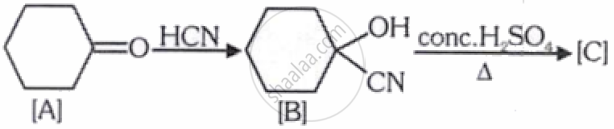
[C] is __________.
