Advertisements
Advertisements
Question
Alkenes  and carbonyl compounds
  , both contain a π bond but alkenes show electrophilic addition reactions whereas carbonyl compounds show nucleophilic addition reactions. Explain.
Advertisements
Solution
Carbonyl group is polar in nature. Due to larger electronegativity of oxygen as compared to carbon, carbon acquires partial positive charge while O acquires partial negative charge.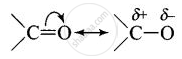
Because of slight positive charge on C atom, it is attacked by nucleophiles and, therefore, undergoes nucleophilic addition reaction.
Ethylenic double bond is a non-polar bond and is a source of electrons. Therefore, it is attacked by electrophiles and undergoes electrophilic addition reactions.
APPEARS IN
RELATED QUESTIONS
Predict the products of the following reactions:

Write the structures of the main products when acetone (CH3 − CO − CH3) reacts with the following reagent :
H2N − NHCONH2/H+
Write the products formed when CH3CHO reacts with the following reagents : H2N – OH
Arrange the following compound in increasing order of its reactivity in nucleophilic addition reactions.
Ethanal, Propanal, Propanone, Butanone.
Hint: Consider steric effect and electronic effect.
Predict the product of the following reaction:
\[\begin{array}{cc}
\phantom{..............}\ce{O}\\
\phantom{..............}||\\
\ce{R - CH = CH - CHO + NH2 - C - NH - NH2 ->[H+]}\end{array}\]
What is meant by the following term? Give an example of the reaction in the following case.
Hemiacetal
What is meant by the following term? Give an example of the reaction in the following case.
Imine
Write balanced chemical equations for action of ammonia on - acetone
How will you convert benzoic acid to m-bromobenzoic acid?
Which one of the following gives only one monochloro derivative?
Grignard reagent on reaction with acetone forms.
A Idol condensation will not be observed in
Paraldehyde is formed as a result of polymerisation:-
Write the name of product formed, when acetone is treated with 2, 4-dinitrophenyl hydrazine.
Aldehydes and ketones react with hydroxylamine to form ______.
Draw structures of the following derivative.
The ethylene ketal of hexan-3-one
Draw the structure of the following derivative.
Acetaldehydedimethylacetal
Draw structure of the following derivative.
The ethylene ketal of hexan-3-one
Draw structure of the following derivative.
The ethylene ketal of hexan-3-one
