Advertisements
Advertisements
प्रश्न
What is meant by the following term? Give an example of the reaction in the following case.
Acetal
Advertisements
उत्तर
Gem-dialkoxy compounds in which two alkoxy groups are present on the terminal carbon atom are called acetals. These are formed when the aldehyde reacts with two equivalents of monohydric alcohol in the presence of dry hydrogen chloride.

APPEARS IN
संबंधित प्रश्न
Write balanced chemical equations for action of ammonia on - formaldehyde
Arrange the following in the increasing order of their reactivity towards nucleophilic addition reaction:
C6H5COCH3, CH3-CHO, CH3COCH3
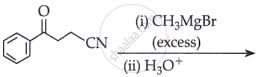
Predict the products of the following reactions:

What is meant by the following term? Give an example of the reaction in the following case.
Cyanohydrin
What is meant by the following term? Give an example of the reaction in the following case.
Hemiacetal
Complete the synthesis by giving missing starting material, reagent or product.
\[\ce{C6H5CHO ->[H2NCONHNH2]}\]
How are the following compounds prepared?
benzaldehyde from benzoyl chloride
Write balanced chemical equations for action of ammonia on - acetaldehyde
Write balanced chemical equations for action of ammonia on - acetone
How will you convert sodium acetate to methane?
Write the main product formed when propanal reacts with the following reagents:
2 moles of 3 CH OH in presence of dry HCl
Alkenes  and carbonyl compounds
  , both contain a π bond but alkenes show electrophilic addition reactions whereas carbonyl compounds show nucleophilic addition reactions. Explain.
Which of the following is most reactive in nucleophilic addition reactions?
Aldehydes and ketones react with hydroxylamine to form ______.
Out of p-tolualdehyde and p-nitrobenzaldehyde, which one is more reactive towards nucleophilic addition reactions, why?
Draw the structure of the following derivative.
The ethylene ketal of hexane-3-one
Draw structure of the following derivative.
The ethylene ketal of hexan-3-one
Draw the structure of the following derivative.
The ethylene ketal of hexan-3-one
Draw structure of the following derivative.
The ethylene ketal of hexan-3-one
The major product of the following reaction is: