Advertisements
Advertisements
प्रश्न
Write the main product formed when propanal reacts with the following reagents:
2 moles of 3 CH OH in presence of dry HCl
Advertisements
उत्तर
2 moles of 3 CH OH in presence of dry HCl 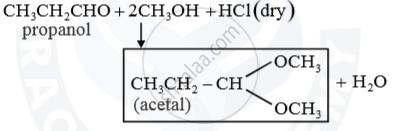
APPEARS IN
संबंधित प्रश्न
Predict the products of the following reactions:

Arrange the following compound in increasing order of its reactivity in nucleophilic addition reactions.
Benzaldehyde, p-Tolualdehyde, p-Nitrobenzaldehyde, Acetophenone.
Hint: Consider steric effect and electronic effect.
Acetaldehyde, Acetone, Di-tert-butyl ketone, Methyl tert-butyl ketone (reactivity towards HCN)
Write the name of product formed, when acetone is treated with 2, 4-dinitrophenyl hydrazine.
Draw structures of the given derivatives.
The ethylene ketal of hexan-3-one
Draw structure of the following derivative.
Acetaldehydedimethylacetal
Why dissociation of HCN is suppressed by the addition of HCL?
Draw the structure of the following derivative.
Acetaldehydedimethylacetal
Draw structure of the following derivative.
The ethylene ketal of hexan-3-one
Complete the following reaction:
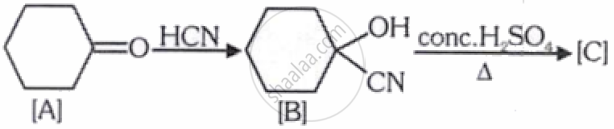
[C] is __________.
