Advertisements
Advertisements
प्रश्न
The title, 'Refugee Blues' encapsulates the theme of the poem. Comment.
Advertisements
उत्तर
Blues are African-American forms of ballads that originated by the end of the 19th century. They primarily are melancholic and sad and can be called as “the sad black slave's songs”. In this Blue Ballad, Auden narrates the suffering of the Jews by Nazis, their persecution, the holocaust, the concentration camps, the rise of Fuhrer, and Nazism. The poem revolves around a Jewish couple who escaped Nazi Germany and emigrated to the United States of America. These refugees now sing this Blue talking of their agony and pain that they have nowhere to go to.
APPEARS IN
संबंधित प्रश्न
Maggu’s achievements are particularly noteworthy because – as is well known – academic institutions in India are less than sold on the idea of inclusive education. In fact, when Maggu lost her sight in class IV, her school (which she declines to name) expelled her while suggesting she attend a “blind school”. Though shocked, Maggu rejected the advice. “Attending a special school would have tarred me with a handicap forever, which was not how I saw my future. Therefore I did the rounds of other public schools with my father, a small – time merchant, explaining that my case was different Since I had vision till the age of ten,” she recalls.
Impressed by her persistence and ambition, Delhi’s Bluebells School not only admitted her but pulled out all the stops to support her in academics sporting events and also notched up a respectable 73 percent average in the class XII exam with the help of Braille, interactive textbooks and extra coaching.
The respectable average in her CBSE exam paved the way for admission into LSR where again she proved her mettle by winning medals in a slew of inter – collage events (100 200 and 400 metre sprints) high jump, long jump, javelin and discuss throw: resulting in her being declared ‘Athlete of the year’ 2003’ at a sports meet for 100 physically challenged athletes. And the cherry on the cake was the selection to the IBSA Games last year. “It was a tough regimen,” recalls Maggu. “I had to attend sports camps manage my studies and officiates as sports president. But I managed.”
Questions:
(1) What qualities of Maggu are highlighted in this passage?
(2) Why did Maggu refuse to attend a ‘blind school’?
(3) Quote the lines that show that Jyoti Maggu was good in academics as well as in sports.
(4) Use any two phrases in sentences of your own :
(a) To win laurels
(b) To pave the way
(c) To prove one’s mettle
(d) A tough regimen
(5)
(a) I did the rounds of other public schools with my father [Change the voice]
(b) though shocked Maggu rejected the advice [Rewrite as a simple sentence]
(6) Should the physically challenged be sent to special schools? Express your views.
Answer any two of the following questions in about 30‒40 words:
(a) How does Kamala Das try to put away the thoughts of her ageing mother?
(b) Which is the exotic moment that the poet refers to in 'Keeping Quiet'?
(c) What are the difficulties that aunt Jennifer faced in her life?
Complete the flow-chart :

Orangutans use big leaves during a downpour because
Attempt a character sketch of Squire Cass.
Answer the following question in 30-40 words:
“The sight of the food maddened him.” What does this suggest? (His First Fight)
Tick the item that is closest in meaning to the following phrase.
to take issue with
We 'draw up a deed'. Complete the following phrase with an appropriate word.
________a loan
Why does Ruskin feel that reading the work of a good author is a painstaking task?
What is the emphasis placed by Ruskin on accuracy?
What, according to the poet, are human beings out of tune with?
What does the reference to raw mythology imply?
Discuss the following in pairs or in small groups.
“Before you begin experimenting you need to perfect the technique with which you experiment.”
“I can see clear bridges between my life experiences and my work in dance.” How does Kumudini Lakhia weave episodes from the two realms in her account?
Read the story and complete the following.
Revathi won the prize for the ‘Best plant’ because, ____________.
Answer in your own words.
What did Revathi discover about her balsam plants?
‘The city now, doth, like garment wear’. The poet imagines that the city is wearing a beautiful garment. Hence, the figure of speech is personification. Find out more examples of personification from the poem.
‘Dull would he be of soul who could pass by.’
This line of the poem can be rewritten as:
'He would be of a dull soul.'
The figure of speech is known as ‘Inversion’.
Find out one more example of Inversion from the poem.
Who gives medicine/treatment to sick animals and birds?
Expand the idea inherent in the following proverb :
One should eat to live, not live to eat - Franklin.
Fill in the gap, choosing a word from the bracket to make an appropriate comparison.
(tall / quiet / humble / merry / busy / slippery / fast / sly / slow / big)
as ______ as a snail
List five of your favourite Hindi or Marathi poems or songs. Try to translate any one of them into English.
Explain the following statement with reference to the context.
And then, once the ring's broken, we'll get to work and show the public every day just how incompetent the Mayor is!
Explain the following statement with reference to the context.
Because your father can't do without my help.
Discuss and write 1-2 lines about the following,
Why Bushi told Yonamine not to travel at night.
Form pairs. Complete the following table through discussions.
| Occupation | Necessary Qualities | Reasons |
| Student | ||
| Teacher | ||
| Housewife | ||
| Sportsman | ||
| Artist | ||
| Singer | ||
| Author | ||
| Umpire | ||
| Actor | ||
| Scientist |
Write a conversation between a donkey and a dog.
Write about Malti and Rima using the following points:
 |
 |
| Appearance... | Appearance... |
| Studies... | Studies... |
| Singing... | Singing... |
| Attitude to others... | Attitude to others... |
| Weak points... | Weak points... |
Use details from the story and your own imagination when you write the above descriptions.
Gather information about your favourite great historical personality. You may use the internet. You may also gather photographs, pictures, etc. Prepare a collage using the pictures, inspirational quotes, and a brief description of the person’s importance. Hold an exhibition of your collages in the classroom.
What do you like better - the original poem or the parody? Why?
Answer in your own words.
What chores did the boys from 1000 CE and 1st Century CE, do on their farms/fields?
Rewrite in your own words.
One event from the story.
Why did he spill the milk?
Find a word that has a similar meaning.
unfair
Give an instance that shows the pathetic condition of the young bird.
Discuss, why it was considered as an adventurous and dangerous thing to travel in those days?
Mahatma Gandhi, Che Guevera, Guru Nanak, and Gauthama Buddha are some of the famous personalities and thinkers who made extensive journeys to understand life. Do you think journeys can be life-changing?
Based on your understanding of the poem, complete the following passage by the using the phrases given in the box.
| youth to old age | up or down the hill | to hurry nor move away | |
| high adventure | joyful | mourn | looking ahead |
The poet wants to live his life __________, willing to do something. He neither wants __________from his goal. He does not want to _______ the things he has lost, not hold back for fear of the future. He instead prefers to live his life with a whole and happy heart which cheerfully travels from __________. Therefore, it does not matter to him whether the path goes __________, rough or smooth, the journey will be __________. He will continue to seek what he wanted as a boy - new friendship, __________ and a crown (prize). His heart will remain courageous and pursue his desires. He hopes that every turn in his life's journey will be the best.
Why did Dr. Ashok’s cousin call him?
An Anagram is a word or a phrase formed by rearranging the letters of a different word or phrase, typically using all the original letters exactly once.

Now try to solve these anagrams
| 1. | ELBOW | |
| 2. | SECTION | |
| 3. | VIEWER | |
| 4. | RIPPLES | |
| 5. | NEEDLESS |
Which gift did Anne value the most?
Two scary events from this section are listed here. Write the events that take place in between in the correct order.
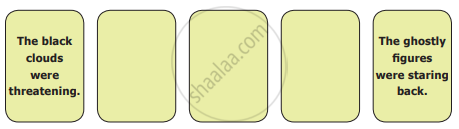
How does the ability to question help us?
Read these lines and answer the questions given below.
Where the voice of the wind calls our wandering feet
Whose ‘Wandering feet’ is referred to here?
Read these lines and answer the questions given below.
Our lays are of cities whose lustre is shed,
Here ‘Lays’ means______
Did he hire Kiouni? Why?
Amma bought the vegetables from the______.
Which planet has rings around it?
Write the rhyming word.
face - ______.
Why did Robinson name the tribe Friday?
Appu felt hungry and ate a______.
Who showed love and care to the children?
Why it is important for people to live without boundaries?
Speak and win.
Join in one of the two groups. Choose two characters. Support or oppose any one of the characters. Say some sentences for the one you support and say some sentences against the other one, to win.
| I support | I oppose |
What makes him fall?
Write the word with same meaning.

pants- ______
If the fisher draws his net soon, he won’t get ______ in the net.
The fir tree was sad ______.
How did the animals know that the king was just a jackal?
Based on the poet’s idea of true success, think of four people in your surroundings - your family, neighbours, friends, teachers, classmates, etc. who have achieved true success. Write, in short, what makes them successful.
