Advertisements
Advertisements
प्रश्न
Explain the aldol condensation of ethanal.
Advertisements
उत्तर १
Aldehydes containing at least one α-hydrogen atom undergo a reaction in the presence of dilute alkali (dilute NaOH, KOH or Na2CO3) as a catalyst to form β-hydroxy aldehydes (aldol). This reaction is known as the aldol reaction.
Ethanal contains an α-hydrogen atom, so it undergoes the aldol condensation reaction.
\[\ce{\underset{Ethanal}{2CH3 - CHO} ->[dil{.} NaOH] \underset{3-Hydroxybutanal}{CH3 - CHOH - CH2 - CHO}}\]
\[\ce{\underset{3-Hydroxybutanal}{CH3 - CHOH - CH2 - CHO} ->[H+] \underset{But-2-enal}{CH3 - CH = CH - CHO} + H2O}\]
When ethanal is treated with dilute base NaOH, KOH or sodium carbonate, two molecules of ethanal add together to form 3-Hydroxybutanal. When 3-Hydroxybutanal is heated in the presence of an acid, a molecule of water is lost, and But-2-enal is formed.
उत्तर २
The carbon atom adjacent to the carbonyl carbon atom is called the α-carbon atom (α − C).
\[\begin{array}{cc}
\phantom{.........}\ce{O}\\
\phantom{.........}||\\
\ce{- \overset{\beta}{C} - \overset{\alpha}{C} - C - \overset{\alpha}{C} -}\\
|\phantom{.....}\\
\ce{H^\alpha}\phantom{...}\\
\end{array}\]
Aldol condensation reaction is a characteristic reaction of aldehydes and ketones containing an active α-hydrogen atom.
When aldehydes or ketones having α-H atoms are heated with a dilute base or dilute acid, two molecules undergo self-condensation to yield β-hydroxy aldehyde (aldol) or β-hydroxy ketone (ketol), respectively. The reaction is referred to as the aldol addition reaction.
For aldehyde:
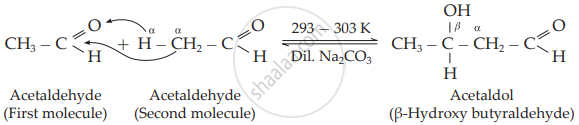
Acetaldol, on heating, undergoes subsequent elimination of water, giving rise to α, β-unsaturated aldehyde.
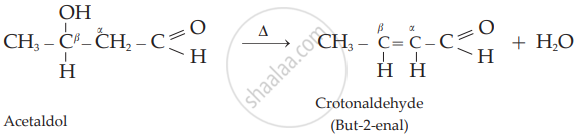
The overall reaction is called aldol condensation. It is a nucleophilic addition-elimination reaction.
संबंधित प्रश्न
What is meant by the following term? Give an example of the reaction in the following case.
Aldol
How will you convert ethanal into the following compound?
Butane-1, 3-diol
How will you convert ethanal into the following compound?
But-2-enal
Write structural formulas and names of four possible aldol condensation products from propanal and butanal. In each case, indicate which aldehyde acts as nucleophile and which as electrophile.
How will you bring about the following conversion in not more than two steps?
Ethanol to 3-Hydroxybutanal
How will you bring about the following conversion in not more than two steps?
Benzaldehyde to 3-Phenylpropan-1-ol
Describe the following:
Cross aldol condensation
Why is alpha (α) hydrogen of carbonyl compounds acidic in nature?
Write chemical equations of the following reaction :
Benzoyl chloride is hydrogenated in the presence of `"Pd"/(BaSO_4)`
Explain aldol condensation reaction in detail.
Which product is formed when the compound  is treated with concentrated aqueous \[\ce{KOH}\] solution?
Compounds A and C in the following reaction are:
\[\ce{CH3CHO ->[(i) CH3MgBr][(ii) H2O] (A) ->[H2SO4, Δ] (B) ->[Hydroboration oxidation] (C)}\]
Which of the following compounds do not undergo aldol condensation?
(i) \[\ce{CH3 - CHO}\]
(ii) 
(iii) \[\begin{array}{cc}
\phantom{}\ce{O}\\
\phantom{}||\\
\ce{CH3 - C - CH3}
\end{array}\]
(iv) \[\begin{array}{cc}
\phantom{}\ce{CH3}\\
|\phantom{...}\\
\ce{CH3 - C - CHO}\phantom{..}\\
|\phantom{...}\\
\phantom{}\ce{CH3}\\
\end{array}\]
Why is there a large difference in the boiling points of butanal and butan-1-ol?
Why are carboxylic acids more acidic than alcohols or phenols although all of them have hydrogen atom attached to a oxygen atom \[\ce{(-O-H)}\]?
Assertion: The α-hydrogen atom in carbonyl compounds is less acidic.
Reason: The anion formed after the loss of α-hydrogen atom is resonance stabilised.
When liquid ‘A’ is treated with a freshly prepared ammoniacal silver nitrate solution, it gives bright silver mirror. The liquid forms a white crystalline solid on treatment with sodium hydrogensulphite. Liquid ‘B’ also forms a white crystalline solid with sodium hydrogensulphite but it does not give test with ammoniacal silver nitrate. Which of the two liquids is aldehyde? Write the chemical equations of these reactions also.
Give reasons to support the answer:
Presence of Alpha hydrogen in aldehydes and ketones is essential for aldol condensation.
Cross aldol condensation occurs between
Identify A and B from the following reaction:
\[\begin{array}{cc}
\ce{CH3}\phantom{.................}\\
|\phantom{....................}\\
\phantom{}\ce{2CH3 - C = O ->[Ba(OH)2] A ->[Δ] B + H2O}
\end{array}\]
Convert the following:
Acetaldehyde to But-2-enal
The major product of the following reaction is:

Which of the following does not give aldol condensation reaction?

Identify A and B:
Which one of the following undergoes reaction with 50% sodiumhydroxide solution to give the corresponding alcohol and acid:
