Advertisements
Advertisements
प्रश्न
Why are carboxylic acids more acidic than alcohols or phenols although all of them have hydrogen atom attached to a oxygen atom \[\ce{(-O-H)}\]?
Advertisements
उत्तर
The aliphatic carboxylic acids are stronger acids than alcohols and phenols. The difference in the relative acidic strengths can be understood if we compare the resonance hybrids of carboxylate ion and ethoxide phenoxide ion.
\[\ce{RCOOH ⇌ RCOO- + H+}\]
\[\ce{ROH ⇌ RO- + H+}\]
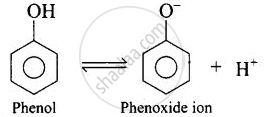
The resonance hybrids may be represented as:
\[\begin{array}{cc}
\phantom{.............}\ce{O^{δ-}}\\
\phantom{.........}//\\
\ce{R - C}\\
\phantom{........}\backslash\backslash\\
\phantom{............}\ce{O^{δ-}}\\
\end{array}\]
Carboxylate ion
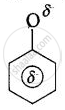
Phenoxide ion
\[\ce{RO-}\]
(No resonance)
The resonance hybrids may be represented as: Carboxylate ion Phenoxide ion (No resonance)
The electron charge on the carboxylate ion is more dispersed in comparison to the phenate ion since there are two electronegative oxygen atoms in carboxylate ion as compared to only one oxygen atom in phenoxide ion. In other words, the carboxylate ion is relatively more stable as compared to phenate ion. Thus, the release of H+ ion from carboxylic acid is comparatively easier or it behaves as a stronger acid than phenol.
APPEARS IN
संबंधित प्रश्न
Write the products formed when CH3CHO reacts with the following reagents: CH3CHO in the presence of dilute NaOH
How will you convert ethanal into the following compound?
But-2-enal
Write structural formulas and names of four possible aldol condensation products from propanal and butanal. In each case, indicate which aldehyde acts as nucleophile and which as electrophile.
How will you bring about the following conversion in not more than two steps?
Ethanol to 3-Hydroxybutanal
How will you bring about the following conversion in not more than two steps?
Benzaldehyde to 3-Phenylpropan-1-ol
Describe the following:
Cross aldol condensation
Complete the synthesis by giving missing starting material, reagent or product.
\[\begin{array}{cc}
\ce{C6H5CHO}\phantom{............}\\
\phantom{........}\ce{+\phantom{......}\ce{->[dil.NaOH][\Delta]}}\phantom{...}\\
\ce{CH3CH2CHO}\phantom{............}
\end{array}\]
Write a chemical equation for the following reaction:
Propanone is treated with dilute Ba( OH)2.
What is substituted imine called?
Cannizaro’s reaction is not given by ______.
Compounds A and C in the following reaction are:
\[\ce{CH3CHO ->[(i) CH3MgBr][(ii) H2O] (A) ->[H2SO4, Δ] (B) ->[Hydroboration oxidation] (C)}\]
Assertion: Aromatic aldehydes and formaldehyde undergo Cannizaro reaction.
Reason: Aromatic aldehydes are almost as reactive as formaldehyde.
Identify A and B from the following reaction:
\[\begin{array}{cc}
\ce{CH3}\phantom{.................}\\
|\phantom{....................}\\
\phantom{}\ce{2CH3 - C = O ->[Ba(OH)2] A ->[Δ] B + H2O}
\end{array}\]
Predict the reagent for carrying out the following transformations:
Ethanal to 3-hydroxy butanal
The major product of the following reaction is:

Explain the aldol condensation of ethanal.
What is aldol condensation? Explain it with suitable examples.
Which one of the following undergoes reaction with 50% sodiumhydroxide solution to give the corresponding alcohol and acid:
