Advertisements
Advertisements
प्रश्न
Discuss in pairs
Chako's firmness in dealing with the irrational behaviour of his father.
Advertisements
उत्तर
Pappachi used to beat Mammachi with brass vases every other night until Chako came home for a summer vacation from Oxford. He had grown into a big and strong man. It had been a week to him since he arrived that he found Pappachi beating Mammachi in the study. Chacko strode into the room, caught Pappachi's hand by which he held vase, and was beating Mammachi and twisted it around his back. He told loud and clear to Pappachi that he would not want the incident to happen again, ever! The father was flabbergasted. He never dared to touch Mammachi again and yet he never talked to her again till he lived. The firm attitude of the young son stopped the domestic violence that used to take place every day in the house. It was a good action taken by the boy. Men in our society beat their wives without any cause just to prove their physical superiority. The boy made it clear to the father that he is not the only one with muscles in the house putting a stop to the violence.
APPEARS IN
संबंधित प्रश्न
You had gone on a trekking expendition with a group of friends. As night closed in, you realised that you were separated from the group. Describe your initial feelings and the place where you got lost. How did you spend the night alone before you were reunited with your group?
Explain the expression, ‘wonder-waiting eyes.’
Define the following terms from the poem: rivulet, plough share (plowshare), yon, and childing.
Explain and discuss the themes in the poem.
Why does the caged bird stand on the “grave of dreams?”
There's nobody on the house-tops now...
Just a palsied few at the windows set;
For the best of the sight is, all allow,
At the Shambles' Gate-or, better yet,
By the very scaffold's foot, I trow.
Read the above lines and answer the question that follow.
Explain with reference to the context.
Who was talking to the old man?
The Little Match Girl can be viewed as a work of opposites. Justify.
What is the theme of all summer in a day by Ray Bradbury?
Relate something unpleasant that happened to you during your childhood that nevertheless helped you to grow up and mature.
Fill in the blank with an appropriate word:
Air pollution is responsible for the spread ……… bronchitis.
In the poem Breaking Out. the poet shows the gradual transformation of a young girl into a confident and independent individual who breaks the conventional stereotypes of society. Discuss with close reference to the text.
Read the extract given below and answer the questions that follow:
Inspector: [Sharply] Are you sure there was nobody in the room already?
De Levis: [Taken aback] I don’t know. I never thought. I didn’t look under the bed if you mean that.
Inspector: [Jotting I Did not look under bed. Did you look under it after the theft?
De Levis: No. I didn’t.
Inspector: Ah! Now, what did you do after you came back from your bath? Just give us that precisely.
(i) What reply did De Levis give to the inspector’s last question in the extract?
(ii) What made De Levis check the contents of his pocketbook? What did he find there?
Whom did he go to upon discovering the theft?
(iii) Who was Robert? Where was Robert’s room? At what time did he take De Levis’ clothes and boots?
(iv) What is the Inspector’s final theory of the theft?
(v) Whom did De Levis accuse of stealing his money? What were his reasons for making this accusation?
Fill in the blank with an appropriate word:
The young child carried the heavy bucket _______ the stairs.
They had to climb ____________the steep pathway to reach the top.
Give reasons for the following.
King Tut’s body has been subjected to repeated scrutiny.
What were the results of the CT scan?
Discuss the following in groups of two pairs, each pair in a group taking opposite points of view.
Knowledge about the past is useful to complete our knowledge of the world we live in.
Find out about experiments in recycling that help in environmental conservation.
Write a letter to the President, Residents’ Welfare Association of your locality suggesting some measures that could be taken for solving the problem of water scarcity and conserving water.
Identify instances of ironical comment in the story.
Rewrite the following incomplete sentences carefully, so that the reader does not have to guess what is left out.
1. more and more books
2. too difficult
3. got up late, missed the bus
4. solved the mystery
The poet says, “Beauty is heard in …”
Can you hear beauty? Add a sound that you think is beautiful to the sounds the poet thinks are beautiful.
The poet, Keats, said:
Heard melodies are Sweet,
But those unheard are sweeter.
What do you think this means? Have you ever heard a song in your head, long after the song was sung or played?
Look at these sentences.
- Deserts are the driest places on earth.
- Gerbils spend the hottest part of the day in cool underground burrows.
Now form pairs. Ask questions using a suitable form of the word in brackets. Try to answer the questions too.
Do you know
1. Which animal is the _______________________ (tall)?
2. Which animal runs the _______________________ (fast)?
3. Which place on earth is the _______________________ (hot) or the _______________________ (cold)?
4. Which animal is the _______________________ (large)?
5. Which is the ————————————— (tall) mountain in the world?
6. Which is the _______________________ (rainy) place on earth?
7. Which is the ________________________ (old) living animal?
Can you add some questions of your own?
You might have learned about organic farming. Make groups and discuss the difference between conventional farming and organic farming and write it down.
| Sr.No. | Conventional Farming | Organic Farming |
| 1. | ||
| 2. | ||
| 3. |
Imagine that you are the fellow pilgrim and you wish to share your experience of the incident in the poem.
Write a short article about it for a magazine/journal. Also, convey what change it has brought in your life.
Imagine that you are one of the soldiers from 18 Grenadiers on the mission Tiger Hill. Narrate your experience of the war to your friend.
Write a summary of the sonnet. Refer to the earlier poems for the points to be covered for writing the summary.
- Title
- Introductory paragraph (about the poem, type, nature, tone)
- Main body (central idea, the gist of the poem)
- Conclusion (opinion, views, appeal).
Write down the consequences of the following occurrences with the help of the play.
Dr. Thomas Stockmann wants an article exposing social evils to be printed in the newspaper.
Given in a mixed order below are some good human attributes of the family. Pick out from the box and write it against the line that reflects it.
After some days, Elizabeth informed that she wanted the family to move to a safer place.
Narrate the story of Sushruta in your own words.
Discuss the following and write about the following in your own words in 5-6 lines.
What would you do, if something like this happens to you?
Write a short passage/essay on ‘Women Power’ in the Neolithic, Medieval, and Present Times.
Hold a discussion in the classroom about the differences between printed newspapers, radio news bulletins, TV news bulletins. Discuss the merits, demerits, and popularity of each.
Write a report of the following event in about 100-120 words.
You are the Coordinator of the Science Forum of your school. An event had been organized on account of National Science Day for the members of the forum. Now, write a report on the observation of “National Science Day” at your school.
Look at the image of the familiar advertisement given below. Identify the product and try to frame your own slogan for them.

Nalan’s grandfather showed him an old treasure trunk. A road map was stuck on the trunk. It showed the spot where a key was hidden. Look at the road map and write five directions to reach the spot where the key is hidden. Discuss with your partner and compare your directions with those of your classmates.
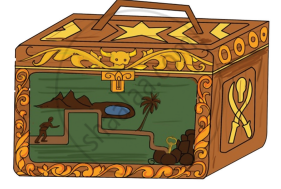
- ____________
- ____________
- ____________
- ____________
- ____________
Bio - Poem
A Bio - Poem is an essay about oneself in the form of poetry.
Line 1: Your name.
Line 2: Four adjectives that describe you.
Line 3: Son of / daughter of … brother of / sister of…
Line 4: Lover of three people, things or idea.
Line 5: Who feels (three sensations or emotion)
Line 6: Who needs (three things)
Line 7: Who gives (three things)
Line 8: Who fears (three things)
Line 9: Who would like to see (three persons or places)
Line 10: Who lives …
Line 11: Your last name.
|
Anne Friendly, kind, smart and obedient Daughter of Sam and Diana, sister of Jack Lover of pets, sports and reading Who feels cheerful, comfortable and excited Who needs education, peace and friends Who gives smiles, support and courage Who fears spiders, the dark and stray dogs Who would like to see Mt. Everest Lives in Cape Sara |
Work in small groups. Pick out the adjectives and nouns that suit you using a dictionary. Read the steps given. Arrange adjectives and nouns like the given sample to construct your Bio-Poem. Present in the class.
______ do you get up?
What will Glory say? Do you think you can help Glory by giving some ideas to Ravi?
| Glory |
You can write a story about the ______ and the ______. |
| Ravi | Great idea! Thank you! |
| Glory | ______ Ravi. |
Write five things that you do at home to make your home look neat and clean.
Connect the pairs of sentences below using and or but.
- Raju plays cricket.
- He also plays hockey.
Here is a word, morning. Now write down words related to it.

Some words have similar sound, but different meaning. Choose the correct word from the option and fill in the blank.
The squirrel has a long ______.
The children finished their work______ [quick]
The grandmother was strong-minded. Justify
What story did the man standing near the hardware store tell the passing cop?
State whether the following statement are true or false
The friends parted one night after watching a movie together.
Bob’s life in the West was not a bed of roses. Give reasons.
How did Mary Kom manage to get financial support for her trip to the USA?
Read and understand the data presented in the pie-chart below on factors affecting health, and write an article for your school magazine highlighting the fact that it’s our lifestyle that determines how healthy we remain. Write your article in about 150 words. Give a suitable title too.

The factors which affect health are given percentage-wise in the pie chart.
Given below is a list of tools and equipment. Associate them with the appropriate profession and complete the table.
plough, hammer, oven, thermometer, voltmeter, wood, chisel, seed drill, voltage, detector, cutting boards, stone picker, spatula, cultivator, nail puller, wire strippers, framing square, fork, flashlight
| Farmer | Carpenter | Electrician | Chef |
| plough | hammer | ||
Why did the photographer feel happy after taking the photograph?
Using the given informal letter as a model, write a letter on any one of the topics given below.
Write letter to your father asking permission to go on a educational tour.
Discuss the following and write the summary of your discussion in the form of bullet points.
- How are certain ideas/customs/knowledge passed on from one generation to the next?
- Is it necessary for children to follow the footsteps of their forefathers? If yes, why? Why is it sometimes necessary to change the old ways?
If you want to become a tourist guide at the following places, which languages will you need to learn?
- Ajanta
- Belgavi
- Delhi
- Tarkarli
Do you like cartoons and cartoon films? Which one do you like best?
Using the given informal letter as a model, write a letter on the topic given below.
Write letter to your father asking permission to go on an educational tour.
Read the passage given below and answer the questions (i), (ii) and (iii) that follow.
| (1) | “Can I see the Manager?” I said, and added solemnly, “Alone.” I don't know why I said “Alone.” “Certainly,” said the accountant and fetched him. | |
| (2) | The Manager was a grave, calm man. I held my fifty-six dollars clutched in a crumpled ball in my pocket. “Are you the Manager?” I asked. God knows I did not doubt it. “Yes,” he said. “Can I see you …. alone?” I asked. |
5 |
| (3) | The Manager looked at me in some alarm. He felt that I had an awful secret to reveal. “Come in here,” he said, and led the way to a private room. He turned the key in the lock. “We are safe from interruption here,” he said; “Sit down.” We both sat down and looked at each other. I found no voice to speak. “You are one of Pinkerton’s men, I presume,” he said. |
10 |
| (4) |
He had gathered from my mysterious manner that I was a detective. I knew what he was thinking, and it made me worse. |
15
20
|
| (5) | The Manager got up and opened the door. He called to the accountant. “Mr. Montgomery,” he said unkindly loud, “this gentleman is opening an account, he will deposit fifty-six dollars. Good morning.” I rose. A big iron door stood open at the side of the room. “Good morning,” I said, and stepped into the safe. “Come out,” said the Manager coldly and showed me the other way. |
30 |
| (6) | I went up to the accountant’s wicket and poked the ball of money at him with a quick convulsive movement as if I were doing a conjuring trick. My face was ghastly pale. “Here,” I said, “deposit it.” The tone of the words seemed to mean, “Let us do this painful thing while the fit is on us.” He took the money and gave it to another clerk. |
35 |
| (7) | He made me write the sum on a slip and sign my name in a book. I no longer knew what I was doing. The bank swam before my eyes. “Is it deposited?” I asked in a hollow, vibrating voice. “It is,” said the accountant. “Then I want to draw a cheque.” My idea was to draw out six dollars of it for present use. Someone gave me a chequebook through a wicket and someone else began telling me how to write it out. The people in the bank had the impression that I was an invalid millionaire. I wrote something on the cheque and thrust it in at the clerk. He looked at it. |
40
45 |
| (8) | “What! Are you drawing it all out again?” he asked in surprise. Then I realised that I had written fifty-six instead of six. I was too far gone to reason now. I had a feeling that it was impossible to explain the thing. I had burned my boats. All the clerks had stopped writing to look at me. Reckless with misery, I made a plunge. “Yes, the whole thing.” “You withdraw all your money from the bank?” “Every cent of it.” “Are you not going to deposit anymore?” said the clerk, astonished. “Never.” |
50
55 |
| (9) | An idiot hope struck me that they might think something had insulted me while I was writing the cheque and that I had changed my mind. I made a wretched attempt to look like a man with a fearfully quick temper. | |
| (10) | The clerk prepared to pay the money. “How will you have it?” he said. This question came as a bolt from the blue. “What?” “How will you have it?” “Oh!”— I caught his meaning and answered without even trying to think— “in fifties.” He gave me a fifty-dollar bill. “And the six?” he asked dryly. “In sixes,” I said. He gave it to me and I rushed out. As the big door swung behind me. I caught the echo of a roar of laughter that went up to the ceiling of the bank. Since then, I bank no more. I keep my money in cash in my trousers pocket and my savings in silver dollars in a sock. |
60
65
70 |
| Adapted from: My Financial Career By Stephen Leacock |
||
-
- Find a single word from the passage that will exactly replace the underlined word or words in the following sentences. [3]
- The kind stranger went and got back the ball from where it had rolled into the bush.
- I took offence at the expression on his face that was clearly meant to insinuate I was a liar.
- The firm experienced a financial loss when the contract went to a contender who had just entered the business.
- For each of the words given below, choose the correct sentence that uses the same word unchanged in spelling, but with a different meaning from that which it carries in the passage. [3]
- alarm (line 8)
- The silence from the other end set off alarm bells in her head.
- The pallor of his skin alarmed those standing around.
- I set my alarm for six o’clock but slept through it.
- The sound of the approaching jets caused some alarm in the war room.
- wicket (line 44)
- The wicketkeeper was the true saviour of the day for that one match.
- The team wanted to bat while the wicket was still dry.
- The man at the window handed us our tickets through the wicket.
- The quick loss of wickets demoralised the team.
- reason (line 48)
- After the tragedy, his ability to reason is severely diminished.
- They reasoned they could get better seats if they arrived early.
- Recipients of funds were selected without rhyme or reason.
- We have every reason to celebrate.
- alarm (line 8)
- Find a single word from the passage that will exactly replace the underlined word or words in the following sentences. [3]
- Answer the following questions as briefly as possible in your own words.
- With reference to the passage, explain the meaning of the expression of the ‘I had burned my boats?’ [2]
- Cite any two instances of the behaviour of the bank employees that indicate the insignificance of a deposit of fifty-six dollars. [2]
- Why do you think the people in the bank thought of the narrator as an “invalid millionaire?” [2]
- Summarise why the narrator decided ‘to bank no more’ (paragraphs 6 to 10). You are required to write the summary in the form of a connected passage in about 100 words. Failure to keep within the word limit will be penalised. [8]
