Advertisements
Advertisements
प्रश्न
'Appearances can be deceptive'. Give your views on this topic.
Advertisements
उत्तर
This proverb unearths a hidden truth, ironically to the old one we were used to, that had earlier said, “Face is the index of the mind.” Previously people were taken by the look of a person. If one dressed neatly and appeared to be very nice and decent, especially – if that person is very handsome – people were influenced by his look and instantly fell for him like a hypnotized. It was only when that good looking person had cheated the believer he/she learned a bitter lesson.
Nevertheless, this proverb, ‘Appearances can be deceptive’ cannot be taken as one hundred percent true. It has a mixture of both good and bad. Good people, of course, look good. At the same time, bad ones also wear the guise of good people, knowing that their appealing appearances would have a sway over the onlookers.
Hence, under this tricky situation, one has to be cautious as to how far that person is trustworthy. By casual conversation, how that person reacts to different situations, what he/she laughs at that can betray his/her mental maturity, his kindness, his anger, his way of cracking jokes, how he behaves in public places, how he respects the fellow citizens as well as the aged, how he/she spends money and so on. These are some of the yardsticks for assessing a person.
Some of the decent looking people behave in an odd way, while some others, though ugly looking, behave very well. Therefore, it is not possible to judge a person by his/her external look. A variant of this proverb says, “Not to judge a book by its cover.”
George Bernard Shaw and Shakespeare were not handsome. But their writings have portrayed their high intellect. Great writer Helen Keller was not a beautiful lady. She was deprived of sight, hearing impaired, unable to speak when she was just a two-year-old child.
But fighting all odds, she had become a celebrity author!
Contrary to this, Walt Disney was not only handsome but had an international reputation by his steadfast work, devotion, and dedication. So, one must not come to a conclusion by mere external look of a person or a thing, be it a book or any commodity for that matter. A spurious product can be more attractive than a genuine one. Some substandard quality products, mostly from China, look good. After some time, they are tending to develop problems beyond salvage.
One can hear a politician talk for a long time, making all false promises. If the voters believed him and elected him, his true color would be exposed. Remember it is also said that, “All that glitter is not gold.” A very well polished brass would pass upon more people than rough genuine gold. Similarly, gold-coated jewels. Do not judge a person by his look. It is said that “All men have eyes, but only a few have the gift of penetration.”
APPEARS IN
संबंधित प्रश्न
Analyse the symbol of Clouds, Sky, and Heavens.
Write a composition (350 - 400 words) on the following:
Study the picture given below. Write a story or a description or an account of what it suggests to you. Your composition may be about the subject of the picture or you may take suggestions from it; however, there must be a clear connection between the picture and your composition.

Read the extract given below and answer the questions that follow:
The woods are lovely, dark and deep.
But I have promises to keep,
And miles to go before I sleep.
And miles to go before I sleep.
(Stopping by Woods on a Snowy Evening: Robert Frosty)
(i) Who is ‘I’ referred to in the extract? Which season of the year is it? What evidence is there in the poem to support your answer?
(ii) Who has made him aware of his mistake? How does it make the speaker aware of his mistake? What does it seem to say?
(iii) What are the three sounds heard?
(iv) What has been said earlier by the poet about the owner of the woods?
(v) What does lovely, dark and deep suggest? What is the underlying significance in the repetition of the last two lines of the extract? Mention the moral tag that the poet attaches to the poem.
Fill in the blank with an appropriate word:
The noise prevented us _______ sleeping.
Below is a topic for essay writing. Follow the steps listed above to write on this topic.
Those who can bear all can dare all
What clues did Sherlock Holmes work upon to get at the fact that the story of the three Garridebs was a ruse?
What was the underlying reason for John Ipe's disgust with the world?
How do these lines capture the essence of the story:
‘Glory was all overlaid with dark shame. Glory was dead.’
‘… let him be wrapped a while in the lingering twilight splendour of departed glory’.
We add ‘un-’ to make opposites. For example, true — untrue. Add ‘un’– to the word below to make its opposite. Then look up the meaning of the word you have formed in the dictionary.
answerable: ____________
Imagine your friend/younger brother or sister has committed a grave mistake that has resulted in a great loss to the college property or to your family. He/she seeks your advice to come out of the situation/problem. Write a dialogue between you and your friend/brother/sister who describes the entire situation and seeks help from you. Take the help of the following points.
- Introduction
- Confessing the mistake
- Seeking help
- Your advice/suggestion
- Concluding part
Refer to a standard dictionary and find out the meaning of the following word:
Reportage
Wars are not fought only on the battlefield. Comment.
Would you like to join the Indian Army/Navy/ Air force? If not, suggest other ways in which you could serve your nation.
Form pairs and make a 'pair presentation' of any one of the two stories. To do so, each person presents only one sentence at a time, and the next one is immediately presented by the partner. Thus, each person in the pair presents alternate sentences without breaking the flow of the narration.
Write a character-sketch of the ‘Stranger-man’ using examples from the story to support the following attributes.
- ignorant, innocent, and polite
- calm and cool
- jumps to wrong conclusions
- hasty and unwise at times
Write a short passage/essay on ‘Women Power’ in the Neolithic, Medieval, and Present Times.
Listen carefully and write the word in the appropriate column.
| Positive Feelings | Negative Feelings |
Teacher: hopeful, lonely, happy, jealous, surprised, shy, loving, proud, cheerful, anxious, nervous, excited, embarrassed, scared, silly, comfortable, peaceful, depressed, enthusiastic, motivated, inspired, threatened, crushed, angry.
Based on the reading of the poem, complete the web chart given below.
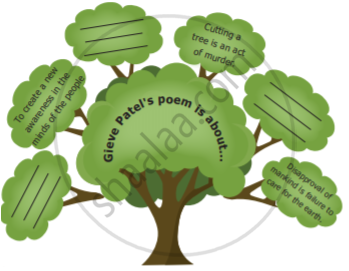
Look at the picture given below and frame your own slogan.

Develop the following hints.
A wood cutter - cutting wood - dropped his axe in the pond - started weeping - an angel appeared - asked what the matter was - brought a golden axe - from the pond - wood cutter did not accept - brought a silver axe - not accepted - brought an iron axe - accepted - pleased with the honesty - offered all the axes to him.
______ is your birthday?
What did Hiawatha love?
In the sentence below the capital letter, comma, full stop and question mark are missing. Put these in the correct place.
what is the colour of the sky
How was she felicitated on her return to India?
Bring out the people’s reaction to the noises from the surgery.
Why did they sympathize with the first patient?
The photographer made the author wait for ______.
We may not have money to buy all our wants at the same time. In such a situation, what are the options available?
On returning home, Tishani Doshi writes her thoughts reflecting on how her decision to enrol for the Students on Ice programme has been the single most important decision of her life that has completely transformed her.
Imagine yourself to be Tishani and express these thoughts.
You may begin like this:
I can’t thank my stars enough for having cashed in on the opportunity of........
Write an original short story in which two children and their school teacher are the main characters.
