Advertisements
Advertisements
प्रश्न
Dreams
Advertisements
उत्तर
Dreams are very different from waking life, but it is extremely difficult clearly to define what the difference consists. When we are dreaming, we are nearly always convinced that we are awake, and in some cases, real experiences have been mistaken for dreams. Sometimes even after waking, we may be doubtful whether our dream was a reality or not, especially if we happen to fall asleep in our chair and do not remember the circumstance of having fallen to sleep. Of course, this doubt can only arise when there has been nothing in our dream that seems impossible to our wakened mind.
It is, however, only in rare cases that a dream exactly copies the experience of our waking hours. As a rule, in our sleep, all kinds of events seem to happen which in our waking hours we should know to be impossible. In our dreams, we see and converse with friends
who is on the other side of the world or have been long dead.
We may even meet historical or fictitious characters that we have read about in books. We often lose our identity and dreams that we are someone else, and in the course of a single dream may be in turn, several different persons. Space and time to the dreamer lose
their reality.
It is possible in a dream that lasts a few seconds to appear to have gone through the experience of many years. The limitations of space may also vanish into nothing so that we seem to travel the most distant parts of the universe with the rapidity of thought.
Our imagination gains in some cases such as complete control over our reason that we can contemplate all such contradictions to our ordinary experience without the least feeling of wonder. But this is not always the case. It is impossible to assert as a universal rule that in
a dream nothing, however extraordinary, can surprise us. Sometimes dreamers do have a feeling of wonder at their strange experiences. Nor can we say that the moral reason loses all control in our sleep.
It does indeed sometimes happen that good men in their dreams seem to do without the slightest compunction horribly wicked deeds, but, on the other hand, even the dreamer sometimes hears the voice of conscience. All the facts that we have been considering are so
various that they chiefly illustrate the extreme difficulty of making any general statement about dreams. They show that in many cases dream- life is very different from real life and that in other cases mind of a sleeping man works much in the same way as if he were awake.
Perhaps the only definite general statement that can be made on the subject is that imagination even in sleep cannot originate anything, although it has an almost unlimited power of uniting together in more or less unusual or even in impossible combinations what we have actually experienced.
APPEARS IN
संबंधित प्रश्न
Fill in the blank with the suitable word.
He ran _____________ from home at the age of ten.
The poet compares the flowers to the milky way. Is the comparison apt?
What is the encaged bird fearful of ?
What docs the line “and his shadow shouts on a nightmare scream” mean?
Write a short note on Abou bin Adhem.
Write an original short story that begins with the words: "It was raining hard that night. In my hurry to get into the house, I didn't notice the black car parked across the road. I realized something was, wrong when .........
What does the phrase “strange to tell” mean?
Notice the following sentence patterns.
For song…duly with love returns
Rewrite the above sentences in prose.
Write a letter to your friend narrating your experiences in a rescue operation.
What kind of relationship did Mrs. Croft share with her daughter Helen?
Find various career opportunities in Small-scale Industries like Handloom, Art and Craft, Block Printing, etc.
Answer the following question:
“It was to be a battle of champions.” (8)
(i) What qualities did the two champions have? Pick out words and phrases from the paragraph above this line in the text and write them down.
|
Mongoose |
Cobra |
| (a) ________ | (a) ________ |
| (b) ________ | (b) ________ |
| (c) ________ | (c) ________ |
(ii) What did the cobra and the mongoose do, to show their readiness for the fight?
The extract deals with the atmosphere of two homes. Collect the words associated with - Garden.
Write down the significance of the following in the context of ‘On to the Summit’:
Red Scarf
Complete the flow chart showing the events on the day of the assault.

Write a letter from Abdul to the Emperor, requesting the Emperor to give Abdul a suitable job.
Do you have pet animals? Write an interesting story about your own or your friends' pet.
Read the following Headline and write the dateline, intro, and a short continuing paragraph.
| India’s first ever tourism university to be established by IIHM |
Create a Personal Particular for your class with support from your teacher and collect personal and educational information.
Imagine yourself as the writer. Narrate the story of your visit to your ancestral house.
Write a letter of enquiry for the following.
Write a letter to the head of the BSNL office enquiring regarding the internet broadband scheme launched recently.
Arrange the picture in order by writing the numbers 1,2,3 and 4 in the given boxes and write this familiar story in about 100 words.
Make use of the words given below.
| thirsty, village, pitcher, disappointment, pebbles, water level |
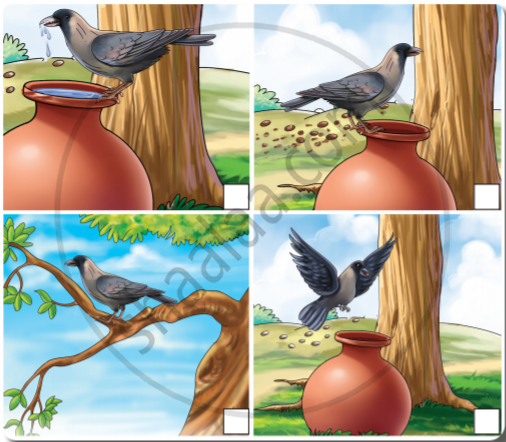
One hot day, a thirsty crow _____________________________________________________________
__________________________________________________________________________________________
Punctuate the following sentences using capital letters, full stops (.) commas (,) question marks (?) apostrophe ( ' ) exclamation mark (!) wherever necessary.

dear samir,
i am sending you a photograph of my newest pet frisky is a bulldog and a very playful puppy by next summer he should be old enough to go with us on our long walks i m sure you are looking forward to seeing him I know you will like him
warm regards
sanju
Now complete the following sentence, choosing the right word.
The sum was ______ difficult for the class to solve. Only ______ students could do it.
(two, too)
The photographer had made changes ______.
Read the given sentence and underline the 'no' word.
Ram has no book.
Read the given sentence and underline the no word.
None of the two boys came.
Imagine someone has invited your family to a program and you were the only person at home when the invitation was given orally.
Write a dialogue between a student and teacher on 'Importance of Yoga'.
Do you have a role model? What qualities do you appreciate in your role model?
