Advertisements
Advertisements
प्रश्न
Refer to a standard dictionary and find out the meaning of the following word:
Reportage
Advertisements
उत्तर
Reportage: the act of reporting news in a newspaper or broadcasting them on radio or television.
APPEARS IN
संबंधित प्रश्न
Write an e-mail to the Principal of a neighbouring school requesting him/her to send a team of three members to participate in the Quiz Competition.
Arun was asked by his mother to explain the missing buttons on his shirt.
(Rewrite: Using ‘explanation’)
Later, too, the old man uses the expression famous victory? Why?
What do you think of the old man’s point of view?
How does the poet describe the flowers by using personification?
What is the theme of the poem? How is it conveyed?
The traffic outside your school is very heavy and chaotic. Write a letter to the Deputy Commissioner of Police (Traffic) pointing out the danger of such heavy and chaotic traffic in a school zone. Suggest possible solutions for the problem.
(A) Ashita is the most beautiful girt in the class.
(B) No ………………………………..
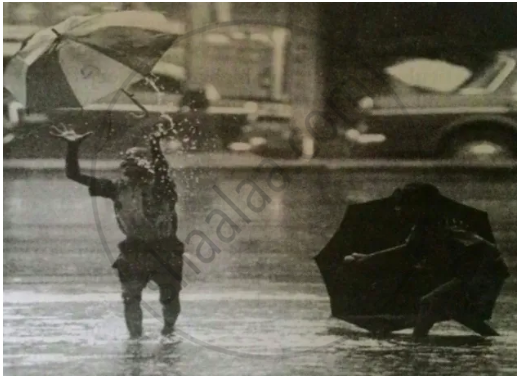
Study the picture given below. Write a story or a description or an account of what it suggests to you. Your composition may be about the subject of the picture or you may take suggestions from it; however, there must be a clear connection between the picture and your composition.
The anthology `ISC Collection of Short Stories' includes several stories in which a woman is a central character. Which female character has awakened your admiration, sympathy or interest and why?
Hardly had the teacher left the room, when all the children started making a noise.
(Begin : No sooner ………..)
Your uncle has promised to give you a gift of Rs. 1000/-. Write a letter thanking him for the offer, tell him how you plan to spend the money; and why you wish to spend it in this way.
Fill in the blank with an appropriate word:
He found the key just _______ the front door.
Fill in the blank with an appropriate word:
The cyclist rode quickly ______ the path.
Join the following sentence to make one complete sentence without using and, but or so.
The child helped her mother to make breakfast. She washed the tomatoes.
Have you heard any boatmen’s songs? What kind of emotions do these songs usually express?
What were the results of the CT scan?
Given below is an interesting combination of words. Explain why they have been used together.
ghostly dust devils
(i) What do you understand by the terms `outsider art’ and `art brut’ or `raw art’?
(ii) Who was the “untutored genius who created a paradise” and what is the nature of his contribution to art?
Below is a topic for essay writing. Follow the steps listed above to write on this topic.
Human Population Grows Up
Discuss in groups of four.
Laws are never respected not enforced in India.
Which do you think are the most poetic lines? Why?
Examine the subtle humour in the narration of the story that lightens the gravity of the subject matter.
Give reasons for the following.
Satyajit attending the village wedding.
How is Satyajit's financial crash introduced to the reader?
We add ‘un-’ to make opposites. For example, true — untrue. Add ‘un’– to the word below to make its opposite. Then look up the meaning of the word you have formed in the dictionary.
interesting: ____________
We add ‘un-’ to make opposites. For example, true — untrue. Add ‘un’– to the word below to make its opposite. Then look up the meaning of the word you have formed in the dictionary.
trained: ____________
Read the following lines. Imagine it is the beginning of an instance you have experienced. Complete the incident using your imagination. Give it a positive ending.
I had often noticed that in my neighbour’s family, the son was greatly pampered, but the daughter was treated unfairly. I could not bear this. So one day I decided to ............................
Continue the write-up, with your own ideas, in about 12 - 15 lines.
Start a collection of proverbs. A proverb is a short, well-known sentence or phrase that gives advice or tells you what is generally true. For example, ‘A stitch in time saves nine’ means ‘If one does something in time or immediately, it saves a lot of work later’. A proverb is also known as a saying. Here are some proverbs for your collection.
- Appearances can be deceptive.
- Do not judge by appearance; a rich heart may be under a poor coat.
- All that glitters is not gold.
- You can’t tell a book by its cover.
- Clothes do not make the man.
Find the meaning of ‘anticlimax’.
Prepare a formal invitation for a function you have arranged at home. It should clearly state the following points:
- Who is inviting people to the function.
- What the program is.
- The date and time.
- The venue. (The place where
- A polite request to attend the function. the function will take place.)
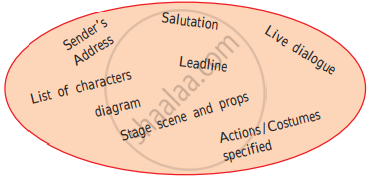
The diagram below encircles the various features that make the script of a skit/ play. List the other words and mention the form of writing of which it is a feature.
Is the insect described in the poem a real insect? Think about an imaginary creature. Describe it in your own words. You may draw its picture and label it.
Read the following Headline and write the dateline, intro, and a short continuing paragraph.
| India’s first ever tourism university to be established by IIHM |
Prepare a set of questions to interview:
a person who has recently scaled Mt. Everest.
Imagine yourself as the writer. Narrate the story of your visit to your ancestral house.
Taking clues from the lists on the board, complete the following chart.

Work in groups and discuss. Then write a diary entry in about 60-80 words describing your feelings and emotions for the given situation.
Imagine, you are Pongo.
Your feelings when you caught the boy.
Create a poster for the following.
Say ‘No to Drugs’ – Design a poster for it is not more than 50 words. You may use slogans/ phrases.
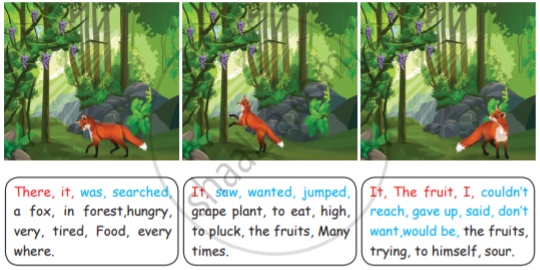
Write the hungry fox story on your own by looking at the pictures and using the clues given under each picture.
The word in the sentence is jumbled. Write them in order.
was afraid I now.
Narrate an incident when you have experienced happiness, excitement, surprise. You can use the following clues.
With whom...
When did it happen...
Why...
Where...
Malu lived with Malu’s parents in the North Pole. Malu had great fun with Malu’s seagull friends.
One day Malu’s father told Malu that the hunters had come to trap Malu and Malu’s family. Malu knew how to hide very well. Malu shut Malu’s eyes and curled up like a ball of snow.
The hunter searched for Malu and Malu's family everywhere but in vain.
We can avoid repeating the names by using certain other words in their place. Study the table below.
| Singular | Plural | |
| person speaking | I, me | we, us |
| person spoken to | you | you |
| other persons | he, him, she, her. | they, |
| places, things | it | them. |
Now rewrite the above paragraph using words from the above table.
Use the option to fill in the blank.
Her frock______too long.
Answer the question by looking at the picture.
Example: What is happening in picture 5?

Do you know that there are seven wonders in the world? Can you tell the name of the one which is in India? Find out and write the names of all the seven wonders and the countries they are located in.
| Wonders of the world | Countries | |
| (i) | The Taj Mahal | |
| (ii) | The Great Wall of China | |
| (iii) | ||
| (iv) | ||
| v) | ||
| (vi) | ||
| vii) |
Why did the friends part ways?
How did the other Women react to Woman 5?
How did the inner room get light?
“To me, it is but a worthless bauble.” Why did the photographer’s touch of technical expertise appear a worthless bauble to Leacock?
Write a paragraph of about 150 word, on the following topic.
Need for Moral Education in schools
Answer the following question as briefly as possible and with close reference to the relevant text.
Referring closely to the short story, The Sound Machine, describe the encounter between Klausner and Mrs. Saunders. How did it affirm his belief in his own invention?
Read the following passage and write a summary of it. Suggest a suitable title to the summary.
|
According to some experts, a staggering 93 percent of our daily communication is non-verbal. Facial expressions are easy to decipher. One can readily detect happiness, sadness, anger. Physicians can tell a patient is doing well (or not) by looking at his/her face. Eye contact is another type of non-verbal communication, which can tell a lot about the other person. The eyes convey a range of emotions-happiness, sadness, boredom, surprise, confidence ..... even emotional interest. Staring at someone's forehead may intimidate the recipient, staring at the mouth is sometimes interpretated as a sign of emotional interest. In fact staring into someone's eyes is a sign of lying, and so is looking away. In certain cultures, lack of eye contact is taken as a sign of respect. If body language is to be defined, it is a combination of facial expression, gestures, eye contact, body movements and posture and voice. Frequent blinking is a sign of the person feeling distressed or uncomfortable. If the pupils are dilated, it often indicates interest, even emotional interest. The lips also reflect our body language, and lip biting indicates worry and/or anxiety; tightening of the lips may be an indication of disapproval. Slightly turned-up lips indicate happiness and slightly turned-down lips indicate sadness. |
News Report:
Read the following headline and prepare a news report with the help of the given points:
21-Year-Old Mayur Wins World Chess Championship
Make use of the following guidelines:
- Headline
- Dateline
- Lead line
- Body of the report
Using the given informal letter as a model, write a letter on any one of the topics given below.
Write letter to your father asking permission to go on a educational tour.
If you want to become a tourist guide at the following places, which languages will you need to learn?
- Ajanta
- Belgavi
- Delhi
- Tarkarli
What’s the difference between ‘hear’ and ‘listen?
Read the passage given below and answer the questions (i), (ii) and (iii) that follow.
| (1) | “Can I see the Manager?” I said, and added solemnly, “Alone.” I don't know why I said “Alone.” “Certainly,” said the accountant and fetched him. | |
| (2) | The Manager was a grave, calm man. I held my fifty-six dollars clutched in a crumpled ball in my pocket. “Are you the Manager?” I asked. God knows I did not doubt it. “Yes,” he said. “Can I see you …. alone?” I asked. |
5 |
| (3) | The Manager looked at me in some alarm. He felt that I had an awful secret to reveal. “Come in here,” he said, and led the way to a private room. He turned the key in the lock. “We are safe from interruption here,” he said; “Sit down.” We both sat down and looked at each other. I found no voice to speak. “You are one of Pinkerton’s men, I presume,” he said. |
10 |
| (4) |
He had gathered from my mysterious manner that I was a detective. I knew what he was thinking, and it made me worse. |
15
20
|
| (5) | The Manager got up and opened the door. He called to the accountant. “Mr. Montgomery,” he said unkindly loud, “this gentleman is opening an account, he will deposit fifty-six dollars. Good morning.” I rose. A big iron door stood open at the side of the room. “Good morning,” I said, and stepped into the safe. “Come out,” said the Manager coldly and showed me the other way. |
30 |
| (6) | I went up to the accountant’s wicket and poked the ball of money at him with a quick convulsive movement as if I were doing a conjuring trick. My face was ghastly pale. “Here,” I said, “deposit it.” The tone of the words seemed to mean, “Let us do this painful thing while the fit is on us.” He took the money and gave it to another clerk. |
35 |
| (7) | He made me write the sum on a slip and sign my name in a book. I no longer knew what I was doing. The bank swam before my eyes. “Is it deposited?” I asked in a hollow, vibrating voice. “It is,” said the accountant. “Then I want to draw a cheque.” My idea was to draw out six dollars of it for present use. Someone gave me a chequebook through a wicket and someone else began telling me how to write it out. The people in the bank had the impression that I was an invalid millionaire. I wrote something on the cheque and thrust it in at the clerk. He looked at it. |
40
45 |
| (8) | “What! Are you drawing it all out again?” he asked in surprise. Then I realised that I had written fifty-six instead of six. I was too far gone to reason now. I had a feeling that it was impossible to explain the thing. I had burned my boats. All the clerks had stopped writing to look at me. Reckless with misery, I made a plunge. “Yes, the whole thing.” “You withdraw all your money from the bank?” “Every cent of it.” “Are you not going to deposit anymore?” said the clerk, astonished. “Never.” |
50
55 |
| (9) | An idiot hope struck me that they might think something had insulted me while I was writing the cheque and that I had changed my mind. I made a wretched attempt to look like a man with a fearfully quick temper. | |
| (10) | The clerk prepared to pay the money. “How will you have it?” he said. This question came as a bolt from the blue. “What?” “How will you have it?” “Oh!”— I caught his meaning and answered without even trying to think— “in fifties.” He gave me a fifty-dollar bill. “And the six?” he asked dryly. “In sixes,” I said. He gave it to me and I rushed out. As the big door swung behind me. I caught the echo of a roar of laughter that went up to the ceiling of the bank. Since then, I bank no more. I keep my money in cash in my trousers pocket and my savings in silver dollars in a sock. |
60
65
70 |
| Adapted from: My Financial Career By Stephen Leacock |
||
-
- Find a single word from the passage that will exactly replace the underlined word or words in the following sentences. [3]
- The kind stranger went and got back the ball from where it had rolled into the bush.
- I took offence at the expression on his face that was clearly meant to insinuate I was a liar.
- The firm experienced a financial loss when the contract went to a contender who had just entered the business.
- For each of the words given below, choose the correct sentence that uses the same word unchanged in spelling, but with a different meaning from that which it carries in the passage. [3]
- alarm (line 8)
- The silence from the other end set off alarm bells in her head.
- The pallor of his skin alarmed those standing around.
- I set my alarm for six o’clock but slept through it.
- The sound of the approaching jets caused some alarm in the war room.
- wicket (line 44)
- The wicketkeeper was the true saviour of the day for that one match.
- The team wanted to bat while the wicket was still dry.
- The man at the window handed us our tickets through the wicket.
- The quick loss of wickets demoralised the team.
- reason (line 48)
- After the tragedy, his ability to reason is severely diminished.
- They reasoned they could get better seats if they arrived early.
- Recipients of funds were selected without rhyme or reason.
- We have every reason to celebrate.
- alarm (line 8)
- Find a single word from the passage that will exactly replace the underlined word or words in the following sentences. [3]
- Answer the following questions as briefly as possible in your own words.
- With reference to the passage, explain the meaning of the expression of the ‘I had burned my boats?’ [2]
- Cite any two instances of the behaviour of the bank employees that indicate the insignificance of a deposit of fifty-six dollars. [2]
- Why do you think the people in the bank thought of the narrator as an “invalid millionaire?” [2]
- Summarise why the narrator decided ‘to bank no more’ (paragraphs 6 to 10). You are required to write the summary in the form of a connected passage in about 100 words. Failure to keep within the word limit will be penalised. [8]
