Advertisements
Online Mock Tests
Chapters
1: GST [Goods and Service Tax]
2: Banking (Recurring Deposit Account)
3: Shares and Dividend
Unit 2. Algebra
4: Linear Inequations (In one variable)
5: Quadratic Equations
6: Solving (simple) Problems (Based on Quadratic Equations)
7: Ratio and Proportion (Including Properties and Uses)
8: Factorization of Polynomials (Remainder and Factor Theorems)
9: Matrices
▶ 10: Arithmetic Progression
11: Geometric Progression
Unit 3. Co-ordinate Geometry
12: Reflection
13: Section Formula and Mid-Point Formula
14: Equation of a Line
Unit 4. Geometry
15: Similarity (With Applications to Maps and Models)
16: Loci (Locus and Its Constructions)
17: Circles
18: Tangents and Intersecting Chords
19: Constructions (Circles)
Unit 5. Mensuration
20: Cylinder, Cone and Sphere
Unit 6. Trigonometry
21: Trigonometrical Identities
22: Height and Distances
Unit 7. Statistics
23: Graphical Representation
24: Measure of Central Tendency (Mean, Median, Quartiles and Mode)
25: Probability
![Selina solutions for Concise Mathematics [English] Class 10 ICSE chapter 10 - Arithmetic Progression - Shaalaa.com](/images/concise-mathematics-english-class-10-icse_6:7eb8c97e7ccc4a1c956f7ac8305d25e3.jpg "Selina solutions for Concise Mathematics [English] Class 10 ICSE chapter 10 - Arithmetic Progression")
Advertisements
Solutions for Chapter 10: Arithmetic Progression
Below listed, you can find solutions for Chapter 10 of CISCE Selina for Concise Mathematics [English] Class 10 ICSE.
Selina solutions for Concise Mathematics [English] Class 10 ICSE 10 Arithmetic Progression Exercise 10 (A) [Pages 133 - 134]
Multiple Choice Type: Choose the correct answer from the options given below.
The first term and the common difference of an A.P. are 8 and –5 respectively. The A.P. is ______.
8, 13, 18, 23, 28, ........
8, 3, –2, –7, ........
–5, 3, 11, 19, 27, ........
–5, –13, –21, –29, ........
Is −8, −8, −8, −8, .......... an A.P.?
no
yes
may be
none of the above
The 15th term of the A.P. 3, 0, –3, –6, ........ is ______.
– 42
39
42
– 39
The 24th term of an A.P. exceeds its 19th term by 10, its common difference is ______.
5
2
10
1
In the A.P. 8, 13, 18, ........., the nth term is 83, then n is equal to ______.
14
16
13
15
The nth term of a sequence is (2n – 3), find its fifteenth term.
If the pth term of an A.P. is (2p + 3); find the A.P.
Find the 24th term of the sequence:
12, 10, 8, 6, .......
Find the 30th term of the sequence:
`1/2, 1, 3/2,.........`
Find the \[100^{\text{th}}\] term of the sequence: \[\sqrt{5}, 2\sqrt{5}, 3\sqrt{5}, ..................\ .\]
Find the 50th term of the sequence:
`1/n, (n + 1)/n, (2n + 1)/n,..........`
Is 402 a term of the sequence:
8, 13, 18, 23, ................. ?
Find the common difference and 99th term of the arithmetic progression:
`7 3/4, 9 1/2, 11 1/4, ................`
How many terms are there in the series 4, 7, 10, 13, ........,148?
How many terms are there in the series 0.5, 0.53, 0.56, ........, 1.1?
How many terms are there in the series `3/4, 1, 1 1/4, ........., 3`?
Which term of the A.P. 1, 4, 7, 10, ....... is 52?
If 5th and 6th terms of an A.P. are respectively 6 and 5, find the 11th term of the A.P.
If tn represents nth term of an A.P., t2 + t5 – t3 = 10 and t2 + t9 = 17, find its first term and its common difference.
Find the 10th term from the end of the A.P. 4, 9, 14, .........., 254.
Determine the arithmetic progression whose 3rd term is 5 and 7th term is 9.
Find the 31st term of an A.P. whose 10th term is 38 and the 16th term is 74.
Which term of the series:
21, 18, 15 ....... is –81?
Can any term of this series be zero? If yes, find the number of terms.
An A.P. consists of 60 terms, If the first and the last terms be 7 and 125 respectively, find the 31st term.
The sum of the 4th and the 8th terms of an A.P. is 24 and the sum of the 6th and the 10th terms of the same A.P. is 34. Find the first three terms of the A.P.
If the third term of an A.P. is 5 and the seventh terms is 9, find the 17th term.
Selina solutions for Concise Mathematics [English] Class 10 ICSE 10 Arithmetic Progression Exercise 10 (B) [Page 136]
Multiple Choice Type: Choose the correct answer from the options given below.
Two A.P.s have the same common difference. If the difference between their 25th terms is 8, the difference between their 50th terms is ______.
16
5
8
25
Ten times the 10th term of an A.P. is equal to twenty times the 20th term of the same A.P. The 30th term of this A.P. is ______.
0
40
20
2 × (30 + 10)
The nth term of an A.P. is 7n – 5. Its common difference is ______.
2
9
16
7
The 40th term of an A.P. exceeds its 16th term by 72. Then its common difference is ______.
40
40 – 16
72
3
The nth term of the A.P. 6, 11, 16, 21, ........ is 106, then the value of n – 4 is ______.
17
15
16
20
In an A.P., ten times of its tenth term is equal to thirty times of its 30th term. Find its 40th term.
How many two-digit numbers are divisible by 3?
Which term of the A.P. 5, 15, 25, ... will be 130 more than its 31st term?
Find the value of p, if x, 2x + p and 3x + 6 are in A.P.
If the 3rd and the 9th term of an A.P. be 4 and –8 respectively, find which term is zero?
How many three-digit numbers are divisible by 87?
For what value of n, the nth terms of the arithmetic progressions 63, 65, 67, ... and 3, 10, 17, ... equal?
Determine the A.P. whose 3rd term is 16 and the 7th term exceeds the 5th term by 12.
If numbers n – 2, 4n – 1 and 5n + 2 are in A.P., find the value of n and its next two terms.
Determine the value of k for which k2 + 4k + 8, 2k2 + 3k + 6 and 3k2 + 4k + 4 are in A.P.
State, true or false:
If a, b and c are in A.P. then 4a, 4b and 4c are in A.P.
State, true or false:
If a, b and c are in A.P. then a + 4, b + 4 and c + 4 are in A.P.
An A.P. consists of 57 terms of which 7th term is 13 and the last term is 108. Find the 45th term of this A.P.
4th term of an A.P. is equal to 3 times its first term and 7th term exceeds twice the 3rd term by 1. Find the first term and the common difference.
The sum of the 2nd term and the 7th term of an A.P. is 30. If its 15th term is 1 less than twice its 8th term, find the A.P.
In an A.P., if mth term is n and nth term is m, show that its rth term is (m + n – r).
Which term of the A.P. 3, 10, 17, .......... will be 84 more than its 13th term?
Selina solutions for Concise Mathematics [English] Class 10 ICSE 10 Arithmetic Progression Exercise 10 (C) [Pages 139 - 140]
Multiple Choice Type: Choose the correct answer from the options given below.
The sum of 41 terms of an A.P. with middle term 40 is ______.
820
1640
2460
None of these
The sum of all two digit numbers is ______.
9810
9045
4509
4905
The sum of A.P. 4, 7, 10, 13, ........ upto 20 terms is ______.
650
10 × 27
510
1300
The sum of 40 terms of the A.P. 7 + 10 + 13 + 16 + .......... is ______.
5240
2620
1310
2680
The nth term of an A.P. is 6n + 4. The sum of its first 2 terms is ______.
16
20
26
None of these
How many terms of the A.P. : 24, 21, 18, ................ must be taken so that their sum is 78?
Find the sum of 28 terms of an A.P. whose nth term is 8n – 5.
Find the sum of all odd natural numbers less than 50.
Find the sum of first 12 natural numbers each of which is a multiple of 7.
Find the sum of first 51 terms of an A.P. whose 2nd and 3rd terms are 14 and 18 respectively.
If the sum of first 7 terms of an A.P. is 49 and that of its first 17 terms is 289, find the sum of first n terms of the A.P.
The first term of an A.P. is 5, the last term is 45 and the sum of its terms is 1000. Find the number of terms and the common difference of the A.P.
Find the sum of all natural numbers between 250 and 1000 which are divisible by 9.
The first and the last terms of an A.P. are 34 and 700 respectively. If the common difference is 18, how many terms are there and what is their sum?
In an A.P. the first term is 25, nth term is –17 and the sum of n terms is 132. Find n and the common difference.
If 18, a, (b – 3) are in AP, then find the value of (2a – b).
Find an AP whose 4th term is 9 and the sum of its 6th and 13th terms is 40.
The sum of n natural numbers is 5n2 + 4n. Find its 8th term.
The fourth term of an A.P. is 11 and the eighth term exceeds twice the fourth term by 5. Find the A.P. and the sum of first 50 terms.
Selina solutions for Concise Mathematics [English] Class 10 ICSE 10 Arithmetic Progression Exercise 10 (D) [Pages 141 - 142]
Multiple Choice Type: Choose the correct answer from the options given below.
k + 2, 2k + 7 and 4k + 12 are the first three terms of an A.P. The first term of this A.P. is ______.
–2
0
2
3
The sum of n terms of an A.P. is 3n2. The second term of this A.P. is ______.
8
3
9
12
If 5, 7 and 9 are in A.P., then which of the following is in A.P.?
5 × 7, 7 × 9 and 9 × 5
5 × 7, 7 × 7 and 9 × 7
2 × 5, 2 × 9 and 5 × 9
5 – 7, 7 – 9 and 9 – 5
Find three numbers in A.P. whose sum is 24 and whose product is 440.
The angles of a quadrilateral are in A.P. with common difference 20°. Find its angles.
Divide 96 into four parts which are in A.P. and the ratio between product of their means to product of their extremes is 15 : 7.
Find five numbers in A.P. whose sum is `12 1/2` and the ratio of the first to the last terms is 2 : 3.
Split 207 into three parts such that these are in A.P. and the product of the two smaller parts is 4623.
The sum of three numbers in A.P. is 15 and the sum of the squares of the extreme terms is 58. Find the numbers.
Find four numbers in A.P. whose sum is 20 and the sum of whose squares is 120.
Insert one arithmetic mean between 3 and 13.
The angles of a polygon are in A.P. with common difference 5°. If the smallest angle is 120°, find the number of sides of the polygon.
If the pth term of an AP is q and its qth term is p then show that its (p + q)th term is zero.
If \(a, b\) and \(c\) are \(p^{\text {th }}, q^{\text {th }}\) and \(r^{\text {th }}\) terms of an A.P., prove that:
\[ a(q-r)+b(r-p)+c(p-q)=0 \]
Show that a2, b2, c2 are in A.P., if \[\frac{1}{b + c}, \frac{1}{c + a}, \frac{1}{a + b}\] are in A.P.
A man saved ₹ 7,65,000 in 10 years. In each year, after the first, he saved ₹ 6,000 more than he did in the preceding year. How much did he save in the first seven years.
If Sn denotes the sum of first n terms of an A.P., prove that S12 = 3(S8 – S4).
18th term of an A.P. is equal to 4 times its 4th term and the 6th term exceeds twice the 2nd term by 4. Find the sum of the first 9 terms of this A.P.
Selina solutions for Concise Mathematics [English] Class 10 ICSE 10 Arithmetic Progression TEST YOURSELF [Pages 142 - 144]
Multiple Choice Type: Choose the correct answer from the options given below.
If A, B and C are three arithmetic progressions (APs) as given below:
A = 2, 4, 6, 8, ....... upto n terms
B = 3, 6, 9, 12, ....... upto n terms
C = 0, 4, 8, 12, ....... upto n terms, then out of A + B, A − C, C − B and B – А which is/are A.P.?
A + B
A − C
C − B
all are A.P.
In an A.P., a = −36, d = 18 and l = 36, then n is ______.
10
5
15
20
Do the numbers \(1^{2}, 5^{2}, 7^{2}, 73 \ldots\) form an A.P.? If yes, its next term will be:
Yes, \(11^{2}\)
No
Yes, 97
Yes, 24
The sum of first 10 even natural numbers is ______.
120
110
65
120
For the given numbers \(\sqrt{3}, \sqrt{12}, \sqrt{27}, \sqrt{48}, \cdots\)
Assertion (A): To find whether these terms form an A.P. or not. Express each term as the product of a natural number and \(\sqrt{3}\)
i.e. \(\sqrt{3}=1 \times \sqrt{3}, \sqrt{12}=2 \sqrt{3}\),
\(\sqrt{27}=3 \sqrt{3}, \sqrt{48}=4 \sqrt{3}\), etc.
Reason (R): Since, for the given numbers difference between the consecutive terms is same. It is an A.P.
A is true, R is false.
A is false, R is true.
Both A and R are true and R is the correct reason for A .
Both A and R are true and R is the incorrect reason for A.
\[5, 8, 11, 14, .....\] are in A.P.
Assertion (A): \[\frac{5}{2}, 4, \frac{11}{2}, 7, .....\] are also in A.P.
Reason (R): If each term of a given A.P. is divided by the same non-zero number, the resulting sequence is an A.P.
A is true, R is false.
A is false, R is true.
Both A and R are true and R is the correct reason for A.
Both A and R are true and R is the incorrect reason for A.
An A.P. with 3rd term = −8 and 9th term = 4.
Assertion (A): Common difference, d = −2.
Reason (R): If first term of the A.P. is a, then (a + 8d) − (a + 2d) = 4 + 8.
A is true, R is false.
A is false, R is true.
Both A and R are true and R is the correct reason for A.
Both A and R are true and R is the incorrect reason for A.
The nth term of a sequence = `5 n^2 - 3`.
Statement (1): The sequence is an A.P.
Statement (2): If the nth term of a sequence is not linear; the sequence does not form an A.P.
Both the statements are true.
Both the statements are false.
Statement 1 is true, and statement 2 is false.
Statement 1 is false, and statement 2 is true.
The sum of first ten terms of an A.P. = 3 and sum of its first fifteen terms = 16.
Statement (1): The sum of first 5 terms of the given A.P. = 16 − 3 = 13.
Statement (2): The sum of last 5 terms of the given A.P. = Sum of first 15 terms minus sum of first 10 terms.
Both the statements are true.
Both the statements are false.
Statement 1 is true, and statement 2 is false.
Statement 1 is false, and statement 2 is true.
The 6th term of an A.P. is 16 and the 14th term is 32. Determine the 36th term.
If the 3rd and the 9th term of an A.P. be 4 and –8 respectively, find which term is zero?
An A.P. consists of 50 terms of which 3rd term is 12 and the last term is 106. Find the 29th term of the A.P.
Find the sum of first 20 terms of an A.P. whose first term is 3 and the last term is 57.
How many terms of the series 18 + 15 + 12 + ........ when added together will give 45?
Find the general term (nth term) and 23rd term of the sequence 3, 1, –1, –3, ........... .
Is –150 a term of 11, 8, 5, 2, .......?
How many multiples of 4 lie between 10 and 250?
The 25th term of an A.P. exceeds its 9th term by 16. Find its common difference.
If the nth term of the A.P. 58, 60, 62, .... is equal to the nth term of the A.P. –2, 5, 12, …., find the value of n.
Which term of the A.P. 105, 101, 97, ........ is the first negative term?
Divide 216 into three parts which are in A.P. and the product of two smaller parts is 5040.
Can 2n2 – 7 be the nth term of an A.P.? Explain.
The first term of an A.P. is 20 and the sum of its first seven terms is 2100; find the 31st term of this A.P.
Find the sum of last 8 terms of the A.P. –12, –10, –8, ……, 58.
An A.P. consists of 57 terms of which 7th term is 13 and the last term is 108. Find the 45th term of this A.P.
Ten times the tenth term of an A.P. is equal to fifteen times, its fifteenth term. Find the twenty-fifth term of this A.P.
The sum of the 2nd term and the 7th term of an A.P. is 30. If its 15th term is 1 less than twice its 8th term, find the A.P.
Refer the given sequence \[23, 21\frac{1}{2}, 20, ...\]
- Find the general term of the given sequence.
- Which term is the last positive term in the sequence.
Case-Study Based Questions:
Cable cars at hill stations are one of the major tourist attractions. On a hill station, the length of the cable car ride from the base point to the top-most point on the hill is 5000 m. Poles are installed at equal intervals on the way to provide support to the cables on which the car moves.
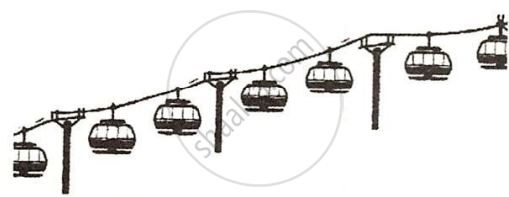
The distance of the first pole from the base point is 200 m and subsequent poles are installed at an equal interval of 150 m. Further, the distance of the last pole from the top is 300 m.
Based on the above information, answer the following questions using arithmetic progression:
- Find the distance of the 10th pole from the base.
- Find the distance between the 15th pole and the 25th pole.
- Find the time taken by the cable car to reach the 15th pole from the top if it is moving at the speed of 5 m/sec and coming from the top.
A school auditorium is to be constructed to accommodate at least 1500 people. The chairs are to be placed in a concentric circular arrangement in such a way that each succeeding circular row has 10 seats more than the previous one.
(i) If the first circular row has 30 seats, how many seats will the \(10^{\text {th }}\) row have?
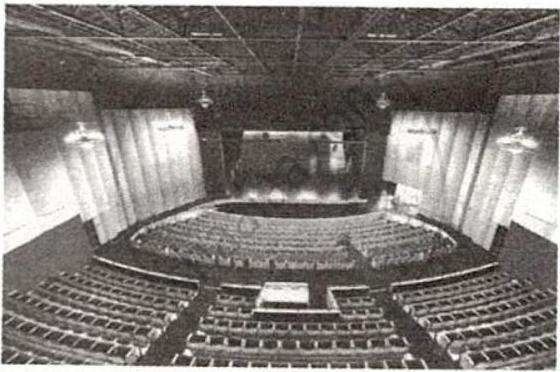
(ii) For 1,500 seats in the auditorium, how many circular rows need to be there?
(iii) If there were 17 rows in the auditorium, how many seats will be there in the middle row?
The figure shows a big triangle in which multiple other triangles can be seen. Observe the pattern of dark shaded and light unshaded triangles starting with one triangle in row 1, three triangles in row 2, five triangles in row 3 and so on.
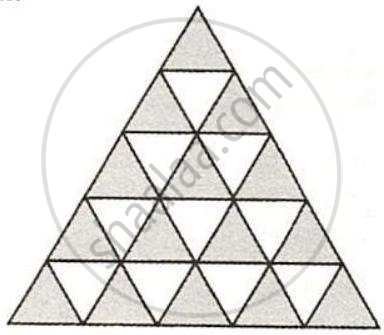
Based on the above information, answer the following questions:
- How many triangles will be there in the 15th row?
- In which row will the number of triangles be 47?
- The number of dark shaded triangles in each row are in A.P. Find the total number of dark shaded triangles in the first 15 rows.
Solutions for 10: Arithmetic Progression
Selina solutions for Concise Mathematics [English] Class 10 ICSE chapter 10 - Arithmetic Progression
Shaalaa.com has the CISCE Mathematics Concise Mathematics [English] Class 10 ICSE CISCE solutions in a manner that help students grasp basic concepts better and faster. The detailed, step-by-step solutions will help you understand the concepts better and clarify any confusion. Selina solutions for Mathematics Concise Mathematics [English] Class 10 ICSE CISCE 10 (Arithmetic Progression) include all questions with answers and detailed explanations. This will clear students' doubts about questions and improve their application skills while preparing for board exams.
Further, we at Shaalaa.com provide such solutions so students can prepare for written exams. Selina textbook solutions can be a core help for self-study and provide excellent self-help guidance for students.
Concepts covered in Concise Mathematics [English] Class 10 ICSE chapter 10 Arithmetic Progression are Arithmetic Mean in A.P., Sequence, Series, and Progression, Arithmetic Progression (A.P.), General Term (nth) of an Arithmetic Progression, Sum of First ‘n’ Terms of an Arithmetic Progressions, Three or More Terms in Arithmetic Progression (A.P.), Properties of an Arithmetic Progression, Arithmetic Mean in A.P., Sequence, Series, and Progression, Arithmetic Progression (A.P.), General Term (nth) of an Arithmetic Progression, Sum of First ‘n’ Terms of an Arithmetic Progressions, Three or More Terms in Arithmetic Progression (A.P.), Properties of an Arithmetic Progression, Arithmetic Mean in A.P., Sequence, Series, and Progression, Arithmetic Progression (A.P.), General Term (nth) of an Arithmetic Progression, Sum of First ‘n’ Terms of an Arithmetic Progressions, Three or More Terms in Arithmetic Progression (A.P.), Properties of an Arithmetic Progression.
Using Selina Concise Mathematics [English] Class 10 ICSE solutions Arithmetic Progression exercise by students is an easy way to prepare for the exams, as they involve solutions arranged chapter-wise and also page-wise. The questions involved in Selina Solutions are essential questions that can be asked in the final exam. Maximum CISCE Concise Mathematics [English] Class 10 ICSE students prefer Selina Textbook Solutions to score more in exams.
Get the free view of Chapter 10, Arithmetic Progression Concise Mathematics [English] Class 10 ICSE additional questions for Mathematics Concise Mathematics [English] Class 10 ICSE CISCE, and you can use Shaalaa.com to keep it handy for your exam preparation.
