Advertisements
Online Mock Tests
Chapters
1: The First War of Independence, 1857
2: Growth of Nationalism
3: First Phase of the Indian National Movement
4: Second Phase of the Indian National Movement
5: The Muslim League
2. MASS PHASE OF THE NATIONAL MOVEMENT (1915-1947)
6: Mahatma Gandhi and the National Movement
7: The Quit India Movement
8: Forward Bloc and The INA
9: Independence and Partition of India
3. THE CONTEMPORARY WORLD
10: The First World War
11: Rise of Dictatorships
12: The Second World War
▶ 13: United Nations
14: Major Agencies of the United Nations
15: Non-Aligned Movement
SECTION B - CIVICS : 1. THE UNION LEGISLATURE
1: The Union Parliament-I
2: The Union Parliament-II
2. THE UNION EXECUTIVE
3: The President and The Vice-President
4: Prime Minister and Council of Ministers
3. THE JUDICIARY
5: The Supreme Court
6: The High Courts and Subordinate Courts
![Morning Star solutions for Total History and Civics [English] Class 10 ICSE chapter 13 - United Nations - Shaalaa.com](/images/total-history-and-civics-english-class-10-icse_6:5245755610f545c08dc24e700b430f63.jpg "Morning Star solutions for Total History and Civics [English] Class 10 ICSE chapter 13 - United Nations")
Advertisements
Solutions for Chapter 13: United Nations
Below listed, you can find solutions for Chapter 13 of CISCE Morning Star for Total History and Civics [English] Class 10 ICSE.
Morning Star solutions for Total History and Civics [English] Class 10 ICSE 13 United Nations EXERCISES [Pages 167 - 170]
Multiple-Choice Questions Select the correct option.
Which of the following was NOT a reason for the establishment of the United Nations?
Disastrous World Wars
Division of the World into Three Blocks
Stockpiling of Destructive weapons
Fear of the Third World War
Which of the following was NOT a purpose of the United Nations?
To develop friendly relations among nations.
To achieve national cooperation in solving problems.
To maintain international peace and security.
To be a centre for harmonising the actions of nations.
Which of the following is NOT part of the new objectives set by the UN?
Disarmament
Decolonisation
Disintegration
Development
Which of the following is NOT a principle of the United Nations?
To respect the sovereign equality of all its members.
All members should settle their international disputes by peaceful means.
The UN shall intervene in the domestic (internal) affairs of the state.
None of the above.
Which of the following statements are true about the UN?
P: The main purpose is to maintain international peace at all costs.
Q: The UN aims to develop friendly relations among nations.
R: All the organs of the UN are located at Paris.
S: The expenditure of the UN is met by contributions from member States.
P and Q
Q and R
R and S
Q and S
Name the main body of the UN.
The General Assembly
The Trusteeship Council
The International Court of Justice
The Security Council
Which Principal organ is the executive body of the UN?
The General Assembly
The Trusteeship Council
The International Court of Justice
The Security Council
Which of the following describes the flag of the UN?
The star sprangled banner
The Indian tricolour
Light blue with the UN emblem in white
Collage of flags of all member states
Which of the following is NOT a part of Article 1 of the Universal Declaration of Human Rights?
All human beings are born free and equal in dignity and rights.
All human beings are endowed with reason and conscience.
They should followed different rights based on their culture.
They should act towards one another in a spirit of brotherhood.
Select the option that shows the correct relationship between Statements (I) and (II).
(I) The United Nations Organisation (UNO) was established on October 24, 1945.
(II) The bitter experience of two World Wars within a span of 25 years made the world leaders realise the need for having an organisation to maintain peace in the world.
(II) contradicts (I).
(II) is the reason for (I).
(I) is true, but (II) is false.
(I) and (II) are independent of each other.
Select the option that shows the correct relationship between Statements (I) and (II).
(I) The League of Nations and the United Nations were established to prevent wars and to maintain peace in the world.
(II) Both the League of Nations and the United Nations were formed after the First World War.
(II) contradicts (I).
(II) is the reason for (I).
(I) is true, but (II) is false.
(I) and (II) are independent of each other.
Select the option that shows the correct relationship between Statements (I) and (II).
(I): Disarm, decolonise and develop are the three objectives of the UN.
(II): The Security Council’s primary responsibility is the maintenance of international peace and security.
(II) contradicts (I).
(II) is the reason for (I).
(I) is true, but (II) is false.
(I) and (II) are independent of each other.
Select the option that shows the correct relationship between Statements (I) and (II).
(I) Human Rights are the basic freedoms that should be enjoyed by every human being.
(II) Much of the UN’s work is based on the Universal Declaration of Human Rights.
(II) contradicts (I).
(II) is the reason for (I).
(I) is true, but (II) is false.
(I) and (II) are independent of each other.
Select the option that shows the correct relationship between Statements (I) and (II).
(I) The General Assembly is the main deliberative organ of the UN.
(II) The General Assembly elects the non-permanent members of the Security Council, the Economic and Social Council and the Trusteeship Council.
(II) contradicts (I).
(II) is the reason for (I).
(I) is true, but (II) is false.
(I) and (II) are independent of each other.
Select the option that shows the correct relationship between Statements (I) and (II).
(I) The Security Council’s five permanent members have the veto power.
(II) If a permanent member abstains from voting, it does not amount to a veto.
(II) contradicts (I).
(II) is the reason for (I).
(I) is true, but (II) is false.
(I) and (II) are independent of each other.
Short Answer Questions
Read the excerpt given below and answer the questions that follow:
| Fifty Nations Charter The Rights of Man Peace By Strength |
With reference to the above headline in the Daily Mail dated June, 1945, which incident is being referred to and what was its final outcome?
Why did world leaders decide to set up a world organisation to maintain peace?
When was the term ‘United Nations’ used for the first time?
Where was the UN established?
Mention any two main aims of the United Nations.
Which day is celebrated as the UN Day every year?
Where the headquarter of United Nations located?
Who can become the member of U. N. O.?
Who appoints the Secretary General of the United Nations?
Who is the present Secretary-General of the UN?
Name the principal organs of the United Nations.
What can the General Assembly do if the Security Council fails to act in a case where there appears to be a threat to peace?
Name the five permanent members of the security council.
Where is the permanent headquarters of the International Court of Justice located?
What is the importance of the International Court of Justice?
Structured Questions
The United Nations, its specialised agencies and staff have been awarded the Nobel Peace Prize 12 times. These include Secretary General Dag Hammarskjold (1961) and Kofi Annan (2001). With reference to the functioning of the United Nations, briefly answer the following:
- State the objectives of the UN.
- Mention the principles of the UN for its members.
- State any four functions of the UN.
With reference to the General Assembly, explain the following:
- Composition of the General Assembly.
- Its role in the promotion of international cooperation.
- Any four of its functions.
The Security Council is the most important and effective organ of the UN. In this context describe.
- Composition of the Security Council.
- Veto power.
- Four of its functions.
With reference to the International Court of Justice, explain the following:
- Its Composition.
- Its Compulsory Jurisdiction.
- Its Advisory Jurisdiction.
With reference to the Universal Declaration of Human Rights, answer the following questions:
- Why was it necessary to bring about the Universal Declaration of Human Rights?
- What is the importance of Articles 1 and 2 of the Universal Declaration of Human Rights?
- Give three reasons for the importance of Human Rights today.
Study the given picture and answer the questions:

- Identify the organisation associated with the emblem. Mention any three principles of this organisation.
- Where is the headquarters of this organisation located? Which is the main deliberative organ of this organisation? State any three of its functions.
- Name the principal judicial organ of this organisation and explain its composition.
Study the picture and answer the following questions:
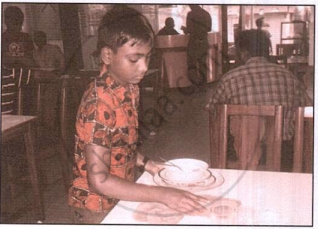
- What does the picture depict? How is it a violation of Human Rights?
- Give three examples of Human Rights violation which children are subjected to.
- What role does the Universal Declaration of Human Rights play in protecting Human Rights?
Higher Order Thinking Skills (HOTS)
Do you think the UN has justified the role for which it was established in 1945, considering the recent wars between Ukraine and Russia and Iran and Israel? Give reasons to support your answer.
Do you think that in the changed global scenario, the Security Council should add more permanent members? Give reasons to support your answer.
Solutions for 13: United Nations
Morning Star solutions for Total History and Civics [English] Class 10 ICSE chapter 13 - United Nations
Shaalaa.com has the CISCE Mathematics Total History and Civics [English] Class 10 ICSE CISCE solutions in a manner that help students grasp basic concepts better and faster. The detailed, step-by-step solutions will help you understand the concepts better and clarify any confusion. Morning Star solutions for Mathematics Total History and Civics [English] Class 10 ICSE CISCE 13 (United Nations) include all questions with answers and detailed explanations. This will clear students' doubts about questions and improve their application skills while preparing for board exams.
Further, we at Shaalaa.com provide such solutions so students can prepare for written exams. Morning Star textbook solutions can be a core help for self-study and provide excellent self-help guidance for students.
Concepts covered in Total History and Civics [English] Class 10 ICSE chapter 13 United Nations are Reasons for the Establishment of the United Nations, The United Nations: Foundation, Objectives, and Global Framework, Organs of the United Nations > The General Assembly, Organs of the United Nations >The Security Council, Organs of the United Nations >International Court of Justice, Major Organs of the United Nations, Reasons for the Establishment of the United Nations, The United Nations: Foundation, Objectives, and Global Framework, Organs of the United Nations > The General Assembly, Organs of the United Nations >The Security Council, Organs of the United Nations >International Court of Justice, Major Organs of the United Nations.
Using Morning Star Total History and Civics [English] Class 10 ICSE solutions United Nations exercise by students is an easy way to prepare for the exams, as they involve solutions arranged chapter-wise and also page-wise. The questions involved in Morning Star Solutions are essential questions that can be asked in the final exam. Maximum CISCE Total History and Civics [English] Class 10 ICSE students prefer Morning Star Textbook Solutions to score more in exams.
Get the free view of Chapter 13, United Nations Total History and Civics [English] Class 10 ICSE additional questions for Mathematics Total History and Civics [English] Class 10 ICSE CISCE, and you can use Shaalaa.com to keep it handy for your exam preparation.
