Advertisements
Online Mock Tests
Chapters
1: The First War of Independence, 1857
2: Growth of Nationalism
3: First Phase of the Indian National Movement
4: Second Phase of the Indian National Movement
5: The Muslim League
2. MASS PHASE OF THE NATIONAL MOVEMENT (1915-1947)
6: Mahatma Gandhi and the National Movement
7: The Quit India Movement
8: Forward Bloc and The INA
9: Independence and Partition of India
3. THE CONTEMPORARY WORLD
10: The First World War
11: Rise of Dictatorships
12: The Second World War
13: United Nations
14: Major Agencies of the United Nations
15: Non-Aligned Movement
SECTION B - CIVICS : 1. THE UNION LEGISLATURE
1: The Union Parliament-I
2: The Union Parliament-II
2. THE UNION EXECUTIVE
▶ 3: The President and The Vice-President
4: Prime Minister and Council of Ministers
3. THE JUDICIARY
5: The Supreme Court
6: The High Courts and Subordinate Courts
![Morning Star solutions for Total History and Civics [English] Class 10 ICSE chapter 3 - The President and The Vice-President - Shaalaa.com](/images/total-history-and-civics-english-class-10-icse_6:5245755610f545c08dc24e700b430f63.jpg "Morning Star solutions for Total History and Civics [English] Class 10 ICSE chapter 3 - The President and The Vice-President")
Advertisements
Solutions for Chapter 3: The President and The Vice-President
Below listed, you can find solutions for Chapter 3 of CISCE Morning Star for Total History and Civics [English] Class 10 ICSE.
Morning Star solutions for Total History and Civics [English] Class 10 ICSE 3 The President and The Vice-President EXERCISES [Pages 224 - 229]
Multiple-Choice Questions
Which of the following statements about the President of India are correct?
P: The President is the supreme commander of the Defence Forces.
Q: The President exercises all powers according to his/her own discretion.
R: The President exercises his/her powers on the advice of the Prime Minister.
S: The executive power of the Indian Union is vested in the Parliament.
P and Q
P and R
P and S
S and R
Identify the qualifications necessary for a person to be eligible for election as President of India.
P: Has completed the age of twenty-five years.
Q: Is qualified to be a member of the Lok Sabha.
R: Is a citizen of India.
S: Is a member of a Political Party.
Q and R
P and R
S and R
P and Q
Identify the officials who form the electoral college for the election of the President of India.
P: The elected members of both Houses of Parliament.
Q: The elected members of the Legislative Assemblies of the States.
R: Nominated members of Parliament.
S: Nominated members of Legislative Assemblies
P and Q
R and S
P and R
Q and S
Which of the following statements about the President of India are correct?
P: The President of India holds office for a term of six years.
Q: The President of India may submit his resignation to the Vice-President of India.
R: The President of India can be removed from office for the violation of the Constitution.
S: The President of India has the power of selecting the Council of Ministers.
P and S
Q and S
Q and R
Q and P
Identify the Legislative Powers of the President of India.
P: The President summons and prorogues the Houses of Parliament.
Q: The President can dissolve the Lok Sabha and order fresh elections.
R: The President can nominate two members from the Anglo-Indian Community to the Lok Sabha.
S: The President appoints the Governors of the States.
R and S
P and R
Q and S
P and Q
Identify the Emergency Powers of the President of India.
P: The President can proclaim a national emergency if there is a natural calamity.
Q: The President can proclaim a national emergency if an epidemic breaks out.
R: The President can proclaim a national emergency if there is a danger of foreign aggression, civil war, insurgency or any other cause.
S: The President can proclaim a Financial Emergency if there is a setback to the financial stability of the country.
P and S
R and S
R and Q
P and R
The power to summon Parliament is subject to the condition that there should not be a gap of more than ______ months between two session of each house.
Four
Six
Three
Nine
For how long can a President’s rule be imposed in a state?
1 month
2 months
6 months
3 months
Who administers the oath of office to the President of India?
Comptroller and Auditor General of India
Prime Minister of India
Chief Justice of India
Judge of the Supreme Court
Select an Executive Function of the President of India.
Issuing ordinances.
Appointing the Prime Minister.
Granting assent to bills passed by Parliament.
Addressing the nation on Independence Day.
Read the excerpt given below:
|
The 14th Vice-President of India leaves office with two years left in his term; the decision comes on the first day of the Monsoon Session of Parliament; stepping down to abide by medical advice, he says. - The Hindu, July 22, 2025 |
What is the normal duration of ‘his term’ in years?
Four
Five
Six
Threе
The Election Commission had announced the schedule for the seventeenth Vice Presidential Election vide its Press Note dated 1st August, 2025, fixing inter alia September 9, 2025, as the date of poll and date of counting. Identify the officials who form the electoral college for the election.
P: Members of Lok Sabha.
Q: Members of State Legislative Assemblies
R: Members of the State Legislative Council
S: Members of the Rajya Sabha.
P and S
P and Q
R and S
Q and S
Read the excerpt given below:
|
CP Radhakrishnan elected as Vice President of India. - DD News, September 9, 2025 |
Which of the following statements about the Vice-President of India are correct?
P: Is the ex officio Chairman of the Lok Sabha.
Q: Holds office for a term of five years.
R: Can be removed as the Vice-President by the process of impeachment.
S: Gets a salary as the Vice-President of India.
P and Q
Q and S
R and S
Q and R
Ms Anita Singh’s nomination for the election as the Vice-President of India was rejected even though she had the qualifications of being a citizen of India and not being a member of the Parliament and State Legislature. On what ground was she disqualified?
For being below the age of thirty-five.
For being qualified to be a Member of Parliament.
For not holding an office of profit.
For her mother, not being a citizen of India.
Select the option that shows the correct relationship between Statements I and II.
(I) No Bill can become a law without the assent and the signature of the Prime Minister.
(II) Money Bills can be introduced only on the recommendation of the President.
(I) is true, but (II) is false.
(I) is false, but (II) is true.
Both (I) and (II) are true, but (II) is not the correct explanation of (I).
Both (I) and (II) are false.
Select the option that shows the correct relationship between Statements I and II.
(I) The President of India can dissolve the Lok Sabha and the Rajya Sabha and order fresh elections.
(II) The President of India has the power to summon both the Houses of Parliament after a gap of more than six months.
(I) is true, but (II) is false.
(I) is false, but (II) is true
Both (I) and (II) are true, but (II) is not the correct explanation of (I).
Both (I) and (II) are false.
Select the option that shows the correct relationship between Statements I and II.
(I) The President uses discretionary judgment to appoint the Prime Minister when no party has a clear majority in the Parliament.
(II) The President cannot appoint a new Prime Minister on the advice of the outgoing Prime Minister, who may have lost the election or the support of the House.
(I) is true, but (II) is false
(I) is false, but (II) is true.
Both (I) and (II) are true, but (II) is not the correct explanation of (I).
Both (I) and (II) are false.
Short Answer Questions
Name the body as well as the process involved in the election of the President.
Why is the President elected by indirect elections?
How can the President vacate his/her office?
On what grounds can the President of India be removed from office?
Mention the occasion when the President addresses both the Houses of Parliament assembled together.
The newspaper clipping announces the declaration of a national emergency. What happens when such an emergency is declared?
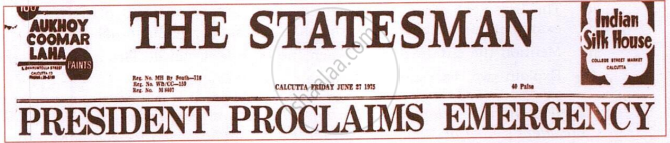
Read the following headline that appeared in The Economic Times, April 23, 2020 and answer the question that follow:
| “COVID-19: Prez Ram Nath Kovind gives nod for promulgating ordinance to punish those attacking healthcare workers.” |
Under which conditions can the President promulgate an Ordinance?
|
The President of India, Smt Droupadi Murmu, accepted credentials from the Ambassadors/High Commissioners of the Dominican Republic, Timor-Leste, Sri Lanka and the Gabonese Republic at a ceremony held at Rashtrapati Bhavan today (July 29, 2025). - Press Information Bureau |
Identify the power of the President of India referred in this press note. Give another example of this power.
How is the Vice-President of India elected?
How long can the Vice-President continue to hold office even after the expiry of his/her term?
How can the Vice-President of India be removed from his office?
State the power of Vice-President as the ex-officio Chairman of the Rajya Sabha.
Mention the ways in which the Vice-President’s office is a unique feature of the Indian Constitution.
The excerpt given below shows which feature of the Indian Constitution: Unitary or Federal? Give a reason to support your answer.
|
The Raj Bhavan (Kerala), in an official communication, said, “Hon’ble President of India has withheld assent to the following Bills which Hon’ble Governor Shri Arif Mohammed Khan had referred to Rashtrapati Bhavan for consideration...Of the seven bills that Governor Arif Mohammed Khan referred to Rashtrapati Bhavan in November last year, assent has been accorded to only one Bill, namely, the Kerala Lokayukta Amendment Bill 2022. Decision on the other three Bills is awaited.” - Indian Express February 29, 2024 |
Structured Questions
The President of India enjoys vast powers. In this context, briefly explain:
- Any three of his/her Executive Powers.
- Any three of his/her Legislative Powers.
- Any two of his/her Judicial Powers.
According to Dr. Ambedkar, “The President represents the nation but does not rule the nation.” In this context, answer the following questions:
- The President of India is referred to as the nominal head of the State. State two examples of his legislative powers that suggest his nominal status.
- Mention the circumstances when the President can declare a national emergency.
- Explain two discretionary Powers of the President.
| Parliament has adopted a Statutory Resolution confirming the imposition of the President’s Rule in Manipur, with the Rajya Sabha giving its nod early this morning. The Statutory Resolution is related to the Proclamation issued by the President on the 13th of February this year (2025) under Article 356(1) of the Constitution in relation to Manipur. The Lok Sabha has already approved it. |
In this context, answer the following questions:
- What is referred to as President’s Rule? When can it be proclaimed?
- What is the duration of such an emergency? State two conditions under which such an emergency can be extended beyond one year.
- State the effect of the emergency on the administration of the State.
|
President Droupadi Murmu has given her assent to the Promotion and Regulation of Online Gaming Bill. - News on Air, August 22, 2025 |
- What happens after this ‘assent’? What procedure has the bill followed till this stage?
- Briefly describe two legislative functions of the President.
- Briefly describe three executive functions og the Head of State.
Study the picture given below and answer the questions that follow:
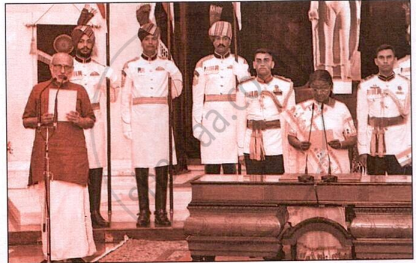
- Who is administering the oath of office, and to whom?
- State the qualifications necessary to become the Vice-President of India.
- How does the Vice-President act as the ex-office Chairman of the Rajya Sabha?
Higher Order Thinking Skills (HOTS)
Suppose you have a penfriend who lives in Los Angeles in the USA. He/She wants to know the difference in powers of the Presidents of India and the USA. Tell him/her the differences and also who has more powers.
Suppose riots break out in your State and there is a break down of law and order. What will the Governor of your State do and what will be its consequences?
There are a few areas where the President of India can act at his/her discretion. Thus proving that the President of India is not a rubber stamp at all. Give your views on this statement by giving examples from the past.
Solutions for 3: The President and The Vice-President
Morning Star solutions for Total History and Civics [English] Class 10 ICSE chapter 3 - The President and The Vice-President
Shaalaa.com has the CISCE Mathematics Total History and Civics [English] Class 10 ICSE CISCE solutions in a manner that help students grasp basic concepts better and faster. The detailed, step-by-step solutions will help you understand the concepts better and clarify any confusion. Morning Star solutions for Mathematics Total History and Civics [English] Class 10 ICSE CISCE 3 (The President and The Vice-President) include all questions with answers and detailed explanations. This will clear students' doubts about questions and improve their application skills while preparing for board exams.
Further, we at Shaalaa.com provide such solutions so students can prepare for written exams. Morning Star textbook solutions can be a core help for self-study and provide excellent self-help guidance for students.
Concepts covered in Total History and Civics [English] Class 10 ICSE chapter 3 The President and The Vice-President are Powers of the President of India > Diplomatic Powers, Powers of the President of India > Legislative Powers, Powers of the President of India > Financial Powers, Powers of the President of India > Military Powers, Powers of the President of India > Judicial Powers, Powers of the President of India > Discretionary Powers, Powers of the President of India > Emergency Powers, The President of India, Qualifications for Election as President, Composition of the Electoral College, Manner of Election, Reasons for Indirect Election, Procedure for Impeachment of the President, Powers of the President of India > Executive Powers, The Vice-President, Powers and Functions of the Vice-President of India, Powers of the President of India > Diplomatic Powers, Powers of the President of India > Legislative Powers, Powers of the President of India > Financial Powers, Powers of the President of India > Military Powers, Powers of the President of India > Judicial Powers, Powers of the President of India > Discretionary Powers, Powers of the President of India > Emergency Powers, The President of India, Qualifications for Election as President, Composition of the Electoral College, Manner of Election, Reasons for Indirect Election, Procedure for Impeachment of the President, Powers of the President of India > Executive Powers, The Vice-President, Powers and Functions of the Vice-President of India, Powers of the President of India > Diplomatic Powers, Powers of the President of India > Legislative Powers, Powers of the President of India > Financial Powers, Powers of the President of India > Military Powers, Powers of the President of India > Judicial Powers, Powers of the President of India > Discretionary Powers, Powers of the President of India > Emergency Powers, The President of India, Qualifications for Election as President, Composition of the Electoral College, Manner of Election, Reasons for Indirect Election, Procedure for Impeachment of the President, Powers of the President of India > Executive Powers, The Vice-President, Powers and Functions of the Vice-President of India.
Using Morning Star Total History and Civics [English] Class 10 ICSE solutions The President and The Vice-President exercise by students is an easy way to prepare for the exams, as they involve solutions arranged chapter-wise and also page-wise. The questions involved in Morning Star Solutions are essential questions that can be asked in the final exam. Maximum CISCE Total History and Civics [English] Class 10 ICSE students prefer Morning Star Textbook Solutions to score more in exams.
Get the free view of Chapter 3, The President and The Vice-President Total History and Civics [English] Class 10 ICSE additional questions for Mathematics Total History and Civics [English] Class 10 ICSE CISCE, and you can use Shaalaa.com to keep it handy for your exam preparation.
