Advertisements
Online Mock Tests
Chapters
1: The First War of Independence, 1857
2: Growth of Nationalism
3: First Phase of the Indian National Movement
▶ 4: Second Phase of the Indian National Movement
5: The Muslim League
2. MASS PHASE OF THE NATIONAL MOVEMENT (1915-1947)
6: Mahatma Gandhi and the National Movement
7: The Quit India Movement
8: Forward Bloc and The INA
9: Independence and Partition of India
3. THE CONTEMPORARY WORLD
10: The First World War
11: Rise of Dictatorships
12: The Second World War
13: United Nations
14: Major Agencies of the United Nations
15: Non-Aligned Movement
SECTION B - CIVICS : 1. THE UNION LEGISLATURE
1: The Union Parliament-I
2: The Union Parliament-II
2. THE UNION EXECUTIVE
3: The President and The Vice-President
4: Prime Minister and Council of Ministers
3. THE JUDICIARY
5: The Supreme Court
6: The High Courts and Subordinate Courts
![Morning Star solutions for Total History and Civics [English] Class 10 ICSE chapter 4 - Second Phase of the Indian National Movement - Shaalaa.com](/images/total-history-and-civics-english-class-10-icse_6:5245755610f545c08dc24e700b430f63.jpg "Morning Star solutions for Total History and Civics [English] Class 10 ICSE chapter 4 - Second Phase of the Indian National Movement")
Advertisements
Solutions for Chapter 4: Second Phase of the Indian National Movement
Below listed, you can find solutions for Chapter 4 of CISCE Morning Star for Total History and Civics [English] Class 10 ICSE.
Morning Star solutions for Total History and Civics [English] Class 10 ICSE 4 Second Phase of the Indian National Movement EXERCISES [Pages 61 - 65]
Multiple-Choice Questions Select the correct option.
What measure did Lord Curzon take to reduce the ‘influence of Bengal’?
Partition of Bengal
Swadeshi Movement
Boycott Movement
Bengal Land Act
The Partition of Bengal was annuled and a new scheme was implemented on which grounds?
Religious
Linguistic
Cultural
Traditional
Both Early Nationalists and Assertive Nationalists spoke, wrote articles, and edited newspapers. Which section had a wider reach and why?
Early Nationalists because they were well educated.
Early Nationalists because they held official positions.
Assertive Nationalists because they used Vernacular press as a medium.
Assertive Nationalists because they used English language as a medium.
Assertive Nationalists adopted the policy of ______ to oppose the unjust acts of the British.
Entreat and beseech
Non-cooperation
Passive redressal
Prayers and petitions
Which of the following international events led to the rise of Assertive Nationalism?
Victory of Japan over Russia
Defeat of Britain in the Anglo-Afghan Wars
Defeat of France in Ethopia
Defeat of Germany in South Africa
Early Nationalists : Ideas of western philosophers : : Assertive Nationalists : .....?......
Ideas of eastern philosophers
Ideas of Swadeshi
Ideas of Karl Marx
India’s past
Early Nationalists : Educated middle class : : Assertive Nationalists : ......?.......
Youth and women
The British nationals in India
The masses
The Civil servants
Select the option that shows the correct relationship between Statements (I) and (II).
(I) Bengal, according to the British, was too big to be efficiently administered by a single provincial government.
(II) The British wanted to stop the rising tide of nationalism by partitioning Bengal.
(II) contradicts (I).
(II) is the reason for (I).
(I) is true, but (II) is false.
(I) and (II) are independent of each other.
Select the option that shows the correct relationship between Statements (I) and (II).
(I) The Anti-Partition movement popularised the idea of Swadeshi and Boycott being complementary, and one would not succeed without the other.
(II) The Assertive Nationalist leaders were expelled from the Congress at the Surat session in 1907.
(II) contradicts (I).
(II) is the reason for (I).
(I) is true, but (II) is false.
(I) and (II) are independent of each other.
Select the option that shows the correct relationship between Statements (I) and (II).
(I) The Early Nationalists did not want to extend support to the boycott movement.
(II) Boycott was in conflict with their policy of ‘petition and persuasion.’
(II) contradicts (I).
(II) is the reason for (I).
(I) is true, but (II) is false.
(I) and (II) are independent of each other.
Select the option that shows the correct relationship between Statements (I) and (II).
(I) Lord Curzon refused to concede to the demands of annulling the Partition of Bengal.
(II) The administrative capital of British India was shifted from Kolkata to Delhi in 1911.
(II) contradicts (I).
(II) is the reason for (I).
(I) is true, but (II) is false.
(I) and (II) are independent of each other.
Select the option that shows the correct relationship between Statements (I) and (II).
(I) The Partition of Bengal was revoked in 1911.
(II) A new scheme of the partition of Bengal was implemented on the basis of the size of the population rather than on religion.
(II) contradicts (I).
(II) is the reason for (I).
(I) is true, but (II) is false.
(I) and (II) are independent of each other.
Select the option that shows the correct relationship between Statements (I) and (II).
(I) The failure of the Early Nationalists to achieve something substantial from the British government led to the demand for more vigorous political action.
(II) The Assertive Nationalists advocated active resistance to British imperialism.
(II) contradicts (I).
(I) is the reason for (II).
(I) is true, but (II) is false.
(I) and (II) are independent of each other.
Select the option that shows the correct relationship between Statements (I) and (II).
(I) The Assertive Nationalists wanted immediate attainment of Swaraj or complete independence as it existed in the United Kingdom.
(II) The Early Nationalists wanted to achieve self-government and autonomy within the Empire and not complete independence.
(II) contradicts (I).
(II) is the reason for (I).
(I) is true, but (II) is false.
(I) and (II) are independent of each other.
Short Answer Questions
Who wrote the Vande Mataram?
State the reaction of the masses to the proclamation of the Partition of Bengal.
Read the excerpt given below and answer the question that follows:
|
Tagore’s ‘Banglar mati, Banglar jol’, and the sentiment of brotherhood and patriotism that it invokes In 1905, Curzon partitioned Bengal on communal lines, which Rabindranath Tagore opposed strongly, and wrote a hymn for communal harmony, brotherhood, and united Bengali identity. The TMC government has now declared ‘Banglar mati, Banglar jol’ the state anthem. The song calls for unity for all Bengalis by invoking the beauty of Bengal - its natural environs, its language, its people, and its soul. This is perhaps best expressed in the final stanza of the song, which is loosely translated as: The soil of Bengal, the water of Bengal; The air of Bengal, the fruit of Bengal; Let them be blessed; Oh my Lord. [All] Bengalis’ life, [all] Bengalis’ soul; All brothers and sisters in Bengal’s homes; may they be united; Oh my Lord - Indian Express, September 9, 2023 |
- What official reason did Lord Curzon give for partitioning Bengal?
- Name another song composed by Rabindranath Tagore during the Anti-partition agitation.
Who were Assertive Nationalists? Why were they so called?
What was the aim of the Assertive Nationalists as far as the National Movement was concerned? How did it differ from that of the Early Nationalists?
How did the Assertive Nationalists expand the social base of the National Movement?
What were the two methods adopted by the Assertive Nationalists in the freedom struggle?
Mention any two causes for the rise of Assertive Nationalism.
Why did the educated Indians turn against the British?
List any two international events that shattered the myth of European superiority.
Mention any two measures that show that Lord Curzon’s policies were repressive.
Name the two books written by Bal Gangadhar Tilak.
When and why did Tilak leave the Indian National Congress?
Why did Tilak revive Ganapati and Shivaji festivals?
Mention any two contributions of Bipin Chandra Pal?
Mention any two achievements of the Assertive Nationalists.
Structured Questions
Read the excerpt given below and answer the questions that follow:
| Rabindranath Tagore endorsed the Swadeshi movement through his songs and poems. There was a change in his attitude as noted by Sumit Sarkar in his book, Swadeshi Movement in Bengal. He says: “[From] trying in vain to placate the foreign ruler and talking big in a foreign tongue, he (Tagore) urges volunteers to the villages instead, spreading social and political enlightenment in the melas and through magic lantern lectures, and, above all, to revive our traditional samaj, channelling all constructive work through it once again.” |
- What was the impact of the Anti-Partition Movement?
- How did the people react to the Partition of Bengal?
- What was Lord Curzon’s argument in favour of the Partition of Bengal? How did the nationalists interpret Lord Curzon’s motives?
In the second phase of the national movement, there emerged a new younger group of leaders within the Congress who did not agree with the old leadership. In this context, answer the following questions:
- Explain how the repressive policies of Lord Curzon and influence of International events led to the Assertive nationalism.
- Name the Assertive Nationalist leader who was wounded when he was leading a protest against the Simon Commission. How were his words, when he was wounded, prophetic?
- Differentiate between the Early Nationalists and the Assertive Nationalists in their objectives and achievements, stating one objective and two achievements of each wing of the Congress.
With reference to the Surat Split of 1907, answer the following questions:
- What were the issues on which the two wings of Congress had differences of opinion? How did the British exploit the differences between the Early Nationalists and the Assertive Nationalists?
- What was the effect of the split between the two wings of Congress on the National Movement?
- Why did the Assertive Nationalists adopt the policy of non-cooperation with the British Government? Name the Assertive Nationalist leader who organised akharas and lathi clubs. Why were these organised?
Read the excerpt given below and answer the questions that follow:
|
“You will have observed the word ‘boycott’ attached to the word ‘movement'. It means that it shall move, move from point to point, move from city to city, move from division to division, move from province to province, till we realise the highest destiny of our people as a nation in the comity of nations. I mean swaraj.” - Bipin Chandra Pal, 1906 Calcutta Session of the Congress |
- Mention Bipin Chandra Pal’s political aims.
- State his ideas on National Education.
- What remedies did he propose to eradicate India’s poverty and unemployment?
Read the excerpt given below and answer the questions that follow:
|
It is a mistake to suppose that the Swadeshi movement requires sacrifice from poor people. We, the middle classes, are the greatest offenders in this respect. The poor Kumbi villagers require not many foreign articles at all, probably none at all. It is we, the middle classes, who are the consumers of foreign goods; and since this Government is not going to stop the drain by imposing a protective duty, it becomes imperatively necessary to adopt a measure by which we can do ourselves what the Government is bound to do and what the government ought to have done long ago. That one point was self-help, another point was determination, and the third was sacrifice. You will find that all this is included in this resolution, joined with the declaration made in the Presidential address that Swadeshism is a forced necessity in India owing to unnatural economic conditions in India, makes up a complete case for you. I trust that the resolution of self-help adopted this year will form the basis of other resolutions of self-help in years to come. -Bal Gangadhar Tilak (At the 1906 session of the Indian National Congress, where the resolution on Swadeshi was moved.) |
- What was the main aim of ‘Swadeshi’ as referred to in the extract? How does it relate to a boycott?
- What are the reasons for focussing on Swadeshi?
- In what ways is the speaker of this extract the forerunner of Gandhiji?
Study the pictures given below and answer the questions that follow:
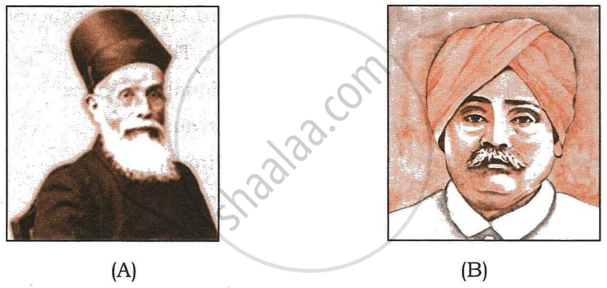
- Identify the persons ‘A’ and ‘B’ given above. To which section of the Congress did each belong, and what were their ultimate objectives?
- State three different methods of struggle adopted by each section of the Congress.
- State two contributions of persons ‘A’ and ‘B’ to the freedom struggle.
Higher Order Thinking Skills (HOTS)
Imagine you are a young boy of 10 years living in Kolkata in 1905. Describe the Anti-Partition Movement as you saw it.
What would have happened in case the Surat Split did not occur and the Assertive Nationalists were suppressed?
Is the Swadeshi Movement on a path to revival with the ‘Make in India’ scheme launched by the Indian government? List initiatives that aim at making India self-reliant and a global leader.
Solutions for 4: Second Phase of the Indian National Movement
Morning Star solutions for Total History and Civics [English] Class 10 ICSE chapter 4 - Second Phase of the Indian National Movement
Shaalaa.com has the CISCE Mathematics Total History and Civics [English] Class 10 ICSE CISCE solutions in a manner that help students grasp basic concepts better and faster. The detailed, step-by-step solutions will help you understand the concepts better and clarify any confusion. Morning Star solutions for Mathematics Total History and Civics [English] Class 10 ICSE CISCE 4 (Second Phase of the Indian National Movement) include all questions with answers and detailed explanations. This will clear students' doubts about questions and improve their application skills while preparing for board exams.
Further, we at Shaalaa.com provide such solutions so students can prepare for written exams. Morning Star textbook solutions can be a core help for self-study and provide excellent self-help guidance for students.
Concepts covered in Total History and Civics [English] Class 10 ICSE chapter 4 Second Phase of the Indian National Movement are Bipin Chandra Pal: Leader of Assertive Nationalism (1858–1932), Lala Lajpat Rai: Leader of Assertive Nationalism (1865–1928), Causes of Partition of Bengal, The Anti-Partition Movement, Surat Split of 1907, The Assertive Nationalists, Methods of Assertive Nationalists, Comparison Between Early Nationalists and Assertive Nationalists, Partition of Bengal (1905) under Lord Curzon, Impact of the Anti-Partition Movement, Achievements of Assertive Nationalists, Bal Gangadhar Tilak: Leader of Assertive Nationalism (1856–1920), Bipin Chandra Pal: Leader of Assertive Nationalism (1858–1932), Lala Lajpat Rai: Leader of Assertive Nationalism (1865–1928), Causes of Partition of Bengal, The Anti-Partition Movement, Surat Split of 1907, The Assertive Nationalists, Methods of Assertive Nationalists, Comparison Between Early Nationalists and Assertive Nationalists, Partition of Bengal (1905) under Lord Curzon, Impact of the Anti-Partition Movement, Achievements of Assertive Nationalists, Bal Gangadhar Tilak: Leader of Assertive Nationalism (1856–1920), Bipin Chandra Pal: Leader of Assertive Nationalism (1858–1932), Lala Lajpat Rai: Leader of Assertive Nationalism (1865–1928), Causes of Partition of Bengal, The Anti-Partition Movement, Surat Split of 1907, The Assertive Nationalists, Methods of Assertive Nationalists, Comparison Between Early Nationalists and Assertive Nationalists, Partition of Bengal (1905) under Lord Curzon, Impact of the Anti-Partition Movement, Achievements of Assertive Nationalists, Bal Gangadhar Tilak: Leader of Assertive Nationalism (1856–1920).
Using Morning Star Total History and Civics [English] Class 10 ICSE solutions Second Phase of the Indian National Movement exercise by students is an easy way to prepare for the exams, as they involve solutions arranged chapter-wise and also page-wise. The questions involved in Morning Star Solutions are essential questions that can be asked in the final exam. Maximum CISCE Total History and Civics [English] Class 10 ICSE students prefer Morning Star Textbook Solutions to score more in exams.
Get the free view of Chapter 4, Second Phase of the Indian National Movement Total History and Civics [English] Class 10 ICSE additional questions for Mathematics Total History and Civics [English] Class 10 ICSE CISCE, and you can use Shaalaa.com to keep it handy for your exam preparation.
