Advertisements
Online Mock Tests
Chapters
1: The First War of Independence, 1857
2: Growth of Nationalism
3: First Phase of the Indian National Movement
4: Second Phase of the Indian National Movement
5: The Muslim League
2. MASS PHASE OF THE NATIONAL MOVEMENT (1915-1947)
6: Mahatma Gandhi and the National Movement
7: The Quit India Movement
8: Forward Bloc and The INA
9: Independence and Partition of India
3. THE CONTEMPORARY WORLD
10: The First World War
▶ 11: Rise of Dictatorships
12: The Second World War
13: United Nations
14: Major Agencies of the United Nations
15: Non-Aligned Movement
SECTION B - CIVICS : 1. THE UNION LEGISLATURE
1: The Union Parliament-I
2: The Union Parliament-II
2. THE UNION EXECUTIVE
3: The President and The Vice-President
4: Prime Minister and Council of Ministers
3. THE JUDICIARY
5: The Supreme Court
6: The High Courts and Subordinate Courts
![Morning Star solutions for Total History and Civics [English] Class 10 ICSE chapter 11 - Rise of Dictatorships - Shaalaa.com](/images/total-history-and-civics-english-class-10-icse_6:5245755610f545c08dc24e700b430f63.jpg "Morning Star solutions for Total History and Civics [English] Class 10 ICSE chapter 11 - Rise of Dictatorships")
Advertisements
Solutions for Chapter 11: Rise of Dictatorships
Below listed, you can find solutions for Chapter 11 of CISCE Morning Star for Total History and Civics [English] Class 10 ICSE.
Morning Star solutions for Total History and Civics [English] Class 10 ICSE 11 Rise of Dictatorships Exercises [Pages 142 - 146]
Multiple-Choice Questions Select the correct option.
The word ‘Fascism’ means ______.
Capitalism
Democracy
Autocracy
Communism
Which of the following was NOT a cause of Fascism in Italy?
Economic stability
Class conflicts
Leadership provided by Mussolini
Threat of socialism or communism
Who was called the ‘Duce’ - meaning the ‘Leader’?
Adolf Hitler
Mussolini
King Victor Emmanull II
King Victor Emmanull III
Which of the following did not contribute to the rise of Fascism?
Treaty of Versailles
Rise of democracy
Economic crisis
Fear of Communism
Hitler planned to capture power through a march on ______.
Berlin
Reichstag
Munich
Rome
Which of the following is NOT a factor contributing to growth of Nazism in Germany?
Resurgence of Militant Nationalism
Economic Crisis
Charismatic Personality of Hitler
Strong opposition
What was the main objective of Hitler’s foreign policy?
To despise internationalism, peace and democracy
To use force and brutality
To establish a Totalitarian state
To reject the Treaty of Versailles
Who all had to be purged to ensure dominance of the master race?
Jews, communists and Christians
Communists, socialists
Germans, Italians and French
British, Americans and Indians
Which of the following is a negative aspect of Fascism?
End of Civil liberties
End of food shortage
Growth of trade
Revival of the economy
What was the main focus of the Fascist’s economic reforms?
Promoting worker’s unions and trade guilds.
Discouraging rise of capitalists.
Removing unemployment and making the nation self sufficient.
Increasing support to fulfil domestic demands for food and power.
Select the option that shows the correct relationship between Statements (I) and (II).
(I) In the post First World War period, totalitarian dictatorships emerged under different names in Italy, Germany, Russia and Spain.
(II) They sacrificed the individual for the sake of the State.
(I) contradicts (II).
(I) is the reason for (II).
(I) is true, but (II) is false.
(I) and (II) are independent of each other.
Select the option that shows the correct relationship between Statements (I) and (II).
(I) The threat of Socialism and Communism created conditions conducive to the growth of Fascism in Italy.
(II) People demanded powerful leadership to put an end to the lawlessness and insecurity created by the communists.
(II) contradicts (I).
(II) is the reason for (I).
(I) is true, but (II) is false.
(I) and (II) are independent of each other.
Select the option that shows the correct relationship between Statements (I) and (II).
(I) Emperor Victor Emmanuel III invited Mussolini to form a new government in Italy.
(II) The victory of Fascism in Italy was the result of a popular uprising.
(II) contradicts (I).
(II) is the reason for (I).
(I) is true, but (II) is false.
(I) and (II) are independent of each other.
Select the option that shows the correct relationship between Statements (I) and (II).
(I) Mussolini believed that Italy must expand or perish.
(II) Mussolini was executed in 1945, thus marking the end of Fascism in Italy.
(II) contradicts (I).
(II) is the reason for (I).
(I) is true, but (II) is false.
(I) and (II) are independent of each other.
Select the option that shows the correct relationship between Statements (I) and (II).
(I) Hitler formed the first Nazi government in Germany in January 1933.
(II) The rise of the Nazi Party in Germany was facilitated by the absence of any strong opposition party.
(II) contradicts (I).
(II) is the reason for (I).
(I) is true, but (II) is false.
(I) and (II) are independent of each other.
Select the option that shows the correct relationship between Statements (I) and (II).
(I) Hitler believed in the doctrine of racial supremacy and that Germans were the master race.
(II) All anti-Nazi books and magazines were consigned to flames.
(II) contradicts (I).
(I) is the reason for (II).
(I) is true, but (II) is false.
(I) and (II) are independent of each other.
Select the option that shows the correct relationship between Statements (I) and (II).
(I) Both the Fascists and the Nazis feared the spread of Communism.
(II) Both the Fascists and the Nazis were anti-Jews.
(II) contradicts (I).
(II) is the reason for (I).
(I) is true, but (II) is false.
(I) and (II) are independent of each other.
Short Answer Questions
How did the Treaty of Versailles lead to the rise of dictatorship?
How did the failure of the League of Nations lead to the rise of dictatorship?
What is meant by Fascism?
Why did the Italians feel that they had been deceived by the Treaty of Versailles?
How did the economic crisis after the First World War create unrest in Italy?
In what way was socialism a cause for the rise of Fascism in Italy?
State two underlying principles of Fascism.
What did Mussolini do to solve the problem of unemployment?
Give any two positive results of Fascism in Italy.
Why did Germans feel humiliated by the Treaty of Versailles?
Why was the economic burden of Germany greater than that of other countries?
In what way was the failure of Weimar Republic responsible for the introduction of Nazism?
How did the spread of Communism lead to the rise of Nazism in Germany?
Give any two aims of Nazism.
Name the book in which Hitler first expressed Nazi principles.
Name the country where the Nazi party came to power in 1933.
Give one positive result of Nazism in Germany.
Give one negative result of Nazism in Germany.
Do you think that the aims of the Fascists and Nazis could have brought lasting peace and prosperity to their countries? Do you agree with those aims? Why?
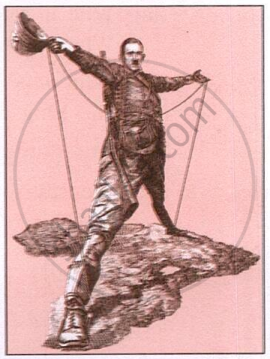
Look at the cartoon depicting the ambitions of Hitler. Briefly describe the steps he undertook to fulfil his ambition.
Structured Questions
With reference to the rise of dictatorship in Europe after the First World War, answer the following questions:
- How did class conflicts lead to the rise of dictatorship that emerged in Italy and Germany after the First World War?
- How did the decline of democracy help in the rise of dictatorship in Italy and Germany?
- What was the reason for the failure of the League of Nations?
Due to Fascism, Italy made progress in different spheres of life and became a powerful nation. With reference to the results of Fascism in Italy, explain the following:
- Reforms introduced in Italy to improve the economic condition of the people.
- Aggressive foreign policy under Mussolini.
- Negative impact of Fascism in Italy.
In the post World War I scenario, Italy and Germany experienced the rise of dictatorships. In this context, explain any three circumstances that led to the rise of Fascism in Italy.
Look at the newspaper clipping given below and answer the questions that follow:
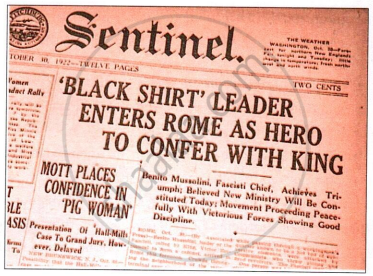
- Who is referred to as ‘Black Shirt Leader’ in the newspaper clipping shown above? Why did he enter Rome?
- Who was the ‘King’ with whom the ‘Black Shirt Leader’ was to confer? What did the King do?
- State any three consequences of the incident.
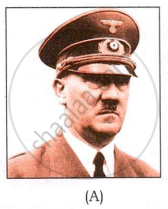
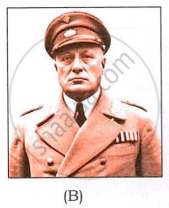
- Identify the two leaders in the picture. How did they establish totalitarian states in their respective countries?
- State three factors that led to the rise of leader (А).
- State four similarities between the ideologies followed by these two people.
Higher Order Thinking Skills (HOTS)
Imagine that you are a student living in Nazi Germany in the 1930 and have a pen friend in Italy. While exchanging letters with him/her, you realised that he/she is living in a similar situation as in your country. Write a reply to him/her stating the similarities in conditions in which you both are living.
Why do you think that all the dictatorships have an appeal to the masses? Give reasons to support your answer.
Every dictator first brings about a positive change in his/her country but eventually leads his/her country towards annihilation. Comment.
What changes in the terms of the Treaty of Versailles, in your opinion, would have prevented the rise of dictatorships like Hitler’s and Mussolini’s?
In your opinion what can the international community do to ensure predominance of democratic machinery in different parts of the world?
Solutions for 11: Rise of Dictatorships
Morning Star solutions for Total History and Civics [English] Class 10 ICSE chapter 11 - Rise of Dictatorships
Shaalaa.com has the CISCE Mathematics Total History and Civics [English] Class 10 ICSE CISCE solutions in a manner that help students grasp basic concepts better and faster. The detailed, step-by-step solutions will help you understand the concepts better and clarify any confusion. Morning Star solutions for Mathematics Total History and Civics [English] Class 10 ICSE CISCE 11 (Rise of Dictatorships) include all questions with answers and detailed explanations. This will clear students' doubts about questions and improve their application skills while preparing for board exams.
Further, we at Shaalaa.com provide such solutions so students can prepare for written exams. Morning Star textbook solutions can be a core help for self-study and provide excellent self-help guidance for students.
Concepts covered in Total History and Civics [English] Class 10 ICSE chapter 11 Rise of Dictatorships are Fascism, Causes for the Rise of Fascism, Aims of Fascism, Fascism in Italy, Impact of Fascism, Nazi Dictatorship in Germany, Causes for the Rise of Nazism, Aims of Nazism, Impact of Nazism, Similarities in the Causes and Ideologies of Fascism and Nazism, The First World War and Its Global Impact, Fascism, Causes for the Rise of Fascism, Aims of Fascism, Fascism in Italy, Impact of Fascism, Nazi Dictatorship in Germany, Causes for the Rise of Nazism, Aims of Nazism, Impact of Nazism, Similarities in the Causes and Ideologies of Fascism and Nazism, The First World War and Its Global Impact, Fascism, Causes for the Rise of Fascism, Aims of Fascism, Fascism in Italy, Impact of Fascism, Nazi Dictatorship in Germany, Causes for the Rise of Nazism, Aims of Nazism, Impact of Nazism, Similarities in the Causes and Ideologies of Fascism and Nazism, The First World War and Its Global Impact.
Using Morning Star Total History and Civics [English] Class 10 ICSE solutions Rise of Dictatorships exercise by students is an easy way to prepare for the exams, as they involve solutions arranged chapter-wise and also page-wise. The questions involved in Morning Star Solutions are essential questions that can be asked in the final exam. Maximum CISCE Total History and Civics [English] Class 10 ICSE students prefer Morning Star Textbook Solutions to score more in exams.
Get the free view of Chapter 11, Rise of Dictatorships Total History and Civics [English] Class 10 ICSE additional questions for Mathematics Total History and Civics [English] Class 10 ICSE CISCE, and you can use Shaalaa.com to keep it handy for your exam preparation.
