Advertisements
Online Mock Tests
Chapters
1: The First War of Independence, 1857
2: Growth of Nationalism
3: First Phase of the Indian National Movement
4: Second Phase of the Indian National Movement
5: The Muslim League
2. MASS PHASE OF THE NATIONAL MOVEMENT (1915-1947)
6: Mahatma Gandhi and the National Movement
7: The Quit India Movement
8: Forward Bloc and The INA
9: Independence and Partition of India
3. THE CONTEMPORARY WORLD
10: The First World War
11: Rise of Dictatorships
12: The Second World War
13: United Nations
14: Major Agencies of the United Nations
15: Non-Aligned Movement
SECTION B - CIVICS : 1. THE UNION LEGISLATURE
▶ 1: The Union Parliament-I
2: The Union Parliament-II
2. THE UNION EXECUTIVE
3: The President and The Vice-President
4: Prime Minister and Council of Ministers
3. THE JUDICIARY
5: The Supreme Court
6: The High Courts and Subordinate Courts
![Morning Star solutions for Total History and Civics [English] Class 10 ICSE chapter 1 - The Union Parliament-I - Shaalaa.com](/images/total-history-and-civics-english-class-10-icse_6:5245755610f545c08dc24e700b430f63.jpg "Morning Star solutions for Total History and Civics [English] Class 10 ICSE chapter 1 - The Union Parliament-I")
Advertisements
Solutions for Chapter 1: The Union Parliament-I
Below listed, you can find solutions for Chapter 1 of CISCE Morning Star for Total History and Civics [English] Class 10 ICSE.
Morning Star solutions for Total History and Civics [English] Class 10 ICSE 1 The Union Parliament-I EXERCISES [Pages 201 - 205]
Multiple-Choice Questions
The Indian Federation - as articulated by the Chairman of the Drafting Committee, B.R. Ambedkar, and the Constituent Assembly - emerged from European colonisation and was formed through the annexation of British provinces and princely states, albeit not by mutual agreement but by historical necessity. Therefore India has a federal system of government with a strong ______.
Federation of States
Supreme Court
Parliament
Unitary bias
A single Constitution is a feature of a ______ form of government.
Monarchial
Federal
Unitary
None of the above
State governments are neither the agents of the Central government nor do they draw their authority from it. The ______ has an overriding position.
Central government
State government
President
Prime Minister
The Central and the State Governments draw their authority from ______
The Constitution of India.
The people of India.
The Supreme Court.
The Judiciary.
The Constitution of India provides for a ______ tier government.
single
two
three
four
Which of the following constitute unitary features as provided in the Constitution of India?
P: A strong Centre.
Q: Adequate financial resources for the Centre and the States.
R: A single Constitution for the Union and the States.
S: Division of legislative and administrative powers between the Union and the States.
P and Q
R and S
P and R
Q and S
The Union Legislature comprises which of the following?
P: The President
Q: The Lok Sabha
R: The Rajya Sabha
S: The two Houses of Parliament
P and Q
R and S
P and R
P and S
How are the members of the Lok Sabha elected?
Directly elected by the people on the basis of universal adult franchise.
Indirectly by the representatives of the people on the basis of single transferable vote.
Directly by all citizens of the country.
Indirectly by members of State Legislatures.
Which of the following statements is incorrect regarding the Lok Sabha?
The members of the Lok Sabha are directly elected by the people.
The Lok Sabha acts as the voice of the nation.
The Lok Sabha represents the States of the Indian Union.
The Lok Sabha keeps a check on the finances of the nation.
Read the excerpt given below:
|
Congress MPs in the Lok Sabha and the Rajya Sabha submitted motions seeking a discussion on matters related to the Election Commission and the Special Intensive Revision (SIR) in Bihar. - The Hindu, August 21, 2025 |
Based on the above excerpt, state which motion was submitted by the Congress MPs in the Parliament.
No-confidence Motion
Adjournment Motion
Confidence Motion
None of the above.
Which of the following statements about the sessions of Parliament are correct?
P: The President of India summons each house of Parliament.
Q: Each house of Parliament shall meet at least thrice a year.
R: Normally, there are three sessions of Parliament in a year.
S: The speaker presides over the joint sessions of both the Houses of Parliament.
P and R
R and S
Q and R
R and S
The strength of a House is 510. What would be the Quorum of the House?
200
112
110
51
Read the excerpt given below:
|
The Monsoon Session, 2025 of Parliament, which commenced on Monday, the 21st of July, 2025, has been adjourned sine die on Thursday, the 21st of August, 2025. The Session provided 21 sittings spreading over 32 days. - PIB, August 2025 |
Which of the following is meant by ‘adjourned sine die’?
Adjourn the session for a day.
Adjourn the session for an indefinite period.
Adjourn the session for a month.
None of the above.
The term of the Lok Sabha can be extended during an emergency by ______.
one year at a time
six months at a time
three months at a time
one month at a time
Which of the following statements about the No-Confidence Motion are correct?
P: No-confidence Motion expresses a lack of confidence in the Parliament.
Q: No-confidence in the government is moved by the Opposition.
R: If the Motion is passed, the government has to resign.
S: If the Motion is not passed, the Opposition party/parties take back the Motion.
P and Q
Q and R
P and R
R and S
When does the President of India address a joint session of Parliament?
- When there is a deadlock between the two Houses of Parliament over an Ordinary Bill.
- At the beginning of the first session after each general election when the lower House meets.
- At the beginning of first session of each year.
(i) and (ii)
(i) and (iii)
(ii) and (iii)
(i), (ii) and (iii)
The Lok Sabha may be adjourned in which of the following cases?
- After the day’s business is over.
- For want of Quorum.
- In case of a natural calamity.
(i) and (ii)
(ii) and (iii)
(i) and (iii)
(i), (ii) and (iii)
How are the Speaker and the Deputy Speaker of the Lok Sabha elected?
By the people during general elections.
By the members of the Lok Sabha from amongst themselves.
By the members of the Rajya Sabha.
By the members of the State Legislature.
Identify the functions of the Speaker of the Lok Sabha.
P: The Speaker votes on all issues put to a vote in the House.
Q: The Speaker presides over the joint sessions of both the houses of Parliament.
R: The Speaker’s decision is final with regard to the Anti-Defection Law.
S: The speaker is the ex officio Chairman of all the committees of the House.
P and Q
P and S
Q and R
Q and S
Who decides whether a bill is a Money Bill or not?
President
Prime Minister
Speaker of the Lok Sabha
Finance Minister
Select the option that shows the correct relationship between Statements I and II.
(I) In a federal system of government, all the administrative powers are vested in the Central Government.
(II) The State Governments are neither the agents of the Central Government nor do they draw their authority from it.
(I) is true, but (II) is false.
(I) is false, but (II) is true.
Both (I) and (II) are true, but (II) is not the correct explanation of (I).
Both (I) and (II) are false.
Short Answer Questions
Name the three levels of government in a federal set-up in India.
Importance of federal set-up in India?
Article 1 of the Constitution delineates India as a ‘Union of States’, comprising regions that have been organised into States and as Union Territories. The existence of Union Territories is a departure from the federal form of Government. Give reasons.
A bicameral legislature strengthens which form of government? Give a reason to support your answer.
Name the law-making body of the Union Government.
Name the main constituents of the law-making body of the Union Government.
How are the members of the Lok Sabha elected?
Who determines the salaries and allowances of the Members of Parliament?
What is the required quorum to hold a meeting of the Lok Sabha?
What happens when the quorum of a House is not met?
How is the Speaker of the Lok Sabha elected?
How is the Deputy Speaker of the Lok Sabha elected?
Who presides over the meetings of the Lok Sabha?
Name the sessions of the Lok Sabha.
What is the maximum gap allowed between two Parliamentary sessions?
If the President does not give his assent to a Bill, what happens?
Structured Questions
According to Dr Ambedkar, “Constitution can be both unitary as well as federal according to the requirements of time and circumstances. In normal times, it (the Constitution) is framed to work as a federal system. But in times of war, it is so designed as to make it work as though it were a unitary system.” In this context, answer the following questions:
- List any three federal features of government in India.
- List any two conditions when the Parliament can make laws on Subjects in the State List.
- Write short notes on any two unitary features of the government in India.
With reference to the powers and functions of the Speaker of the Lok Sabha, state the following:
- Any three functions to regulate the proceedings of the House.
- Any three administrative functions.
- The Speaker of the Lok Sabha occupies a position of great authority and responsibility. Give reasons to support this statement.
Read the excerpt given below and answer the questions that follow:
|
The Monsoon Session of Parliament begins next week. The dates were announced 45 days ago. Unusual. Normally, schedules for Parliament sessions are put out 18-20 days in advance.... For Narendra Modi and his team, there is no running away from answering 21 hours of questions in each House this session. A total of 42 hours. Question Hour, for 60 minutes a day, puts Union ministers in the hot seat. They are obliged to reply, either orally on the floor of the House (starred questions), or in writing (unstarred questions). On average, nine questions are answered orally on the floor of Parliament every day, and over 400 questions receive written replies daily. - Indian Express, July 18, 2025 |
- What is a ‘Session’ of Parliament?
- What do you understand by Question Hour?
- Write short notes on the types of questions that are put up in Parliament.
This picture is a symbol of our democratic rule. In this context, answer the following questions:
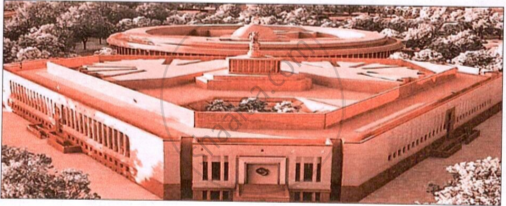
- How does the Parliament work to ensure that the people of India make laws for themselves?
- How does the Parliament exercise control over the Executive?
- When you grow up, you will have a chance to become an MP. Would you like to be an MP in the Lok Sabha or the Rajya Sabha? Why?
Higher Order Thinking Skills (HOTS)
Why is the Lok Sabha often referred to as the ‘House of People’? What does this title reflect on its role in Indian democracy?
How does the exclusive power given to the Lok Sabha regarding the Money Bill highlight the principle of financial control by the people?
Do you think the Speaker of the Lok Sabha can remain completely impartial despite belonging to a political party? Discuss with reasons and examples.
How does the system of Question Hour and Zero Hour empower the opposition in the Lok Sabha?
Do you think Members of Parliament should be fined for unruly scenes, frequent adjournments and disruptions in the Lok Sabha leading to loss of valuable working hours and wastage of public money? Give your views and suggestions.
Do you think there should be a limit on the number of times a person can be elected as a Member of Parliament? Give your views with reasons.
Solutions for 1: The Union Parliament-I
Morning Star solutions for Total History and Civics [English] Class 10 ICSE chapter 1 - The Union Parliament-I
Shaalaa.com has the CISCE Mathematics Total History and Civics [English] Class 10 ICSE CISCE solutions in a manner that help students grasp basic concepts better and faster. The detailed, step-by-step solutions will help you understand the concepts better and clarify any confusion. Morning Star solutions for Mathematics Total History and Civics [English] Class 10 ICSE CISCE 1 (The Union Parliament-I) include all questions with answers and detailed explanations. This will clear students' doubts about questions and improve their application skills while preparing for board exams.
Further, we at Shaalaa.com provide such solutions so students can prepare for written exams. Morning Star textbook solutions can be a core help for self-study and provide excellent self-help guidance for students.
Concepts covered in Total History and Civics [English] Class 10 ICSE chapter 1 The Union Parliament-I are Revocation of Articles 370 and 35A: Origin, Abrogation, and Key Differences, Non-Federal or Unitary Features, Lok Sabha, Parliamentary Procedures of Lok Sabha, Federal Setup in India, The Union Parliament, Speaker of the Lok Sabha, Role and Functions of the Speaker, Rajya Sabha, Powers and Functions of the Rajya Sabha and the Lok Sabha, Relationship and Differences Between the Two Houses of Parliament, Revocation of Articles 370 and 35A: Origin, Abrogation, and Key Differences, Non-Federal or Unitary Features, Lok Sabha, Parliamentary Procedures of Lok Sabha, Federal Setup in India, The Union Parliament, Speaker of the Lok Sabha, Role and Functions of the Speaker, Rajya Sabha, Powers and Functions of the Rajya Sabha and the Lok Sabha, Relationship and Differences Between the Two Houses of Parliament, Revocation of Articles 370 and 35A: Origin, Abrogation, and Key Differences, Non-Federal or Unitary Features, Lok Sabha, Parliamentary Procedures of Lok Sabha, Federal Setup in India, The Union Parliament, Speaker of the Lok Sabha, Role and Functions of the Speaker, Rajya Sabha, Powers and Functions of the Rajya Sabha and the Lok Sabha, Relationship and Differences Between the Two Houses of Parliament.
Using Morning Star Total History and Civics [English] Class 10 ICSE solutions The Union Parliament-I exercise by students is an easy way to prepare for the exams, as they involve solutions arranged chapter-wise and also page-wise. The questions involved in Morning Star Solutions are essential questions that can be asked in the final exam. Maximum CISCE Total History and Civics [English] Class 10 ICSE students prefer Morning Star Textbook Solutions to score more in exams.
Get the free view of Chapter 1, The Union Parliament-I Total History and Civics [English] Class 10 ICSE additional questions for Mathematics Total History and Civics [English] Class 10 ICSE CISCE, and you can use Shaalaa.com to keep it handy for your exam preparation.
