Advertisements
Online Mock Tests
Chapters
1: The First War of Independence, 1857
2: Growth of Nationalism
3: First Phase of the Indian National Movement
4: Second Phase of the Indian National Movement
5: The Muslim League
2. MASS PHASE OF THE NATIONAL MOVEMENT (1915-1947)
6: Mahatma Gandhi and the National Movement
7: The Quit India Movement
8: Forward Bloc and The INA
9: Independence and Partition of India
3. THE CONTEMPORARY WORLD
10: The First World War
11: Rise of Dictatorships
▶ 12: The Second World War
13: United Nations
14: Major Agencies of the United Nations
15: Non-Aligned Movement
SECTION B - CIVICS : 1. THE UNION LEGISLATURE
1: The Union Parliament-I
2: The Union Parliament-II
2. THE UNION EXECUTIVE
3: The President and The Vice-President
4: Prime Minister and Council of Ministers
3. THE JUDICIARY
5: The Supreme Court
6: The High Courts and Subordinate Courts
![Morning Star solutions for Total History and Civics [English] Class 10 ICSE chapter 12 - The Second World War - Shaalaa.com](/images/total-history-and-civics-english-class-10-icse_6:5245755610f545c08dc24e700b430f63.jpg "Morning Star solutions for Total History and Civics [English] Class 10 ICSE chapter 12 - The Second World War")
Advertisements
Solutions for Chapter 12: The Second World War
Below listed, you can find solutions for Chapter 12 of CISCE Morning Star for Total History and Civics [English] Class 10 ICSE.
Morning Star solutions for Total History and Civics [English] Class 10 ICSE 12 The Second World War Exercises [Pages 154 - 158]
Hitler invaded Poland in ______.
September, 1939
September, 1919
October, 1936
July, 1942
Which of the following was the immediate cause of The World War II?
Japanese Invasion of China
Failure of League of Nations
Hitler’s Invasion of Poland
Rise of Fascism and Nazism
Arrange the following events in chronological order.
- Treaty of Versailles
- Hitler’s invasion of Poland
- Japanese attack on Pearl Harbour
- Japanese invasion of China
(i), (ii), (iii) and (iv)
(i), (iv), (ii) and (iii)
(i), (iii), (iv) and (ii)
(i), (iv), (iii) and (ii)
When was the first atomic bomb dropped and where?
August 6, 1947; Berlin
August 6, 1945; Hiroshima
August 8, 1945; Nagasaki
August 8, 1947, New Mexico
Arrange the various conferences in chronological order.
- Potsdam
- Yaltra
- San Francisco
(i), (ii) and (iii)
(iii), (ii) , and (i)
(ii), (i) and (iii)
(ii), (i) and (iii)
Which of the following is NOT a feature of Cold War?
No open armed conflict
Peace time diplomacy
Trade agreements
Arms race
NATO was primarily formed to ______.
protect communist countries.
defend democratic nations from the threat of communism.
promote isolationism.
promote the policy of non-alignment.
Which of the following statements best describes the Warsaw Pact?
A military alliance of capitalist countries.
An alliance formed to protect democracies.
A non-military economic union.
A military bloc of communist countries led by the erstwhile USSR.
What does the cartoon given below depict about NATO through the missile?
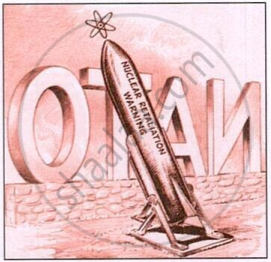
NATO’s role in curbing nuclear arms.
NATO’s defence relies on nuclear threat.
NATO’s attempt at declaring the USA as super power.
NATO’s decision to start a direct war with the USSR.
Select the option that shows the correct relationship between Statements (I) and (II).
(I) The peace treaties signed after the end of the First World War sowed the seeds for the Second World War.
(II) The Second World War was a continuation of the First World War.
(II) contradicts (I).
(II) is the reason for (I).
(I) is true, but (II) is false.
(I) and (II) are independent of each other.
Select the option that shows the correct relationship between Statements (I) and (II).
(I) The Treaty of Versailles was signed to end the First World War and prevent further wars.
(II) The Treaty of Versailles sowed seeds of bitterness and conflict, which finally culminated in the Second World War.
(II) contradicts (I).
(II) is the reason for (I).
(I) is true, but (II) is false.
(I) and (II) are independent of each other.
Select the option that shows the correct relationship between Statements (I) and (II).
(I) Hitler wanted to re-establish the prestige of Germany after the First World War.
(II) Hitler flouted the military clauses in the Treaty of Versailles and declared re-armament.
(II) contradicts (I).
(I) is the reason for (II).
(I) is true, but (II) is false.
(I) and (II) are independent of each other.
Select the option that shows the correct relationship between Statements (I) and (II).
(I) Britain and France followed the policy of appeasement towards dictatorial countries like Germany and Italy.
(II) They wanted to check the rising tide of Communism and Bolshevism.
(II) contradicts (I).
(II) is the reason for (I).
(I) is true, but (II) is false.
(I) and (II) are independent of each other.
Short Answer Questions
What was the issue between Germany and Poland that was a cause of World War Second?
How was the Treaty of Versailles responsible for the Second World War?
How did the rise of Fascism and Nazism become one of the causes of the Second World War?
What was the Berlin-Rome-Tokyo-Axis?
Why did Italy join the side of Germany and Japan in the Second World War?
What was the immediate cause of the Second World War?
Name the incident which brought the USA in the Second World War.
Why did the USA drop atom bombs on the Japanese cities of Hiroshima and Nagasaki?
With reference to the newspaper headline given below, what is meant by V-J Day and what made Japan to surrender to the Allies.
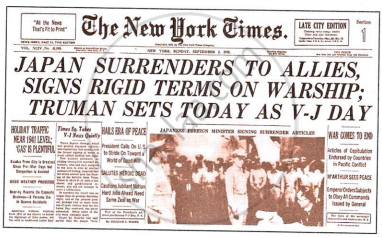
Mention two important consequences of the Second World War.
What is meant by the term Cold War?
Mention any two characteristics of the Cold War.
Give two causes that led to the Cold War.
Name two countries belonging to the Capitalist Bloc.
Name two countries belonging to the Communist Bloc.
What were the views of each of the two Cold War blocs about the other bloc?
Name any two countries which became independent after the Second World War.
Name the two military alliances formed during the Cold War.
Explain briefly NATO’s principle of collective security.
Structured Questions
State how each of the following factors were the causes of the Second World War:
- The failure of the League of Nations.
- The Aggressive Nationalism of Germany.
- The Policy of Appeasement.
The League of Nations was unable to eliminate power struggles leading to another World War. In this context, describe how the following were connected with the Second World War:
- Japanese invasion of China.
- Ideological differences between nations.
- Hitler’s invasion of Poland.
Look at the newspaper clipping given below and answer the questions that follow:
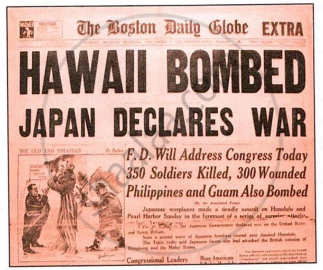
- Japan declared war against which country? Where did Japan order an attack? What were the consequences of the bombing of Hawaii?
- Japan made two crucial mistakes during this attack. What were these mistakes and what were the consequences of these mistakes?
- How was this attack finally avenged by the USA?
Study the picture and answer the questions:
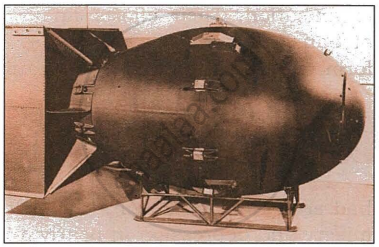
- Identify the object in the picture. Which country was responsible for its production?
- Where was this object used for the first time? How did it being an end to the War?
- How can a future war be avoided following the teachings of Mahatma Gandhi?
With the surrender of Japan, the Second World War was finally over. The war had far-reaching consequences. Against this background, write short notes on effect of World War Second on Japan.
With reference to the Second World War, explain the impact on the following:
- The Axis powers.
- Origin of the Cold War.
- The formation of the UN.
The cartoon given below shows Uncle Sam forgiving a sword while reading about the Russians’ proposal for an international arms treaty.
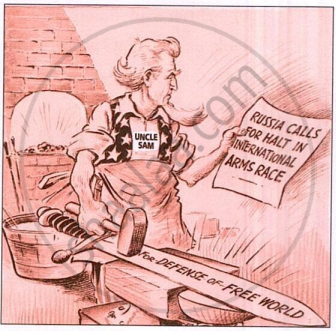
- The cartoon reflects which consequence of the Second World War? Give any two of its characteristic features.
- Who is conventionally referred to as Uncle Sam? What attitude is he likely to be expressing while reading the message? What policy is reflected in the phrase “For Defence of Free World”?
- What is referred to by the statement “Russia calls for halt in international arms race”? Whom, do you think, the cartoon is criticising, the USA, the USSR or both? Give reasons to support your answer.
Higher Order Thinking Skills (HOTS)
How was the Second World War different from the First World War?
The dropping of atomic bombs on Hiroshima and Nagasaki in Japan during the Second World War heralded an era of Nuclear Warfare. Give your views on the given statement.
Find out the causes of the recent war between Ukraine and Russia.
Do you think the concept of Cold War is still visible in the 21st century global geopolitics? Give reasons to support your answer.
Solutions for 12: The Second World War
Morning Star solutions for Total History and Civics [English] Class 10 ICSE chapter 12 - The Second World War
Shaalaa.com has the CISCE Mathematics Total History and Civics [English] Class 10 ICSE CISCE solutions in a manner that help students grasp basic concepts better and faster. The detailed, step-by-step solutions will help you understand the concepts better and clarify any confusion. Morning Star solutions for Mathematics Total History and Civics [English] Class 10 ICSE CISCE 12 (The Second World War) include all questions with answers and detailed explanations. This will clear students' doubts about questions and improve their application skills while preparing for board exams.
Further, we at Shaalaa.com provide such solutions so students can prepare for written exams. Morning Star textbook solutions can be a core help for self-study and provide excellent self-help guidance for students.
Concepts covered in Total History and Civics [English] Class 10 ICSE chapter 12 The Second World War are Causes of Second World War, Events of the Second World War, Consequences of the Second World War, Causes of Second World War, Events of the Second World War, Consequences of the Second World War, Causes of Second World War, Events of the Second World War, Consequences of the Second World War.
Using Morning Star Total History and Civics [English] Class 10 ICSE solutions The Second World War exercise by students is an easy way to prepare for the exams, as they involve solutions arranged chapter-wise and also page-wise. The questions involved in Morning Star Solutions are essential questions that can be asked in the final exam. Maximum CISCE Total History and Civics [English] Class 10 ICSE students prefer Morning Star Textbook Solutions to score more in exams.
Get the free view of Chapter 12, The Second World War Total History and Civics [English] Class 10 ICSE additional questions for Mathematics Total History and Civics [English] Class 10 ICSE CISCE, and you can use Shaalaa.com to keep it handy for your exam preparation.
