Advertisements
Online Mock Tests
Chapters
1: The First War of Independence, 1857
2: Growth of Nationalism
3: First Phase of the Indian National Movement
4: Second Phase of the Indian National Movement
5: The Muslim League
2. MASS PHASE OF THE NATIONAL MOVEMENT (1915-1947)
6: Mahatma Gandhi and the National Movement
7: The Quit India Movement
8: Forward Bloc and The INA
▶ 9: Independence and Partition of India
3. THE CONTEMPORARY WORLD
10: The First World War
11: Rise of Dictatorships
12: The Second World War
13: United Nations
14: Major Agencies of the United Nations
15: Non-Aligned Movement
SECTION B - CIVICS : 1. THE UNION LEGISLATURE
1: The Union Parliament-I
2: The Union Parliament-II
2. THE UNION EXECUTIVE
3: The President and The Vice-President
4: Prime Minister and Council of Ministers
3. THE JUDICIARY
5: The Supreme Court
6: The High Courts and Subordinate Courts
![Morning Star solutions for Total History and Civics [English] Class 10 ICSE chapter 9 - Independence and Partition of India - Shaalaa.com](/images/total-history-and-civics-english-class-10-icse_6:5245755610f545c08dc24e700b430f63.jpg "Morning Star solutions for Total History and Civics [English] Class 10 ICSE chapter 9 - Independence and Partition of India")
Advertisements
Solutions for Chapter 9: Independence and Partition of India
Below listed, you can find solutions for Chapter 9 of CISCE Morning Star for Total History and Civics [English] Class 10 ICSE.
Morning Star solutions for Total History and Civics [English] Class 10 ICSE 9 Independence and Partition of India Exercises [Pages 120 - 123]
Multiple-Choice Questions Select the correct option.
Which of the following international events forced Britain to consider handing over the governance of India to Indians?
End of Fascism
Rise of Communism
World War II
Rise of USA as a Superpower
Arrange the following events in chronological order:
- End of World War
- Attlee’s Announcement
- Mountbatten Plan
- Cabinet Mission
(i), (ii), (iii) and (iv)
(i), (iv), (ii) and (iii)
(i), (iv), (iii) and (ii)
(i), (iii), (ii) and (iv)
Why was the Cabinet Mission sent to India in 1946?
To facilitate transfer of power to Indians.
To facilitate the Partition of the country.
To facilitate the division of resources between Provinces and Princely States.
To facilitate the drawing up of the Constitution for each Dominion.
Group A : United Provincess : : Group B : ______.
Baluchistan
Punjab
Delhi
Bihar
Why did the Muslim League accept the Cabinet Mission Plan?
Its demand for a separate nation was fulfilled.
It felt that grouping of Muslim majority Provinces was a step towards a separate dominion.
It felt that its claim to nominate Muslim members to the Executive Council was supported.
None of the above.
Which of the following is incorrect about the formation of a Constituent Assembly according to the Cabinet Mission Plan?
Members to be directly elected by the people of India.
Members to be elected by Provincial Legislative Assemblies.
296 members from the Provinces and 93 from princely states.
Complete freedom to frame the Constitution of the Indian Union.
Which of the following forced the British government to send Lord Mountbatten?
Communal riots
Labour Unrest
Congress-League deadlock
All of the above
According to Indian Independence Act, a plebiscite would be held in ______.
Bihar
Sylhet
Princely states
Central provinces
Which of the following provisions regarding the Constituent Assemblies is/are correct?
Act as Central Legislatures in each dominion
Full powers to make laws for their dominion
Act as soverign bodies for legislative purpose
All of the above
Who had the power to bring India Independence Act into operation?
The Secretary of State for India
The Governor General
The British Prime Minister
None of the above
Select the option that shows the correct relationship between Statements (I) and (II).
(I) The Wavell Plan offered the granting of Dominion Status to India in the long run and drafting of its own Constitution by Indians.
(II) The Wavell Plan was rejected by both the Congress and the Muslim League.
(II) contradicts (I).
(II) is the reason for (I).
(I) is true, but (II) is false.
(I) and (II) are independent of each other.
Select the option that shows the correct relationship between Statements (I) and (II).
(I) The Cabinet Mission proposed a two-tier federal plan for India.
(II) The Cabinet Mission was sent in India in 1946 to facilitate the process of transfer of power.
(I) contradicts (II).
(II) is the reason for (I).
(I) is true, but (II) is false.
(I) and (II) are independent of each other.
Select the option that shows the correct relationship between Statements (I) and (II).
(I) The Muslim League’s demand for Pakistan was rejected by the Cabinet Mission.
(II) The Muslim League accepted the Cabinet Mission Plan as it felt that the grouping of Muslim majority Provinces in a way meant the formation of Pakistan.
(II) contradicts (I).
(II) is the reason for (I).
(I) is true, but (II) is false.
(I) and (II) are independent of each other.
Select the option that shows the correct relationship between Statements (I) and (II).
(I) The Congress won an overwhelming majority in the Constituent Assembly, the elections to which were held in 1946.
(II) The Muslim League kept itself out of the Government.
(II) contradicts (I).
(I) is the reason for (II).
(I) is true, but (II) is false.
(I) and (II) are independent of each other.
Select the option that shows the correct relationship between Statements (I) and (II).
(I) The Muslim League asked Wavell, the Viceroy, to constitute the Interim Government in 1946.
(II) The Muslim League kept itself out of the Interim Government.
(II) contradicts (I).
(II) is the reason for (I).
(I) is true, but (II) is false.
(I) and (II) are independent of each other.
Select the option that shows the correct relationship between Statements (I) and (II).
(I) The Mountbatten Plan provided for the Partition of India into two independent and Sovereign States, i.e., India and Pakistan.
(II) A referendum was to be held in Punjab and Bengal.
(II) contradicts (I).
(II) is the reason for (I).
(I) is true but (II) is false.
(I) and (II) are independent of each other.
Short Answer Questions
State two important reasons that prompted the British to withdraw from India.
Read the excerpt given below and answer the questions that follow:
|
INDIAN SAILORS IN REVOLT SIX HOURS BATTLE WITH BRITISH TROOPS. |
- Identify the event associated with the above mentioned newspaper heading.
- How did this event end?
In what way did the outcome of the Second World War help India’s demand for self-government?
What was the implication of the Group ‘B’ States proposed by the Cabinet Mission Plan?
What was mentioned in the Cabinet Mission Plan regarding provincial Autonomy?
What arguments did the Cabinet Mission give to reject Jinnah’s proposal of Pakistan?
What was said in the Cabinet Mission Plan about the division of power between the Federal Government and the Provinces?
What was the reactions of the Congress to the Cabinet Mission Plan.
Who was elected as the president of the Constituent Assembly in 1946?
Name the last Viceroy of India.
State one proposal regarding the princely states made by the last viceroy of India.
What was the most important but tragic provision of the Mountbatten Plan?
To whom was the power to be transferred according to the Mountbatten Plan?
Mention the reasons that made the Congress accept the Partition Proposals.
Mention any two provisions of the Indian Independence Act, 1947.
What did the Indian Independence Act 1947 state about Bengal and Punjab?
What did the Indian Independence Act 1947 state about North West Frontier Province?
What did the Indian Independence Act 1947 state about Sylhet District of Assam?
Name the first Governor-General of independent India.
Name the first Indian Governor-General of India.
Structured Questions
The Cabinet Mission Plan proposed a two-tiered federal union of British provinces and princely states. With reference to this, describe the following:
- Name the persons who constituted the Cabinet Mission. What was the purpose of sending the Cabinet Mission to India in 1946?
- The federal structure proposed by the Cabinet Mission Plan.
- The option given to the Princely States.
The attempt of the British to pacify the Congress and the Muslim League was clearly visible in the Cabinet Mission proposals but in reality neither could be pleased. With reference to this, explain:
- Any three proposals of the Cabinet Mission.
- The reasons for the Muslim League’s acceptance and later rejection of the Cabinet Mission Plan.
- Why did the Congress refuse to participate in the formation of the Interim Government under the Cabinet Mission Plan?
With reference to the newspaper article, answer the questions that follow:
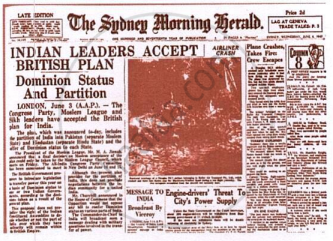
- Which Plan is referred to in the given newspaper article? State any two features of this Plan.
- How was the Plan supposed to solve the communal problem existing in India?
- Why did Congress accept the Plan? State three reasons to justify its acceptance.
Read the excerpt given below and answer the questions that follow:
|
“Long years ago we made a tryst with destiny and now the time comes, when we shall redeem our pledge, not wholly or in full measure, but very substantially. At the stroke of the midnight hour, when the world sleeps, India will awake to life and freedom... It is fitting that at this solemn moment we take the pledge of dedication to the service of India and her people and to the still large cause of humanity.” - Tryst with Destiny Speech by Pt. Jawaharlal Nehru |
- What happened at the stroke of midnight hour? Which ‘unending quest’ is Jawaharlal Nehru talking about in the excerpt? Who all strived to end this quest?
- Where and when did Jawaharlal Nehru made this historic speech? Name any two famous dignitaries present there?
- Name the British Act that led to Jawaharlal Nehru’s speech. State three features of this Act.
Higher Order Thinking Skills (HOTS)
A number of Acts were passed by the British to pacify the demands of the Indians relating to the Government of India. But the Indian Independence Act, 1947 is considered as a unique piece of legislation. Why is it so? Give reasons to support your answer.
Do you think that the Congress had no alternative but to accept the Mountbatten Plan? Support your answer with examples.
Solutions for 9: Independence and Partition of India
Morning Star solutions for Total History and Civics [English] Class 10 ICSE chapter 9 - Independence and Partition of India
Shaalaa.com has the CISCE Mathematics Total History and Civics [English] Class 10 ICSE CISCE solutions in a manner that help students grasp basic concepts better and faster. The detailed, step-by-step solutions will help you understand the concepts better and clarify any confusion. Morning Star solutions for Mathematics Total History and Civics [English] Class 10 ICSE CISCE 9 (Independence and Partition of India) include all questions with answers and detailed explanations. This will clear students' doubts about questions and improve their application skills while preparing for board exams.
Further, we at Shaalaa.com provide such solutions so students can prepare for written exams. Morning Star textbook solutions can be a core help for self-study and provide excellent self-help guidance for students.
Concepts covered in Total History and Civics [English] Class 10 ICSE chapter 9 Independence and Partition of India are Clauses of Cabinet Mission Plan, Independence by an Act of Legislation, Events that Led to the Cabinet Mission, Cabinet Mission in India, Rejection of the Demand for Pakistan, Reaction to the Cabinet Mission Plan, Conflict Between Congress and Muslim League, The Wavell Plan: A Step Towards Constitutional Resolution, Mountbatten Plan, The Indian Independence Act, 1947, Clauses of Cabinet Mission Plan, Independence by an Act of Legislation, Events that Led to the Cabinet Mission, Cabinet Mission in India, Rejection of the Demand for Pakistan, Reaction to the Cabinet Mission Plan, Conflict Between Congress and Muslim League, The Wavell Plan: A Step Towards Constitutional Resolution, Mountbatten Plan, The Indian Independence Act, 1947, Clauses of Cabinet Mission Plan, Independence by an Act of Legislation, Events that Led to the Cabinet Mission, Cabinet Mission in India, Rejection of the Demand for Pakistan, Reaction to the Cabinet Mission Plan, Conflict Between Congress and Muslim League, The Wavell Plan: A Step Towards Constitutional Resolution, Mountbatten Plan, The Indian Independence Act, 1947.
Using Morning Star Total History and Civics [English] Class 10 ICSE solutions Independence and Partition of India exercise by students is an easy way to prepare for the exams, as they involve solutions arranged chapter-wise and also page-wise. The questions involved in Morning Star Solutions are essential questions that can be asked in the final exam. Maximum CISCE Total History and Civics [English] Class 10 ICSE students prefer Morning Star Textbook Solutions to score more in exams.
Get the free view of Chapter 9, Independence and Partition of India Total History and Civics [English] Class 10 ICSE additional questions for Mathematics Total History and Civics [English] Class 10 ICSE CISCE, and you can use Shaalaa.com to keep it handy for your exam preparation.
