Advertisements
Advertisements
Question
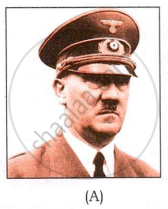
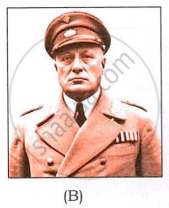
- Identify the two leaders in the picture. How did they establish totalitarian states in their respective countries?
- State three factors that led to the rise of leader (А).
- State four similarities between the ideologies followed by these two people.
Very Long Answer
Advertisements
Solution
- The leaders shown in the picture are Adolf Hitler and Benito Mussolini.
Adolf Hitler (Germany) and Benito Mussolini (Italy) established totalitarian states using identical strategies.- Use of Propaganda: Both leaders used media to promote their ideals and establish a personality cult.
- Suppression of Opposition: Political rivals and dissent were suppressed using violence, intimidation, and laws, such the Reichstag Fire Decree in Germany and the Acerbo Law in Italy.
- Dictatorial Powers: Hitler gained power with the Enabling Act (1933), and Mussolini became Prime Minister following the March on Rome (1922), solidifying control.
- Control of the Military: Both leaders relied on military allegiance to enforce their regimes.
- Economic Control: Mussolini introduced corporatism in Italy, whereas Hitler controlled industry to serve the state.
- Three factors that led to the rise of the leader Adolf Hitler are as follows:
- The Germans felt humiliated and defenceless following their defeat in World War I and the Treaty of Versailles. Germany had to pay 33 billion in reparations and had a one lakh-strong army.
Hitler urged Germans to disregard the Treaty of Versailles and focus on rebuilding their empire and regaining lost colonies. - Following the Bolshevik Revolution in Russia, communist influence in Germany increased significantly. The Communists organised efficiently and won several seats in the Reichstag. Hitler warned that German Communists will serve Russian overlords and follow Communist instructions. He attempted to persuade Germans that only Nazism could counter Communism’s growing influence.
- The harsh terms of the Treaty of Versailles led to economic crisis in Germany, including reduced agricultural production, colonies, foreign investment, and trade contracts. Foreign governments raised levies on German goods. The number of unemployed individuals grew. Farmers’ living conditions deteriorated significantly. By June 1931, farmers’ debts had reached $300 million.
- The Germans felt humiliated and defenceless following their defeat in World War I and the Treaty of Versailles. Germany had to pay 33 billion in reparations and had a one lakh-strong army.
- The similarities between the Ideologies of Nazism and Fascism:
- To believe in the totalitarian rule.
- Despise democratic political systems.
- The state can suppress people’s fundamental rights and liberties.
- To support one party and one leader.
- Support aggressive nationalism and imperialism.
- Viewing war as a tool for advancing national objectives.
- To maintain strongly nationalistic, anticommunist, and antidemocratic rule.
shaalaa.com
Is there an error in this question or solution?
