Advertisements
Online Mock Tests
Chapters
![Balbharati solutions for Science and Technology Part 1 [English] Standard 10 Maharashtra State Board chapter 9 - Carbon Compounds - Shaalaa.com](/images/science-and-technology-part-1-english-standard-10-maharashtra-state-board_6:c9a4ae86c3724b9b8c519cd188fdfa1f.jpg "Balbharati solutions for Science and Technology Part 1 [English] Standard 10 Maharashtra State Board chapter 9 - Carbon Compounds")
Advertisements
Solutions for Chapter 9: Carbon Compounds
Below listed, you can find solutions for Chapter 9 of Maharashtra State Board Balbharati for Science and Technology Part 1 [English] Standard 10 Maharashtra State Board.
Balbharati solutions for Science and Technology Part 1 [English] Standard 10 Maharashtra State Board 9 Carbon Compounds Intext Questions [Pages 110 - 133]
Can you recall?
What are the types of compounds?
Objects in everyday use such as foodstuff, fibers, paper, medicines, wood, fuels, are made of various compounds. Which constituent elements are common in these compounds?
To which group in the periodic table does the element carbon belongs? Write down the electronic configuration of carbon and deduce the valency of carbon.
Can you tell?
What is meant by a chemical bond?
What is the number of chemical bonds that an atom of an element forms called?
What are the two important types of chemical bonds?
Use your brain power!
Atomic number of chlorine is 17.
What is the number of electron in the valence shell of chlorine?
Molecular formula of chlorine is Cl2.
Draw electron-dot and line structure of a chlorine molecule.
The molecular formula of water is H2O. Draw electron-dot and line structures for this triatomic molecule. (Use dots for electron of oxygen atom and crosses for electrons of hydrogen atoms.)
The molecular formula of ammonia is NH3. Draw electron-dot and line structures for ammonia molecule.
Use your brain power!
The molecular formula of carbon dioxide is CO2. Draw the electron-dot structure (without showing circle) and line structure for CO2.
With which bond C atom in CO2 is bonded to each of the O atoms?
The molecular formula of sulphur is S8 in which eight sulphur atoms are bonded to each other to form one ring. Draw an electron-dot structure for S8 without showing the circles.
Use your brain power!
Hydrogen peroxide decomposes on its own by the following reaction
\[\ce{H - O - O - H -> 2H - O - H + O2}\]
From this, what will be your inference about the strength of O – O covalent bond?
Tell from the above example whether oxygen has catenation power or not.
Use your brain power!
Molecular formula of Propane is C3H8 , write the structural formula of propane.
Use your brain power!
The molecular formula ethyne is C2H2. From this draw its structural formula and electron - dot structure.
How many bonds have to be there in between the two carbon atoms in ethyne so as to satisfy their tetravalency?
Use your brain power!
Draw electron-dot structure of cyclohexane.
Complete the table
Fill in the gaps in the table a, b and c of homologous series.
a. Homologous Series of Alkanes
| Name | Molecular formula | Condensed Structural formula | Number of carbon atoms | Number of -CH2 - units | Boiling point °C |
| Methane | CH4 | CH4 | 1 | 1 | −162 |
| Ethane | C2H6 | \[\ce{CH3 - CH3}\] | 2 | 2 | −88.5 |
| Propane | C3H8 | \[\ce{CH3 - CH2 - CH3}\] | 3 | 3 | −42 |
| Butane | C4H10 | \[\ce{CH3 - CH2 - CH2 - CH3}\] | ... | ... | 0 |
| Pentane | C5H12 | \[\ce{CH3 - CH2 - CH2 - CH2 - CH3}\] | ... | ... | 36 |
| Hexane | C6H14 | \[\ce{CH3 - CH2 - CH2 - CH2 - CH2 - CH3}\] | ... | ... | 69 |
b. Homologous Series of Alcohols
| Name | Molecular formula | Condensed Structural formula | Number of carbon atoms | Number of -CH2 - units | Boiling point °C |
| Methanol | CH4O | \[\ce{CH3 - OH}\] | 1 | 1 | 63 |
| Ethanol | C2H6O | \[\ce{CH3 - CH2 - OH}\] | 2 | 2 | 78 |
| Propanol | C3H8O | \[\ce{CH3 - CH2 - CH2 - OH}\] | ... | ... | 97 |
| Butanol | C4H10O | \[\ce{CH3 - CH2 - CH2 - CH2 - OH}\] | ... | ... | 118 |
c. Homologous Series of Alkenes
| Name | Molecular formula | Condensed Structural formula | Number of carbon atoms | Number of -CH2 - units | Boiling point °C |
| Ethene | C2H4 | \[\ce{CH2 = CH2}\] | 2 | 0 | −102 |
| Propene | C3H6 | \[\ce{CH3 - CH = CH2}\] | 3 | 1 | −48 |
| 1-Butene | C4H8 | \[\ce{CH3 - CH2 - CH = CH2}\] | ... | ... | −6.5 |
| 1-Pentene | C5H10 | \[\ce{CH3 - CH2 - CH2 - CH = CH2}\] | ... | ... | 30 |
Use your brain power!
By how many -CH2- (methylene) units do the formulae of the first two members of homologous series of alkanes, methane (CH4) and ethane (C2H6) differ? Similarly, by how many -CH2- units do the neighbouring members ethane (C2H6) and propane (C3H8) differ from each other?
How many methylene units are extra in the formula of the fourth member than the third member of the homologous series of alcohols?
How many methylene units are less in the formula of the second member than the third member of the homologous series of alkenes?
Use your brain power!
| Name | Molecular formula | Condensed Structural formula | Number of carbon atoms | Number of -CH2 - units | Boiling point °C |
| Ethene | C2H4 | \[\ce{CH2 = CH2}\] | 2 | 0 | −102 |
| Propene | C3H6 | \[\ce{CH3 - CH = CH2}\] | 3 | 1 | −48 |
| 1-Butene | C4H8 | \[\ce{CH3 - CH2 - CH = CH2}\] | 4 | 2 | −6.5 |
| 1-Pentene | C5H10 | \[\ce{CH3 - CH2 - CH2 - CH = CH2}\] | 5 | 3 | 30 |
The above table shows the homologous series of alkenes. Inspect the molecular formulae of the members of this series. Do you find any relationship, in the number of carbon atoms and the number of hydrogen atoms in the molecular formulae?
If the number of carbon atoms in the molecular formulae of alkenes is denoted by ‘n’, what will be the number of hydrogen atoms?
What would be the general formula for the molecular formulae of the members of the homologous series of alkanes? What would be the value of ‘n’ for the first member of this series?
The general molecular formula for the homologous series of alkynes is CnH2n−2. Write down the individual molecular formulae of the first, second and third members by substituting the values 2, 3 and 4 respectively for ‘n’ in this formula.
Use your brain power!
Write down structural formulae of the first four members of the various homologous series formed by making use of the functional groups in the given table.
| Hetero Atom | Functional Group | ||
| Name | Structural formula | Condensed Structural formula | |
| Halogen (chlorine, bromine, iodine) | Halo (chromo/bromo/iodo) | -X (-C1, -Br, -I) | - X (-C1, -Br, -I) |
| Oxygen | 1. Alcohol | - O - H | -OH |
| 2. Aldehyde | O || - C - H |
-CHO | |
| 3. Ketone | O || - C - |
-CO- | |
| 4. Carboxylic Acid | O || - C - O - H |
-COOH- | |
| 5. Ether | - O - | -O- | |
| 6. Ester | O || - C - O - |
-COO- | |
| Nitrogen | Amines | - N - H | H |
- NH2 |
General formula of the homologous series of alkanes is CnH2n+2. Write down the molecular formula of the 8th and 12th member using this.
Use your brain power!
- Draw three structural formulae having molecular formula C5H12.
- Give the names n-pentane, 1(i-pentane) and neopentane to the above three structural formulae. (Use the same logic as used in the names of the isomeric butanes for this purpose.)
Draw all the possible structural formulae having molecular formula C6H14. Give names to all the isomers. Which difficulties were faced by you while naming?
Complete the table
The table shows common names and structural formulae of a few carbon compounds. Complete the following table with writing IUPAC name of carbon compound.
| Sr. No. | Common name | Structural formula | IUPAC Name |
| 1. | ethylene | CH2 = CH2 | |
| 2. | acetylene | HC ≡ CH | |
| 3. | acetic acid | CH3 – COOH | |
| 4. | methyl alcohol | CH3 – OH | |
| 5. | ethyl alcohol | CH3 – CH2 – OH | |
| 6. | acetaldehyde | CH3 – CHO | |
| 7. | acetone | CH3 – CO – CH3 | |
| 8. | ethyl methyl ketone | CH3 – CO – CH2 – CH3 | |
| 9. | ethyl amine | CH3 – CH2 – NH2 | |
| 10. | n-propyl chloride | CH3 – CH2 – CH2 – Cl |
Can you recall?
Which is the component of biogas that makes it useful as fuel?
Which product is formed by the combustion of elemental carbon?
Is the biogas combustion reaction endothermic or exothermic?
Use your brain power!
Propane (C3H8) is one of the combustible component of L.P.G. Write down the reaction for complete combustion of Propane (C3H8).
Compare
The proportion of carbon atoms in ethanol (C2H5OH) and naphthalene (C10H8).
Compare
How is the transformation of ethanol into ethanoic acid an oxidation reaction?
Use your brain power!
In the chlorination, substitution reaction of propane two isomeric products containing one chlorine atom are obtained. Draw their structural formulae and give their IUPAC names.
Use your brain power!
Explain by writing a reaction, what will happen when pieces of sodium metal are put in n-propyl alcohol.
Explain by writing a reaction, which product will be formed on heating n - butyl alcohol with concentrated sulphuric acid.
Use your brain power!
Which one of ethanoic acid and hydrochloric acid is stronger?
Which indicator paper out of blue litmus paper and pH paper is useful to distinguish between ethanoic acid and hydrochloric acid?
Use your brain power!
Explain with reaction why does the lime water turns milky in the reaction of acetic acid with sodium carbonate.
Explain the reaction that would take place when a piece of sodium metal is dropped in ethanoic acid.
Two test tubes contain two colourless liquids ethanol and ethanoic acid. Explain by writing reaction which chemical test you would perform to tell which substance is present in which test tube.
Use your brain power!
When fat is heated with sodium hydroxide solution, soap and glycerin are formed. Which functional groups might be present in fat and glycerin? What do you think?
Can you tell?
What are the chemical names of the nutrients that we get from the food stuffs namely cereals, pulses and meat?
What are the chemical substances that make cloth, furniture and elastic objects?
Use your brain power!
Structural formulae of some monomers are given below. Write the structural formula of the homopolymer formed from them.
- \[\begin{array}{cc}
\phantom{.....}\ce{CH3}\\
\phantom{}|\\
\ce{CH2 = C}\phantom{............}\\
\phantom{}|\\
\phantom{....}\ce{CH3}
\end{array}\] - \[\begin{array}{cc}
\phantom{.....}\ce{CH3}\phantom{}\\
\phantom{}|\\
\phantom{}\ce{CH2 = C}\phantom{............}\\
\phantom{}|\\
\phantom{....}\ce{CH3}
\end{array}\]
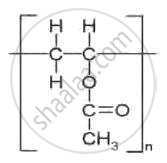
From the given structural formula of polyvinyl acetate, that is used in paints and glues, deduce the name and structural formula of the corresponding monomer.
Balbharati solutions for Science and Technology Part 1 [English] Standard 10 Maharashtra State Board 9 Carbon Compounds Exercise [Pages 133 - 134]
Match the pairs.
| Group 'A' | Group 'B' |
| a. C2H6 | 1. Unsaturated hydrocarbon |
| b. C2H2 | 2. Molecular formula of an alcohol |
| c. CH4O | 3. Saturated hydrocarbon |
| d. C3H6 | 4. Triple bond |
Draw an electron dot structure of the following molecule. (Without showing the circle) :
Methane
Draw an electron dot structure of the following molecule. (Without showing the circle) :
Ethene
Draw an electron dot structure of the following molecule. (Without showing the circle) :
Methanol
Draw an electron dot structure of the following molecule. (Without showing the circle) :
Water
Draw all possible structural formulae of the compound from its molecular formula given below.
C3H8
Draw all possible structural formulae of the compound from its molecular formula given below.
C4H10
Draw all possible structural formulae of the compound from its molecular formula given below.
C3H4
Explain the Structural isomerism term with example.
Explain the following term with example.
Covalent bond
Explain the following term with example.
Hetero atom in a carbon compound
Explain the following term with an example.
Functional group
Explain the following term with example.
Alkane
Explain the following term with an example.
Unsaturated hydrocarbon
Explain the following term with example.
Homopolymer
Explain the following term with example.
Monomer
Explain the following term with example.
Reduction
Explain the following term with an example.
Oxidant
Write the IUPAC name of the following structural formulae.
CH3-CH2-CH2-CH3
Write the IUPAC name of the following structural formulae.
CH3-CHOH-CH3
Write the IUPAC name of the following structural formulae.
CH3-CH2-COOH
Write the IUPAC name of the following structural formulae.
CH3-CH2-NH2
Write the IUPAC name of the following structural formulae.
CH3-CHO
Write the IUPAC name of the following structural formulae.
CH3-CO-CH2-CH3
Identify the type of the following reaction of carbon compound.
CH3 -CH2 -CH2-OH → CH3 -CH2 -COOH
Identify the type of the following reaction of carbon compound.
\[\ce{CH3 - CH2 - CH3 -> 3CO2 + 4H2O}\]
Identify the type of the following reaction of carbon compound.
CH3 -CH = CH -CH3 + Br2 → CH3 -CHBr - CHBr -CH3
Identify the type of the following reaction of carbon compound.
CH3 -CH3 + Cl2 → CH3 -CH2 -Cl + HCl
Identify the type of the following reaction of carbon compound.
CH3 -CH2 -CH2 -CH2 -OH → CH3 -CH2 -CH=CH2 + H2O
Identify the type of the following reaction of carbon compound.
CH3 -CH2 -COOH + NaOH → CH3 -CH2 -COO - Na+ + H2O
Identify the type of the following reaction of carbon compound.
CH3 -COOH + CH3 -OH → CH3 -COO- CH3 + H2O
Write structural formulae for the following IUPAC name.
pent-2-one
Write the structural formula for the following IUPAC name.
2-chlorobutane
Write structural formulae for the following IUPAC name.
propan- 2 ol
Write structural formulae for the following IUPAC name.
methanal
Write structural formulae for the following IUPAC name.
butanoic acid
Write structural formulae for the following IUPAC name.
1- bromopropane
Write structural formulae for the following IUPAC name.
ethanamine
Write structural formulae for the following IUPAC name.
butanone
Write answer as directed.
What causes the existance of very large number of carbon compound ?
Write answer as directed.
Saturated hydrocarbons are classified into three types. Write these names giving one example each.
Write answer as directed.
Give any four functional groups containing oxygen as the heteroatom in it. Write name and structural formula of one example each.
Give names of three functional groups containing three different hetero atoms. Write name and structural formula of one example each.
Write answer as directed.
Give names of three natural polymers. Write the place of their occurance and names of monomers from which they are formed.
Write the answer as directed.
What is meant by vinegar?
What is gasohol?
Write the answer as directed.
What are the uses of vinegar?
Write the answer as directed.
What are the uses of gasohol?
Write the answer as directed.
What is a catalyst?
Write any one reaction which is brought about by use of catalyst?
Solutions for 9: Carbon Compounds
Balbharati solutions for Science and Technology Part 1 [English] Standard 10 Maharashtra State Board chapter 9 - Carbon Compounds
Shaalaa.com has the Maharashtra State Board Mathematics Science and Technology Part 1 [English] Standard 10 Maharashtra State Board Maharashtra State Board solutions in a manner that help students grasp basic concepts better and faster. The detailed, step-by-step solutions will help you understand the concepts better and clarify any confusion. Balbharati solutions for Mathematics Science and Technology Part 1 [English] Standard 10 Maharashtra State Board Maharashtra State Board 9 (Carbon Compounds) include all questions with answers and detailed explanations. This will clear students' doubts about questions and improve their application skills while preparing for board exams.
Further, we at Shaalaa.com provide such solutions so students can prepare for written exams. Balbharati textbook solutions can be a core help for self-study and provide excellent self-help guidance for students.
Concepts covered in Science and Technology Part 1 [English] Standard 10 Maharashtra State Board chapter 9 Carbon Compounds are Homologous Series, Functional Groups in Carbon Compounds, Ethanol, Ethanoic Acid, Chemical Properties of Carbon Compounds > Oxidation, Chemical Properties of Carbon Compounds > Addition Reaction, Chemical Properties of Carbon Compounds > Substitution Reaction, Hydrocarbons, Macromolecules and Polymers, Bonds in Carbon Compounds, Carbon: A Versatile Element, Straight chains, Branched chains, and Rings of Carbon atoms, Nomenclature, Chemical Properties of Carbon Compounds > Combustion.
Using Balbharati Science and Technology Part 1 [English] Standard 10 Maharashtra State Board solutions Carbon Compounds exercise by students is an easy way to prepare for the exams, as they involve solutions arranged chapter-wise and also page-wise. The questions involved in Balbharati Solutions are essential questions that can be asked in the final exam. Maximum Maharashtra State Board Science and Technology Part 1 [English] Standard 10 Maharashtra State Board students prefer Balbharati Textbook Solutions to score more in exams.
Get the free view of Chapter 9, Carbon Compounds Science and Technology Part 1 [English] Standard 10 Maharashtra State Board additional questions for Mathematics Science and Technology Part 1 [English] Standard 10 Maharashtra State Board Maharashtra State Board, and you can use Shaalaa.com to keep it handy for your exam preparation.
