Advertisements
Advertisements
Question
Which method of biasing is used for operating a transistor as an amplifier?
Advertisements
Solution 1
For use as an amplifier, the transistor should be inactive mode. Therefore, the emitter-base junction is forward biased and the collector-base junction is reverse biased. Also, an amplifier uses an emitter bias rather than a base bias.
Solution 2
For transistor operating as an amplifier, the emitter-base junction is forward biased while the collector-base junction is reverse biased.
RELATED QUESTIONS
In a BJT, the largest current flow occurs ______.
Why are the emitter, the base, and the collector of a BJT doped differently?
In a common-base connection, a certain transistor has an emitter current of 10mA and a collector current of 9.8 mA. Calculate the value of the base current.
Draw the circuit symbol of the PNP transistor.
Explain the working of the PNP transistor?
The principle based on which a solar cell operates is ____________.
Sketch the static characteristics of a common emitter transistor and bring out the essential features of input and output characteristics.
Transistor functions as a switch. Explain.
Describe the function of a transistor as an amplifier with the neat circuit diagram. Sketch the input and output wave forms.
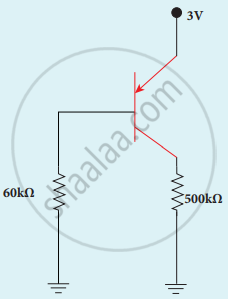
In the circuit shown in the figure, the BJT has a current gain (β) of 50. For an emitter-base voltage VEB = 600 mV, calculate the emitter-collector voltage VEC (in volts).
In an npn transistor, the base current is 100 µA and the collector current is 10 mA. The emitter current is ______.
ln switching circuit, transistor is in ON state and values of IC and IB are 4.2 mA and 5 µA respectively and RC= l k`Omega` and RB= 300 k`Omega`. If VBE = 0.5 V, find the value of VBB.
In switching circuit, transistor is in ON state, values of IE and lB are 10 mA and 0.8 mA respectively and RL is 2 k`Omega`. If VCE is 7.6 V, then VCC is ____________.
In case of npn transistors, the collector current is always less than the emitter current because ______.
In a silicon transistor, a change of 7.89 mA in the emitter current if produces a change of 7.8 mA in the collector current, then the base current must change by ____________.
In a transistor, a change of 8.0 mA in the emitter current produces a change of 7.8 mA in the collector current. Then change in the base current is ____________.
In a transistor, the thickness of the base region ____________.
In transistor amplifier, base-emitter junction is forward biased and collector emitter junction is reverse biased. The current gain is ______.
In common emitter mode of transistor, the d.c. current gain is 20, the emitter current is 7 mA. The collector current is ______.
A transistor is connected in C - E mode. If collector current is 72 × 10-5 A and α = 0.96, then base current will be ______.
In common emitter amplifier, a change of 0.2 mA in the base current causes a change of 5 mA in the collector current. If input resistance is 2K `Omega` and voltage gain is 75, the load resistance used in the circuit is ______.
A transistor having α = 0.8 is connected in a common emitter configuration. When the base current changes by 6 mA, the change in collector current is ______
The reverse bias in a junction diode is changed from 8V to 13V, then the value of the current changes from 40μA to 60μA. The resistance of junction diode will be ______.
A common emitter amplifier circuit built using an n-p-n transistor is shown in the figure. Its DC current gain is 300, RC = 4 kΩ and VCC = 20 V. What is the minimum base current for VCE to reach saturation?

The base current in common emitter mode of the transistor changes by 10 µA. If the current gain of the transistor is 50, then change in collector current is ______.
Explain the working of the n-p-n transistor in a common base configuration.
In a CE amplifier, the current gain is 80 and the emitter current is 9 mA. The base current is ______.
Define β
