Advertisements
Advertisements
Question
Why are the emitter, the base, and the collector of a BJT doped differently?
Advertisements
Solution
A BJT is a bipolar device, both electrons and holes participate in the conduction process. Under the forward-biased condition, the majority of carriers injected from the emitter into the base constitute the largest current component in a BJT. For these carriers to diffuse across the base region with negligible recombination and reach the collector junction, they must overwhelm the majority of carriers of the opposite charge in the base. The total emitter current has two components, due to majority carriers in the emitter and due to minority carriers diffusing from the base into the emitter. The ratio of the current component due to the injected majority carriers from the emitter to the total emitter current is a measure of the emitter efficiency. To improve the emitter efficiency and the common-base current gain (α), it can be shown that the emitter should be much more heavily doped than the base.
Also, the base width is a function of the base-collector voltage. A low doping level of the collector increases the size of the depletion region. This increases the maximum collector-base voltage and reduces the base width. Further, the large depletion region at the collector-base junction-extending mainly into the collector-corresponds to a smaller electric field and avoids avalanche breakdown of the reverse-biased collector-base junction.
[Note: Effective dopant concentrations of (a) npn transistor (b) pnp transistor are shown below.]
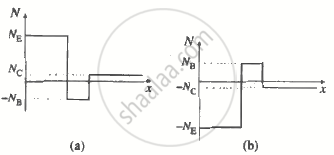
The base doping is less than the emitter doping but greater than the collector doping.
RELATED QUESTIONS
In a BJT, the largest current flow occurs ______.
The common-base DC current gain of a transistor is 0.967. If the emitter current is 10mA. What is the value of base current?
In a common-base connection, a certain transistor has an emitter current of 10mA and a collector current of 9.8 mA. Calculate the value of the base current.
Derive the relation between α and β.
In a common base configuration, the transistor has an emitter current of 10 mA and a collector current of 9.8 mA. The value of base current is ______
For a transistor IC = 15 mA, IB = 0.5 mA. What is the current amplification factor?
Sketch the static characteristics of a common emitter transistor and bring out the essential features of input and output characteristics.
A transistor having α = 0.8 is connected in common emitter configuration. When the base current changes by 6 mA, then the change in collector current is ______.
If l1, l2, l3 are the lengths of the emitter, base and collector of a transistor, then ____________.
For a transistor, the current ratio 'βdc' is defined as the ratio of ______.
In the study of transistor as an amplifier, the ratio of collector current to emitter current is 0.98 then the ratio of collector current to base current will be ______.
Ve, Vb, and Ve are emitter, base, and collector voltage respectively for npn transistor in CE mode. Amplifier works for the combination of biasing voltage equal to ______.
In an npn transistor, the base current is 100 µA and the collector current is 10 mA. The emitter current is ______.
In switching circuit, transistor is in ON state, values of IE and lB are 10 mA and 0.8 mA respectively and RL is 2 k`Omega`. If VCE is 7.6 V, then VCC is ____________.
In a silicon transistor, a change of 7.89 mA in the emitter current if produces a change of 7.8 mA in the collector current, then the base current must change by ____________.
The current gain `alpha` of a transistor is 0.95. The change in collector current corresponding to a change of 0.4 mA in the base current in a common emitter arrangement is ______.
In a transistor, doping level in base is increased slightly, the collector current and base current respectively ______.
In the case of transistor, the relation between current ratios αdc and βdc is ______.
A transistor having α = 0.8 is connected in a common emitter configuration. When the base current changes by 6 mA, the change in collector current is ______
In the common-emitter configuration of a transistor, the current gain is more than 1 because [lb, le, and lc are base, emitter, and collector currents respectively] ______
A conducting wire has length 'L1' and diameter 'd1'. After stretching the same wire length becomes 'L2' and diameter 'd2' The ratio of resistances before and after stretching is ______.
In a p-n-p transistor circuit, the collector current is 10 mA. If 90% of the holes emitted from the emitter reach the collector, ______.
The reverse bias in a junction diode is changed from 8V to 13V, then the value of the current changes from 40μA to 60μA. The resistance of junction diode will be ______.
The base current in common emitter mode of the transistor changes by 10 µA. If the current gain of the transistor is 50, then change in collector current is ______.
Define peak value of alternating signal.
Define β
In a transistor (common emitter configuration) the ratio of power gain to voltage gain is (α and β are current ratios) ______.
