Advertisements
Advertisements
Question
Why is the base of a transistor made thin and is lightly doped?
Advertisements
Solution
The base of a transistor is lightly doped than the emitter and narrowed so that almost all electrons injected from the emitter (in a n-p-n transistor) diffuse right across the base to the collector junction without recombining with holes. In other words, the base width is kept smaller than the recombination distance. In addition, to improve emitter efficiency and common-base current gain α, the emitter is much more heavily doped than the base.
APPEARS IN
RELATED QUESTIONS
In a BJT, the largest current flow occurs ______.
Why are the emitter, the base, and the collector of a BJT doped differently?
In a common-base connection, the emitter current is 6.28 mA and the collector current is 6.20 mA. Determine the common-base DC current gain.
Draw the circuit symbol of the PNP transistor.
Draw the circuit symbol for NPN and PNP transistors. What is the difference in the Emitter, Base, and Collector regions of a transistor?
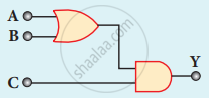
The output of the following circuit is 1 when the input ABC is
Give the Barkhausen conditions for sustained oscillations.
Transistor functions as a switch. Explain.
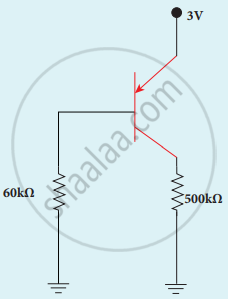
In the circuit shown in the figure, the BJT has a current gain (β) of 50. For an emitter-base voltage VEB = 600 mV, calculate the emitter-collector voltage VEC (in volts).
A common emitter amplifier is designed with n-p-n transistor (α = 0.99). The input impedance is 1 kΩ and the load is 10 kΩ. The voltage gain will be ______
In a transistor in CE configuration, the ratio of power gain to voltage gain is ____________.
In a common emitter amplifier circuit using an n-p-n transistor, the phase difference between the input and the output voltages will be: ____________.
In case of npn transistors, the collector current is always less than the emitter current because ______.
In a silicon transistor, a change of 7.89 mA in the emitter current if produces a change of 7.8 mA in the collector current, then the base current must change by ____________.
In a transistor, a change of 8.0 mA in the emitter current produces a change of 7.8 mA in the collector current. Then change in the base current is ____________.
A transistor when connected in common emitter mode has a ____________.
A pnp transistor is used in common-emitter mode. If a change of 40 µA in base current brings a change of 2 µA in collector current with 0.04 V in base-emitter voltage, then the input resistance is ____________.
The current gain `alpha` of a transistor is 0.95. The change in collector current corresponding to a change of 0.4 mA in the base current in a common emitter arrangement is ______.
In a transistor, doping level in base is increased slightly, the collector current and base current respectively ______.
A transistor is connected in C - E mode. If collector current is 72 × 10-5 A and α = 0.96, then base current will be ______.
For an ideal diode, the current in the following arrangement is ______.

A conducting wire has length 'L1' and diameter 'd1'. After stretching the same wire length becomes 'L2' and diameter 'd2' The ratio of resistances before and after stretching is ______.
For a transistor, αdc and βdc are the current ratios, then the value of `(beta_"dc"-delta_"dc")/(alpha_"dc".beta_"dc")`
The base current in common emitter mode of the transistor changes by 10 µA. If the current gain of the transistor is 50, then change in collector current is ______.
The transfer ratio of a transistor is 50. The input resistance of the transistor when used in the CE configuration is 1K Ω. The peak value for an AC input voltage of 0.01 V of collector current is ______.
In a transistor (common emitter configuration) the ratio of power gain to voltage gain is (α and β are current ratios) ______.
