Advertisements
Advertisements
प्रश्न
Why is the base of a transistor made thin and is lightly doped?
Advertisements
उत्तर
The base of a transistor is lightly doped than the emitter and narrowed so that almost all electrons injected from the emitter (in a n-p-n transistor) diffuse right across the base to the collector junction without recombining with holes. In other words, the base width is kept smaller than the recombination distance. In addition, to improve emitter efficiency and common-base current gain α, the emitter is much more heavily doped than the base.
APPEARS IN
संबंधित प्रश्न
Why are the emitter, the base, and the collector of a BJT doped differently?
In a common-base connection, the emitter current is 6.28 mA and the collector current is 6.20 mA. Determine the common-base DC current gain.
Derive the relation between α and β.
Draw the circuit symbol for NPN and PNP transistors. What is the difference in the Emitter, Base, and Collector regions of a transistor?
With the help of a neat circuit diagram, explain the transistor as an amplifier?
The principle based on which a solar cell operates is ____________.
Explain the need for a feedback circuit in a transistor oscillator.
Sketch the static characteristics of a common emitter transistor and bring out the essential features of input and output characteristics.
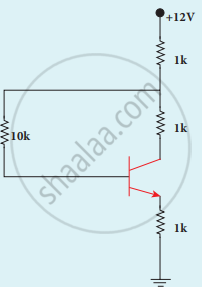
A transistor of α = 0.99 and VBE = 0.7 V is connected in the common-emitter configuration as shown in the figure. If the transistor is in the saturation region, find the value of collector current.
A transistor has a voltage gain A. If the amount βA of its output is applied to the input of the transistor, then the transistor becomes oscillator, when ______.
The condition to convert an amplified signal into an oscillating signal is ______
For a transistor, the current ratio 'βdc' is defined as the ratio of ______.
Least doped region in a transistor ____________.
If `alpha`-current gain of a transistor is 0.98. What is the value of `beta`- current gain of the transistor?
In an npn transistor, the collector current is 24 mA. If 80% of electrons reach collector, its base current in mA is ______.
ln switching circuit, transistor is in ON state and values of IC and IB are 4.2 mA and 5 µA respectively and RC= l k`Omega` and RB= 300 k`Omega`. If VBE = 0.5 V, find the value of VBB.
In a transistor in CE configuration, the ratio of power gain to voltage gain is ____________.
In switching circuit, transistor is in ON state, values of IE and lB are 10 mA and 0.8 mA respectively and RL is 2 k`Omega`. If VCE is 7.6 V, then VCC is ____________.
In case of npn transistors, the collector current is always less than the emitter current because ______.
For a common emitter configuration, if 'α' and 'β' have their usual meanings, the correct relationship between 'α' and 'β' is ______.
A change of 9.0 mA in the emitter current brings a change of 8.9 mA in the collector current. The value of current gain β will be ______.
A transistor is connected in C - E mode. If collector current is 72 × 10-5 A and α = 0.96, then base current will be ______.
A transistor having α = 0.8 is connected in a common emitter configuration. When the base current changes by 6 mA, the change in collector current is ______
A conducting wire has length 'L1' and diameter 'd1'. After stretching the same wire length becomes 'L2' and diameter 'd2' The ratio of resistances before and after stretching is ______.
In a p-n-p transistor circuit, the collector current is 10 mA. If 90% of the holes emitted from the emitter reach the collector, ______.
The reverse bias in a junction diode is changed from 8V to 13V, then the value of the current changes from 40μA to 60μA. The resistance of junction diode will be ______.
The transfer ratio of a transistor is 50. The input resistance of the transistor when used in the CE configuration is 1K Ω. The peak value for an AC input voltage of 0.01 V of collector current is ______.
The collector current in a common-emitter transistor amplifier is 4 mA. When the base current is increased by 20 µA, the collector current increases to 6 mA. The current gain is ______.
In a CE amplifier, the current gain is 80 and the emitter current is 9 mA. The base current is ______.
Define peak value of alternating signal.
