Advertisements
Advertisements
प्रश्न
Draw the circuit symbol for NPN and PNP transistors. What is the difference in the Emitter, Base, and Collector regions of a transistor?
Advertisements
उत्तर
The circuit symbols of the two types of transistors:
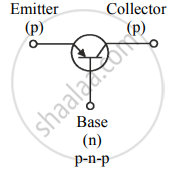
Figure (a)
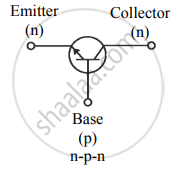
Figure (b)
The difference in the Emitter (E), the Base (b), and the Collector (C) are as follows:
- Emitter: It is a thick heavily doped layer. This supplies a large number of majority carriers for the current flow through the transistor
- Base: It is the thin, lightly doped central layer.
- Collector: It is a thick and moderately doped layer. Its area is larger than that of the emitter and the base. This layer collects a major portion of the majority of carriers supplied by the emitter. The collector also helps dissipation of any small amount of heat generated.
APPEARS IN
संबंधित प्रश्न
Draw the circuit symbol of the PNP transistor.
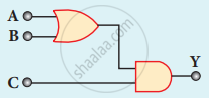
The output of the following circuit is 1 when the input ABC is
Explain the current flow in an NPN transistor.
Explain the need for a feedback circuit in a transistor oscillator.
Sketch the static characteristics of a common emitter transistor and bring out the essential features of input and output characteristics.
A common emitter amplifier is designed with n-p-n transistor (α = 0.99). The input impedance is 1 kΩ and the load is 10 kΩ. The voltage gain will be ______
For a transistor, the current ratio 'βdc' is defined as the ratio of ______.
In the symbol for a transistor, the arrow head points in the direction of the ____________.
If `alpha`-current gain of a transistor is 0.98. What is the value of `beta`- current gain of the transistor?
In an npn transistor, the base current is 100 µA and the collector current is 10 mA. The emitter current is ______.
In a common emitter amplifier circuit using an n-p-n transistor, the phase difference between the input and the output voltages will be: ____________.
The current gain `alpha` of a transistor is 0.95. The change in collector current corresponding to a change of 0.4 mA in the base current in a common emitter arrangement is ______.
In transistor amplifier, base-emitter junction is forward biased and collector emitter junction is reverse biased. The current gain is ______.
A transistor is connected in C - E mode. If collector current is 72 × 10-5 A and α = 0.96, then base current will be ______.
In common emitter amplifier, a change of 0.2 mA in the base current causes a change of 5 mA in the collector current. If input resistance is 2K `Omega` and voltage gain is 75, the load resistance used in the circuit is ______.
In a study of transistor as an amplifier, the ratio of collector current to emitter current is 0.98. The collector current is 3mA, then base current will be approximately ______.
A transistor having α = 0.8 is connected in a common emitter configuration. When the base current changes by 6 mA, the change in collector current is ______
A common emitter amplifier has a voltage gain of 50, an input impedance of 100Ω and an output impedance of 2000Ω. The power gain of the amplifier is ______.
A transistor is used as a common emitter amplifier with a load resistance 2 KΩ. The input resistance is 150 Ω. Base current is changed by 20 µA which results in a change in collector current by 1.5 mA. The voltage gain of the amplifier is ______.
In a p-n-p transistor circuit, the collector current is 10 mA. If 90% of the holes emitted from the emitter reach the collector, ______.
The base current in common emitter mode of the transistor changes by 10 µA. If the current gain of the transistor is 50, then change in collector current is ______.
The current amplification factor for a transistor in its common emitter mode is 50. The current amplification factor in the common base mode of the transistor is ______.
In a CE amplifier, the current gain is 80 and the emitter current is 9 mA. The base current is ______.
Define peak value of alternating signal.
Define β
For a common emitter transistor configuration the ratio of `I_c/I_E` = 0.96, then the current gain in this configuration is ______.
In the case of constants ‘α’ and ‘β’ of a transistor ______.
