Advertisements
Advertisements
प्रश्न
With the help of a neat diagram, explain the working of the npn transistor?
Advertisements
उत्तर
Working of n-p-n transistor:
- The majority of charge carriers in the emitter of the n-p-n transistor are electrons.
- A typical biasing of a transistor is shown in figure (a). In this, the emitter-base junction is forward biased while the collector-base junction is reverse biased.

Figure (a) - At the instant when the EB junction is forward biased, electrons in the emitter region have not entered the base region as shown in figure (b).

Figure (b) - When the biasing voltage VBE is greater than the barrier potential (0.6 – 0.7 V for Si transistors), many electrons enter the base region and form the emitter current IE as shown in figure (c).
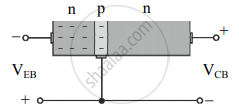
Figure (c) - These electrons can either flow through the base circuit and constitute the base current (IB), or they can also flow through the collector circuit and contribute towards the collector current (IC).
- The base is thin and lightly doped, the base current is only 5% of IE.
- Electrons injected from the emitter into the base diffuse into the collector-base depletion region due to the thin base region. When the electrons enter the collector-base depletion region, they are pushed into the collector region by the electric field at the collector-base depletion region. The collector current (IC) flows through the external circuit as shown in figure (d). The collector's current IC is about 95% of IE.

Figure (d)
From the figure, we can conclude that IE = IB + IC Since the base current IB is very small we can write IC ≈ IE.
APPEARS IN
संबंधित प्रश्न
Derive the relation between α and β.
Draw the circuit symbol of the PNP transistor.
Draw the circuit symbol for NPN and PNP transistors. What is the difference in the Emitter, Base, and Collector regions of a transistor?
With the help of a neat circuit diagram, explain the transistor as an amplifier?
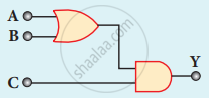
The output of the following circuit is 1 when the input ABC is
Explain the current flow in an NPN transistor.
Explain the need for a feedback circuit in a transistor oscillator.
What is rectification?
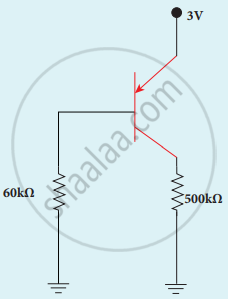
In the circuit shown in the figure, the BJT has a current gain (β) of 50. For an emitter-base voltage VEB = 600 mV, calculate the emitter-collector voltage VEC (in volts).
In a common emitter amplifier, the input resistance is 1000 Ω, the peak value of Input signal voltage is 5 mV, and β = 60. The peak value of output current is
A common emitter amplifier is designed with n-p-n transistor (α = 0.99). The input impedance is 1 kΩ and the load is 10 kΩ. The voltage gain will be ______
A transistor having α = 0.8 is connected in common emitter configuration. When the base current changes by 6 mA, then the change in collector current is ______.
For a transistor, the current ratio 'βdc' is defined as the ratio of ______.
Least doped region in a transistor ____________.
In a transistor in CE configuration, the ratio of power gain to voltage gain is ____________.
In a common emitter amplifier circuit using an n-p-n transistor, the phase difference between the input and the output voltages will be: ____________.
In case of npn transistors, the collector current is always less than the emitter current because ______.
A transistor when connected in common emitter mode has a ____________.
In a transistor, the thickness of the base region ____________.
In a transistor, doping level in base is increased slightly, the collector current and base current respectively ______.
In transistor amplifier, base-emitter junction is forward biased and collector emitter junction is reverse biased. The current gain is ______.
In common emitter mode of transistor, the d.c. current gain is 20, the emitter current is 7 mA. The collector current is ______.
A common emitter amplifier has a voltage gain of 50, an input impedance of 100Ω and an output impedance of 2000Ω. The power gain of the amplifier is ______.
A common emitter amplifier circuit built using an n-p-n transistor is shown in the figure. Its DC current gain is 300, RC = 4 kΩ and VCC = 20 V. What is the minimum base current for VCE to reach saturation?

The current amplification factor for a transistor in its common emitter mode is 50. The current amplification factor in the common base mode of the transistor is ______.
Explain the working of the n-p-n transistor in a common base configuration.
Define β
When an n-p-n junction transistor is used as an amplifier in common emitter mode, ______.
