Advertisements
Advertisements
प्रश्न
Derive the relation between α and β.
Obtain the relation between the current gain αDC and βDC for a transistor.
Advertisements
उत्तर
In common emitter configuration, the emitter current is
IE = IB + lC ...(i)
Dividing the above equation by lC we get
`"I"_"E"/"I"_"C" = "I"_"B"/"I"_"C" + 1`
By definition of αDC and βDC
∴ `1/alpha_"DC" = 1/beta_"DC" + 1` ...(ii)
`1/alpha_"DC" = (beta_"DC" + 1)/beta_"DC"`
∴ `alpha_"DC" = beta_"DC"/(1 + beta_"DC")`
∴ `alpha_"DC" = beta/(1 + beta)` ...(iii)
Also, from equation (ii),
`1/alpha_"DC" - 1 = 1/beta_"DC"`
`(1 - alpha_"DC")/alpha_"DC" = 1/beta_"DC"`
∴ `beta_"DC" = alpha_"DC"/(1 - alpha_"dc")`
∴ `beta_"DC" = alpha/(1 - alpha)` ...(iv)
संबंधित प्रश्न
In a common-base connection, a certain transistor has an emitter current of 10mA and a collector current of 9.8 mA. Calculate the value of the base current.
In a transistor amplifier, IC = 5.5 mA , IE = 5.6 mA. The current amplification factor β is ______
For a transistor IC = 15 mA, IB = 0.5 mA. What is the current amplification factor?
Draw the circuit diagram to study the characteristic of the transistor in common emitter mode. Draw the input and output characteristics.
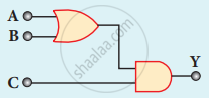
The output of the following circuit is 1 when the input ABC is
Give the Barkhausen conditions for sustained oscillations.
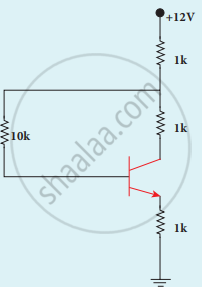
A transistor of α = 0.99 and VBE = 0.7 V is connected in the common-emitter configuration as shown in the figure. If the transistor is in the saturation region, find the value of collector current.
If l1, l2, l3 are the lengths of the emitter, base and collector of a transistor, then ____________.
In switching circuit, transistor is in ON state. Values of IC and IB are 5.2 mA and 10 µA respectively and value of RC is 1 k`Omega`. If Vcc is at 5.5 V, then VCE is ______.
Ve, Vb, and Ve are emitter, base, and collector voltage respectively for npn transistor in CE mode. Amplifier works for the combination of biasing voltage equal to ______.
In switching circuit, transistor is in ON state, values of IE and lB are 10 mA and 0.8 mA respectively and RL is 2 k`Omega`. If VCE is 7.6 V, then VCC is ____________.
Which of the following regions of a transistors are, respectively, heavily dopped and lightly dopped?
In a common emitter amplifier circuit using an n-p-n transistor, the phase difference between the input and the output voltages will be: ____________.
In case of npn transistors, the collector current is always less than the emitter current because ______.
In an npn transistor circuit, the collector current is 10 mA. If 90% of the electrons emitted reach the collector, the emitter current (IE) and base current (IB) are given by ____________.
In a transistor, the thickness of the base region ____________.
In a transistor, doping level in base is increased slightly, the collector current and base current respectively ______.
In transistor amplifier, base-emitter junction is forward biased and collector emitter junction is reverse biased. The current gain is ______.
A common emitter amplifier has a voltage gain of 50, an input impedance of 100Ω and an output impedance of 2000Ω. The power gain of the amplifier is ______.
For a transistor, αdc and βdc are the current ratios, then the value of `(beta_"dc"-delta_"dc")/(alpha_"dc".beta_"dc")`
In a p-n-p transistor circuit, the collector current is 10 mA. If 90% of the holes emitted from the emitter reach the collector, ______.
The transfer ratio of a transistor is 50. The input resistance of the transistor when used in the CE configuration is 1K Ω. The peak value for an AC input voltage of 0.01 V of collector current is ______.
Define peak value of alternating signal.
Explain the output characteristics of common emitter configuration of n-p-n transistor.
Define β
For a common emitter transistor configuration the ratio of `I_c/I_E` = 0.96, then the current gain in this configuration is ______.
