Advertisements
Advertisements
प्रश्न
What is rectification?
Advertisements
उत्तर
- Rectification is the process of converting alternating current into the direct current is called rectification.
- An alternating current voltage varies sinusoidally, which means that its value and direction change in one cycle.
- A rectifier turns this bidirectional voltage or current to a unidirectional voltage, which is then converted to a DC voltage. This is known as correction.
- Rectification is the process of converting an alternating current voltage to a direct current voltage.
APPEARS IN
संबंधित प्रश्न
In a common-base connection, the emitter current is 6.28 mA and the collector current is 6.20 mA. Determine the common-base DC current gain.
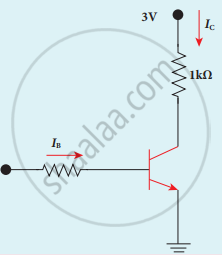
Assuming VCEsat = 0.2 V and β = 50, find the minimum base current (IB) required to drive the transistor given in the figure to saturation.
A transistor has a voltage gain A. If the amount βA of its output is applied to the input of the transistor, then the transistor becomes oscillator, when ______.
The condition to convert an amplified signal into an oscillating signal is ______
For a common emitter configuration, if 'α' and 'β' have their usual meanings, the correct relationship between 'α' and 'β' is ______.
A transistor when connected in common emitter mode has a ____________.
In common emitter mode of transistor, the d.c. current gain is 20, the emitter current is 7 mA. The collector current is ______.
A transistor is used as a common emitter amplifier with a load resistance 2 KΩ. The input resistance is 150 Ω. Base current is changed by 20 µA which results in a change in collector current by 1.5 mA. The voltage gain of the amplifier is ______.
The transfer ratio of a transistor is 50. The input resistance of the transistor when used in the CE configuration is 1K Ω. The peak value for an AC input voltage of 0.01 V of collector current is ______.
In a CE amplifier, the current gain is 80 and the emitter current is 9 mA. The base current is ______.
