Advertisements
Advertisements
प्रश्न
Why is the base of a transistor made thin and is lightly doped?
Advertisements
उत्तर
The base of a transistor is lightly doped than the emitter and narrowed so that almost all electrons injected from the emitter (in a n-p-n transistor) diffuse right across the base to the collector junction without recombining with holes. In other words, the base width is kept smaller than the recombination distance. In addition, to improve emitter efficiency and common-base current gain α, the emitter is much more heavily doped than the base.
APPEARS IN
संबंधित प्रश्न
In a common-base connection, a certain transistor has an emitter current of 10mA and a collector current of 9.8 mA. Calculate the value of the base current.
In a common-base connection, the emitter current is 6.28 mA and the collector current is 6.20 mA. Determine the common-base DC current gain.
In a transistor amplifier, IC = 5.5 mA , IE = 5.6 mA. The current amplification factor β is ______
The light emitted in an LED is due to
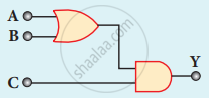
The output of the following circuit is 1 when the input ABC is
Explain the current flow in an NPN transistor.
Explain the need for a feedback circuit in a transistor oscillator.
What is rectification?
In a common emitter amplifier, the input resistance is 1000 Ω, the peak value of Input signal voltage is 5 mV, and β = 60. The peak value of output current is
The condition to convert an amplified signal into an oscillating signal is ______
In the symbol for a transistor, the arrow head points in the direction of the ____________.
In switching circuit, transistor is in ON state. Values of IC and IB are 5.2 mA and 10 µA respectively and value of RC is 1 k`Omega`. If Vcc is at 5.5 V, then VCE is ______.
In case of npn transistors, the collector current is always less than the emitter current because ______.
In a transistor, a change of 8.0 mA in the emitter current produces a change of 7.8 mA in the collector current. Then change in the base current is ____________.
A transistor when connected in common emitter mode has a ____________.
In transistor amplifier, base-emitter junction is forward biased and collector emitter junction is reverse biased. The current gain is ______.
A transistor is connected in C - E mode. If collector current is 72 × 10-5 A and α = 0.96, then base current will be ______.
In common emitter amplifier, a change of 0.2 mA in the base current causes a change of 5 mA in the collector current. If input resistance is 2K `Omega` and voltage gain is 75, the load resistance used in the circuit is ______.
In the common-emitter configuration of a transistor, the current gain is more than 1 because [lb, le, and lc are base, emitter, and collector currents respectively] ______
A transistor is used as a common emitter amplifier with a load resistance 2 KΩ. The input resistance is 150 Ω. Base current is changed by 20 µA which results in a change in collector current by 1.5 mA. The voltage gain of the amplifier is ______.
For a transistor, αdc and βdc are the current ratios, then the value of `(beta_"dc"-delta_"dc")/(alpha_"dc".beta_"dc")`
In a p-n-p transistor circuit, the collector current is 10 mA. If 90% of the holes emitted from the emitter reach the collector, ______.
A common emitter amplifier circuit built using an n-p-n transistor is shown in the figure. Its DC current gain is 300, RC = 4 kΩ and VCC = 20 V. What is the minimum base current for VCE to reach saturation?

In a CE amplifier, the current gain is 80 and the emitter current is 9 mA. The base current is ______.
Define peak value of alternating signal.
When an n-p-n junction transistor is used as an amplifier in common emitter mode, ______.
In a transistor (common emitter configuration) the ratio of power gain to voltage gain is (α and β are current ratios) ______.
