Advertisements
Advertisements
प्रश्न
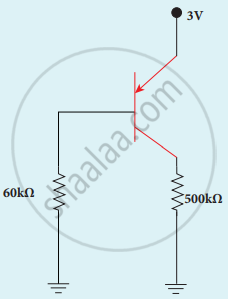
In the circuit shown in the figure, the BJT has a current gain (β) of 50. For an emitter-base voltage VEB = 600 mV, calculate the emitter-collector voltage VEC (in volts).
Advertisements
उत्तर
β = 50
VEB = 600 × 10−3 V
RB = 60 k Ω
RC = 500 k Ω
VB = VE – VEB
= 3 – 0.6
= 2.4 V
IB = `"V"_"B"/"R"_"B"`
= `2.4/(60 xx 10^9)`
= 0.04 × 10⁻³ A
IB = 40 µA
IC = β IB
= 50 × 40 × 10−6
IC = 2 mA
VC = IC RC = 500 IC
= 500 × 2 × 10−3
VEC = VE – VC
= 3 – 1
= 2 V
APPEARS IN
संबंधित प्रश्न
In a BJT, the largest current flow occurs ______.
Which method of biasing is used for operating a transistor as an amplifier?
With the help of a neat circuit diagram, explain the transistor as an amplifier?
The light emitted in an LED is due to
Give the Barkhausen conditions for sustained oscillations.
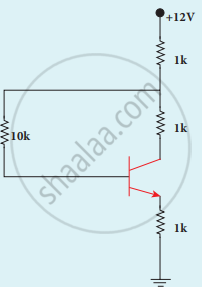
A transistor of α = 0.99 and VBE = 0.7 V is connected in the common-emitter configuration as shown in the figure. If the transistor is in the saturation region, find the value of collector current.
In the symbol for a transistor, the arrow head points in the direction of the ____________.
In an npn transistor, the base current is 100 µA and the collector current is 10 mA. The emitter current is ______.
A transistor when connected in common emitter mode has a ____________.
The current gain `alpha` of a transistor is 0.95. The change in collector current corresponding to a change of 0.4 mA in the base current in a common emitter arrangement is ______.
