Advertisements
Advertisements
Question
In the circuit shown in the figure, the BJT has a current gain (β) of 50. For an emitter-base voltage VEB = 600 mV, calculate the emitter-collector voltage VEC (in volts).
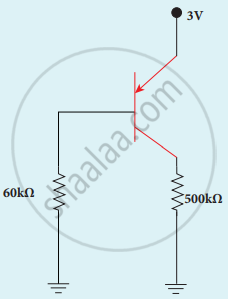
Advertisements
Solution
β = 50
VEB = 600 × 10−3 V
RB = 60 k Ω
RC = 500 k Ω
VB = VE – VEB
= 3 – 0.6
= 2.4 V
IB = `"V"_"B"/"R"_"B"`
= `2.4/(60 xx 10^9)`
= 0.04 × 10⁻³ A
IB = 40 µA
IC = β IB
= 50 × 40 × 10−6
IC = 2 mA
VC = IC RC = 500 IC
= 500 × 2 × 10−3
VEC = VE – VC
= 3 – 1
= 2 V
APPEARS IN
RELATED QUESTIONS
The common-base DC current gain of a transistor is 0.967. If the emitter current is 10mA. What is the value of base current?
For a transistor β =75 and IE = 7.5 mA. The value of α is ______
Explain the current flow in an NPN transistor.
What is rectification?
Describe the function of a transistor as an amplifier with the neat circuit diagram. Sketch the input and output wave forms.
For a transistor, the current ratio 'βdc' is defined as the ratio of ______.
In an npn transistor, the base current is 100 µA and the collector current is 10 mA. The emitter current is ______.
In a transistor in CE configuration, the ratio of power gain to voltage gain is ____________.
For an ideal diode, the current in the following arrangement is ______.

Define peak value of alternating signal.
