Advertisements
Advertisements
Question
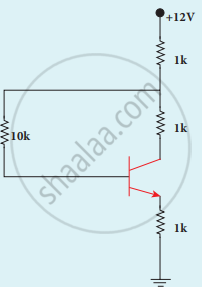
A transistor of α = 0.99 and VBE = 0.7 V is connected in the common-emitter configuration as shown in the figure. If the transistor is in the saturation region, find the value of collector current.
Advertisements
Solution
Vcc = 12 V
α = 0.99
VBE = 0.7 V
IC =?
Applying Kirchoff’s voltage law,
VBE + (IC + IB) 1k + 10k.IB + (IC + IB) 1k = 12 ………(1)
IB = `"I"_"C"/β`
β = `α/(1 - α) = 0.99/(1 - 0.99)` = 0.99
IB = `"I"_"C"/99`
IC = β IB
IC = 99 IB
IC = `"I"_"C"/99`
VBE = 0.7 V
Substitute in equation (1)
`0.7/10^3 + (99 "I"_"B" + "I"_"B") + 10 "I"_"B" + (99 "I"_"B" + "I"_"B") = 12/10^3`
100 IB + 10 IB + 100 IB = `(12 - 0.7)/10^3`
210 IB = `11.3/10^3`;
IB = 0.054 × 10⁻³ A
IC = 99 IB = 99 × 0.054 × 10−3 A
IC = 5.34 × 10⁻³ A
IC = 5.34 mA
APPEARS IN
RELATED QUESTIONS
The common-base DC current gain of a transistor is 0.967. If the emitter current is 10mA. What is the value of base current?
Derive the relation between α and β.
For a transistor β =75 and IE = 7.5 mA. The value of α is ______
The condition to convert an amplified signal into an oscillating signal is ______
ln switching circuit, transistor is in ON state and values of IC and IB are 4.2 mA and 5 µA respectively and RC= l k`Omega` and RB= 300 k`Omega`. If VBE = 0.5 V, find the value of VBB.
In a transistor in CE configuration, the ratio of power gain to voltage gain is ____________.
In transistor amplifier, base-emitter junction is forward biased and collector emitter junction is reverse biased. The current gain is ______.
A transistor is used as a common emitter amplifier with a load resistance 2 KΩ. The input resistance is 150 Ω. Base current is changed by 20 µA which results in a change in collector current by 1.5 mA. The voltage gain of the amplifier is ______.
The base current in common emitter mode of the transistor changes by 10 µA. If the current gain of the transistor is 50, then change in collector current is ______.
Explain the working of the n-p-n transistor in a common base configuration.
