Advertisements
Advertisements
Question
Assuming VCEsat = 0.2 V and β = 50, find the minimum base current (IB) required to drive the transistor given in the figure to saturation.
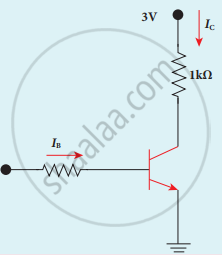
Advertisements
Solution
VCC = 3 V
β = 50
IB =?
Collector current
VCC = 3 – 0.2 = 2.8 V
IC = `"V"_"CC"/"R"_"c"`
= `2.8/(1 xx 10^3)`
= 2.8 × 10⁻³ A
β = `"I"_"c"/"I"_"B"`
IB = `"I"_"c"/β`
= `(2.8 xx 10^-3)/50`
= 56 × 10−6 A
IB = 56 µA
APPEARS IN
RELATED QUESTIONS
In a common-base connection, a certain transistor has an emitter current of 10mA and a collector current of 9.8 mA. Calculate the value of the base current.
In a common base configuration, the transistor has an emitter current of 10 mA and a collector current of 9.8 mA. The value of base current is ______
Explain the current flow in an NPN transistor.
Transistor functions as a switch. Explain.
In a transistor in CE configuration, the ratio of power gain to voltage gain is ____________.
The current gain `alpha` of a transistor is 0.95. The change in collector current corresponding to a change of 0.4 mA in the base current in a common emitter arrangement is ______.
In a transistor, doping level in base is increased slightly, the collector current and base current respectively ______.
A change of 9.0 mA in the emitter current brings a change of 8.9 mA in the collector current. The value of current gain β will be ______.
In common emitter amplifier, a change of 0.2 mA in the base current causes a change of 5 mA in the collector current. If input resistance is 2K `Omega` and voltage gain is 75, the load resistance used in the circuit is ______.
In a CE amplifier, the current gain is 80 and the emitter current is 9 mA. The base current is ______.
