Advertisements
Advertisements
Question
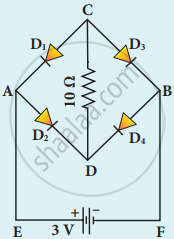
Four silicon diodes and a 10 Ω resistor are connected as shown in the figure below. Each diode has a resistance of 1 Ω. Find the current flows through the 10 Ω resistor.
Advertisements
Solution
Current flow through D1 and D3 = 2 Ω
Current flow through D2 and D4 = 2 Ω
These two are in parallel so
Net resistants = `1/2 + 1/2` = 1 Ω
Total Resistance = 1 Ω + 18 Ω = 19 Ω
V = 2.5 Ω
I = `"V"/"R" = 2.5/19`
I = 0.13 A
APPEARS IN
RELATED QUESTIONS
In an unbiased p-n junction, the majority of charge carriers (that is, holes) in the p-region diffuse into the n-region because of
The zener diode is primarily used as ____________.
Which one of the following represents forward bias diode?
What do you mean by leakage current in a diode?
Draw the input and output waveforms of a full wave rectifier.
Distinguish between avalanche breakdown and Zener breakdown.
What is meant by biasing?
What is an LED? Give the principle of its operation with a diagram.
Write notes on the photodiode.
Determine the current flowing through 3 Ω and 4 Ω resistors of the circuit given below. Assume that diodes D1 and D2 are ideal diodes.

