Advertisements
Advertisements
प्रश्न
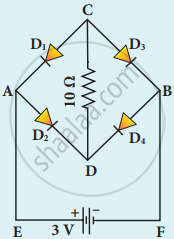
Four silicon diodes and a 10 Ω resistor are connected as shown in the figure below. Each diode has a resistance of 1 Ω. Find the current flows through the 10 Ω resistor.
Advertisements
उत्तर
Current flow through D1 and D3 = 2 Ω
Current flow through D2 and D4 = 2 Ω
These two are in parallel so
Net resistants = `1/2 + 1/2` = 1 Ω
Total Resistance = 1 Ω + 18 Ω = 19 Ω
V = 2.5 Ω
I = `"V"/"R" = 2.5/19`
I = 0.13 A
APPEARS IN
संबंधित प्रश्न
In an unbiased p-n junction, the majority of charge carriers (that is, holes) in the p-region diffuse into the n-region because of
If a positive half-wave rectified voltage is fed to a load resistor, for which part of a cycle there will be current flow through the load?
The zener diode is primarily used as ____________.
The barrier potential of a p-n junction depends on
(i) type of semiconductor material
(ii) amount of doping
(iii) temperature
Which one of the following is correct?
Mention the types of biasing.
Explain the construction and working of a full-wave rectifier.
Write notes on the photodiode.
Explain the formation of depletion region and barrier potential in PN junction diode.
The given circuit has two ideal diodes connected as shown in the figure below. Calculate the current flowing through the resistance R1.

Determine the current flowing through 3 Ω and 4 Ω resistors of the circuit given below. Assume that diodes D1 and D2 are ideal diodes.

