Advertisements
Advertisements
प्रश्न
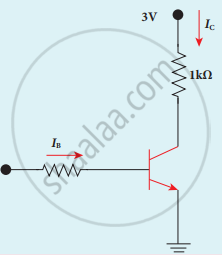
Assuming VCEsat = 0.2 V and β = 50, find the minimum base current (IB) required to drive the transistor given in the figure to saturation.
Advertisements
उत्तर
VCC = 3 V
β = 50
IB =?
Collector current
VCC = 3 – 0.2 = 2.8 V
IC = `"V"_"CC"/"R"_"c"`
= `2.8/(1 xx 10^3)`
= 2.8 × 10⁻³ A
β = `"I"_"c"/"I"_"B"`
IB = `"I"_"c"/β`
= `(2.8 xx 10^-3)/50`
= 56 × 10−6 A
IB = 56 µA
APPEARS IN
संबंधित प्रश्न
For a transistor IC = 15 mA, IB = 0.5 mA. What is the current amplification factor?
The light emitted in an LED is due to
If l1, l2, l3 are the lengths of the emitter, base and collector of a transistor, then ____________.
In switching circuit, transistor is in ON state, values of IE and lB are 10 mA and 0.8 mA respectively and RL is 2 k`Omega`. If VCE is 7.6 V, then VCC is ____________.
Which of the following regions of a transistors are, respectively, heavily dopped and lightly dopped?
In a common emitter amplifier circuit using an n-p-n transistor, the phase difference between the input and the output voltages will be: ____________.
In an npn transistor circuit, the collector current is 10 mA. If 90% of the electrons emitted reach the collector, the emitter current (IE) and base current (IB) are given by ____________.
In a transistor, the thickness of the base region ____________.
In the case of transistor, the relation between current ratios αdc and βdc is ______.
A common emitter amplifier circuit built using an n-p-n transistor is shown in the figure. Its DC current gain is 300, RC = 4 kΩ and VCC = 20 V. What is the minimum base current for VCE to reach saturation?

