Advertisements
Advertisements
Question
Draw the circuit symbol of the PNP transistor.
Advertisements
Solution
The circuit symbol of the p-n-p transistor

APPEARS IN
RELATED QUESTIONS
Derive the relation between α and β.
For a transistor β =75 and IE = 7.5 mA. The value of α is ______
With the help of a neat circuit diagram, explain the transistor as an amplifier?
The light emitted in an LED is due to
Explain the current flow in an NPN transistor.
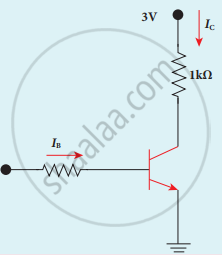
Assuming VCEsat = 0.2 V and β = 50, find the minimum base current (IB) required to drive the transistor given in the figure to saturation.
A transistor has a voltage gain A. If the amount βA of its output is applied to the input of the transistor, then the transistor becomes oscillator, when ______.
A common emitter amplifier is designed with n-p-n transistor (α = 0.99). The input impedance is 1 kΩ and the load is 10 kΩ. The voltage gain will be ______
The condition to convert an amplified signal into an oscillating signal is ______
A transistor having α = 0.8 is connected in common emitter configuration. When the base current changes by 6 mA, then the change in collector current is ______.
If l1, l2, l3 are the lengths of the emitter, base and collector of a transistor, then ____________.
In the symbol for a transistor, the arrow head points in the direction of the ____________.
Ve, Vb, and Ve are emitter, base, and collector voltage respectively for npn transistor in CE mode. Amplifier works for the combination of biasing voltage equal to ______.
In an npn transistor, the base current is 100 µA and the collector current is 10 mA. The emitter current is ______.
Which of the following regions of a transistors are, respectively, heavily dopped and lightly dopped?
In a transistor, a change of 8.0 mA in the emitter current produces a change of 7.8 mA in the collector current. Then change in the base current is ____________.
A transistor when connected in common emitter mode has a ____________.
In a transistor, the thickness of the base region ____________.
In the case of transistor, the relation between current ratios αdc and βdc is ______.
In common emitter mode of transistor, the d.c. current gain is 20, the emitter current is 7 mA. The collector current is ______.
A transistor is used as a common emitter amplifier with a load resistance 2 KΩ. The input resistance is 150 Ω. Base current is changed by 20 µA which results in a change in collector current by 1.5 mA. The voltage gain of the amplifier is ______.
For a transistor, αdc and βdc are the current ratios, then the value of `(beta_"dc"-delta_"dc")/(alpha_"dc".beta_"dc")`
In a CE amplifier, the current gain is 80 and the emitter current is 9 mA. The base current is ______.
Explain the output characteristics of common emitter configuration of n-p-n transistor.
Define β
In a transistor (common emitter configuration) the ratio of power gain to voltage gain is (α and β are current ratios) ______.
