Advertisements
Advertisements
Question
Draw the circuit diagram to study the characteristic of the transistor in common emitter mode. Draw the input and output characteristics.
Advertisements
Solution
- Circuit to study Common Emitter (CE) characteristic:

- The Input characteristics:

- The output characteristics:

APPEARS IN
RELATED QUESTIONS
In a common-base connection, a certain transistor has an emitter current of 10mA and a collector current of 9.8 mA. Calculate the value of the base current.
In a common base configuration, the transistor has an emitter current of 10 mA and a collector current of 9.8 mA. The value of base current is ______
In a transistor amplifier, IC = 5.5 mA , IE = 5.6 mA. The current amplification factor β is ______
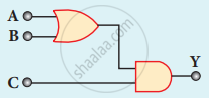
The output of the following circuit is 1 when the input ABC is
Give the Barkhausen conditions for sustained oscillations.
Explain the need for a feedback circuit in a transistor oscillator.
Sketch the static characteristics of a common emitter transistor and bring out the essential features of input and output characteristics.
Describe the function of a transistor as an amplifier with the neat circuit diagram. Sketch the input and output wave forms.
A transistor having α = 0.8 is connected in common emitter configuration. When the base current changes by 6 mA, then the change in collector current is ______.
For a transistor, the current ratio 'βdc' is defined as the ratio of ______.
Least doped region in a transistor ____________.
In switching circuit, transistor is in ON state. Values of IC and IB are 5.2 mA and 10 µA respectively and value of RC is 1 k`Omega`. If Vcc is at 5.5 V, then VCE is ______.
In switching circuit, transistor is in ON state, values of IE and lB are 10 mA and 0.8 mA respectively and RL is 2 k`Omega`. If VCE is 7.6 V, then VCC is ____________.
For a common emitter configuration, if 'α' and 'β' have their usual meanings, the correct relationship between 'α' and 'β' is ______.
In a transistor, the thickness of the base region ____________.
In a transistor, doping level in base is increased slightly, the collector current and base current respectively ______.
A transistor having α = 0.8 is connected in a common emitter configuration. When the base current changes by 6 mA, the change in collector current is ______
A transistor is used as a common emitter amplifier with a load resistance 2 KΩ. The input resistance is 150 Ω. Base current is changed by 20 µA which results in a change in collector current by 1.5 mA. The voltage gain of the amplifier is ______.
A conducting wire has length 'L1' and diameter 'd1'. After stretching the same wire length becomes 'L2' and diameter 'd2' The ratio of resistances before and after stretching is ______.
The base current in common emitter mode of the transistor changes by 10 µA. If the current gain of the transistor is 50, then change in collector current is ______.
Explain the working of the n-p-n transistor in a common base configuration.
In a CE amplifier, the current gain is 80 and the emitter current is 9 mA. The base current is ______.
Define peak value of alternating signal.
Explain the output characteristics of common emitter configuration of n-p-n transistor.
For a common emitter transistor configuration the ratio of `I_c/I_E` = 0.96, then the current gain in this configuration is ______.
