Advertisements
Advertisements
प्रश्न
Draw the circuit diagram to study the characteristic of the transistor in common emitter mode. Draw the input and output characteristics.
Advertisements
उत्तर
- Circuit to study Common Emitter (CE) characteristic:

- The Input characteristics:

- The output characteristics:

APPEARS IN
संबंधित प्रश्न
In a BJT, the largest current flow occurs ______.
Why is the base of a transistor made thin and is lightly doped?
For a transistor β =75 and IE = 7.5 mA. The value of α is ______
For a transistor IC = 15 mA, IB = 0.5 mA. What is the current amplification factor?
With the help of a neat diagram, explain the working of the npn transistor?
Give the Barkhausen conditions for sustained oscillations.
Sketch the static characteristics of a common emitter transistor and bring out the essential features of input and output characteristics.
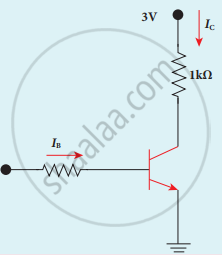
Assuming VCEsat = 0.2 V and β = 50, find the minimum base current (IB) required to drive the transistor given in the figure to saturation.
A transistor having α = 0.8 is connected in common emitter configuration. When the base current changes by 6 mA, then the change in collector current is ______.
If l1, l2, l3 are the lengths of the emitter, base and collector of a transistor, then ____________.
In the symbol for a transistor, the arrow head points in the direction of the ____________.
In the study of transistor as an amplifier, the ratio of collector current to emitter current is 0.98 then the ratio of collector current to base current will be ______.
In switching circuit, transistor is in ON state. Values of IC and IB are 5.2 mA and 10 µA respectively and value of RC is 1 k`Omega`. If Vcc is at 5.5 V, then VCE is ______.
ln switching circuit, transistor is in ON state and values of IC and IB are 4.2 mA and 5 µA respectively and RC= l k`Omega` and RB= 300 k`Omega`. If VBE = 0.5 V, find the value of VBB.
Which of the following regions of a transistors are, respectively, heavily dopped and lightly dopped?
In case of npn transistors, the collector current is always less than the emitter current because ______.
In a transistor, a change of 8.0 mA in the emitter current produces a change of 7.8 mA in the collector current. Then change in the base current is ____________.
In transistor amplifier, base-emitter junction is forward biased and collector emitter junction is reverse biased. The current gain is ______.
A transistor is connected in C - E mode. If collector current is 72 × 10-5 A and α = 0.96, then base current will be ______.
In a study of transistor as an amplifier, the ratio of collector current to emitter current is 0.98. The collector current is 3mA, then base current will be approximately ______.
A transistor having α = 0.8 is connected in a common emitter configuration. When the base current changes by 6 mA, the change in collector current is ______
A common emitter amplifier has a voltage gain of 50, an input impedance of 100Ω and an output impedance of 2000Ω. The power gain of the amplifier is ______.
The base current in common emitter mode of the transistor changes by 10 µA. If the current gain of the transistor is 50, then change in collector current is ______.
The current amplification factor for a transistor in its common emitter mode is 50. The current amplification factor in the common base mode of the transistor is ______.
How is a transistor biased for operating it as amplifier?
Define β
When an n-p-n junction transistor is used as an amplifier in common emitter mode, ______.
For a common emitter transistor configuration the ratio of `I_c/I_E` = 0.96, then the current gain in this configuration is ______.
